Tag Archives: Black Country

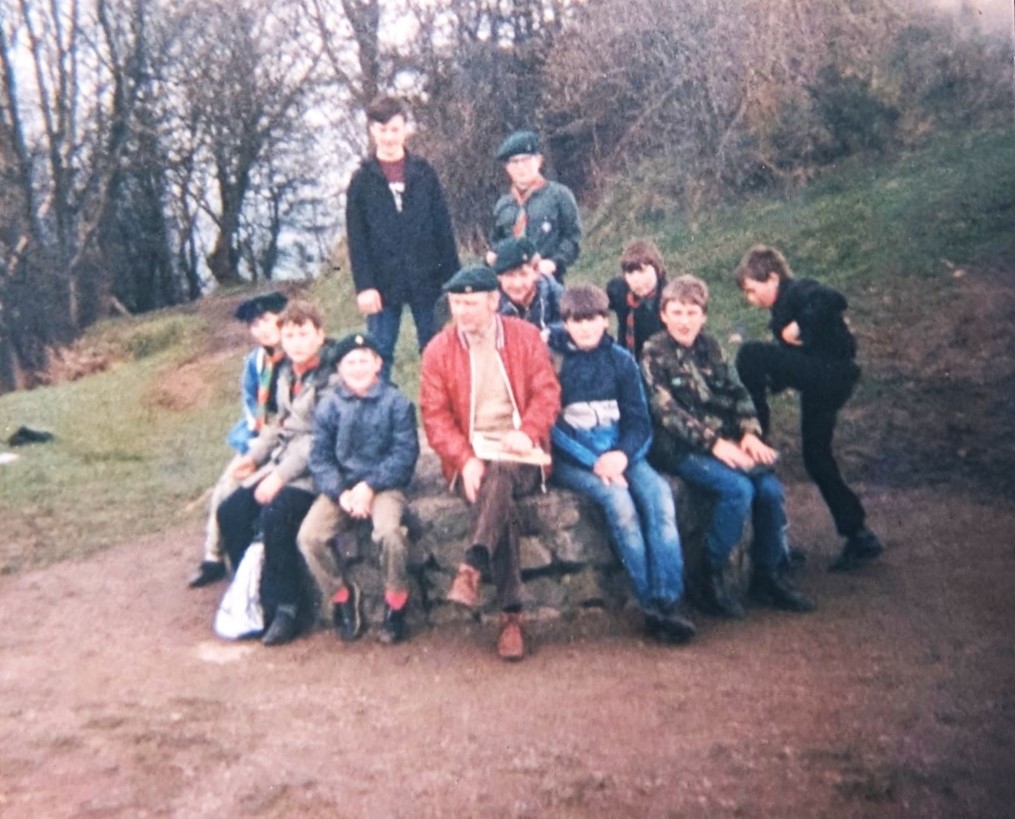
Dave Hadley and his 1st Lion Farm Scout Troop

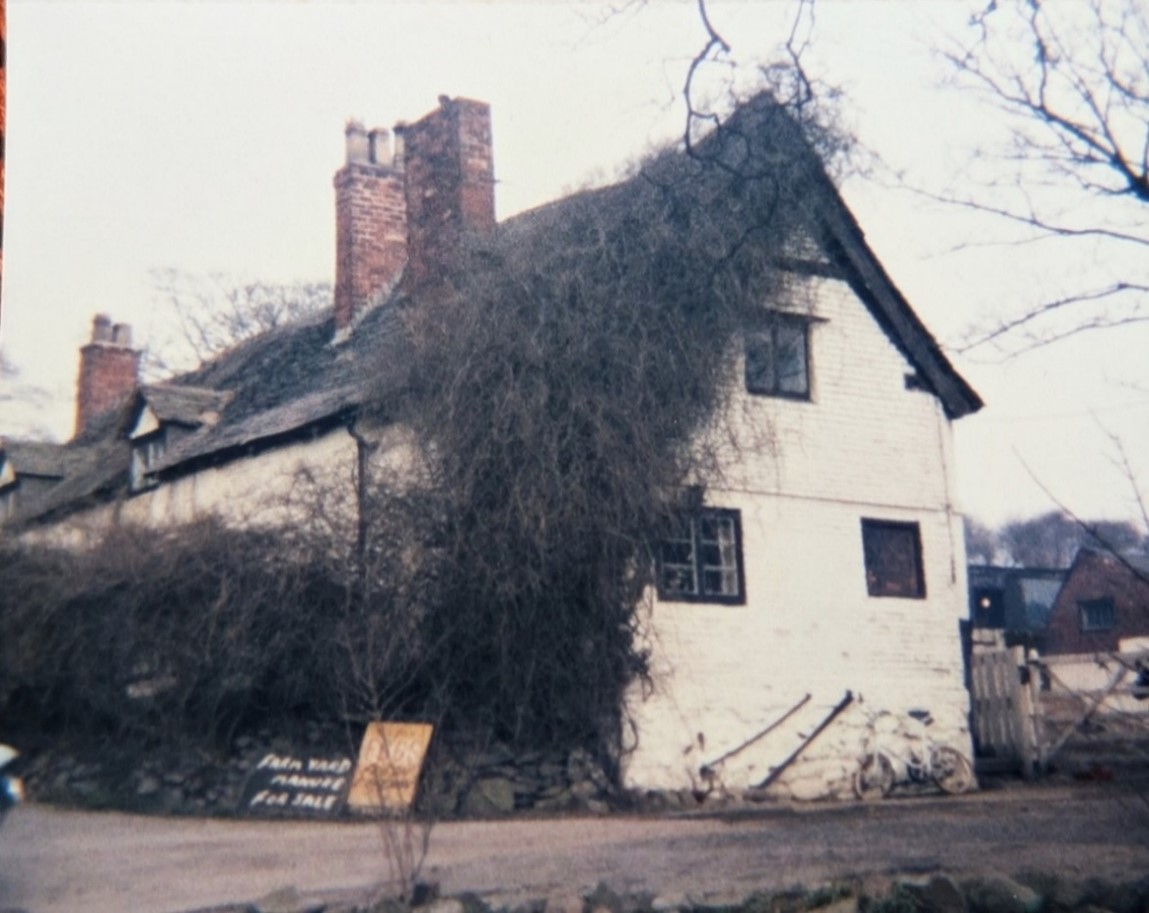
Dave and Kath Hadley have only recently started volunteering with FORH. Dave remembers when the Grade II listed Portway Farm was a working farm, with cattle, horses, ducks, and chickens, and a board outside the farmhouse advertising eggs and farmyard manure for sale.
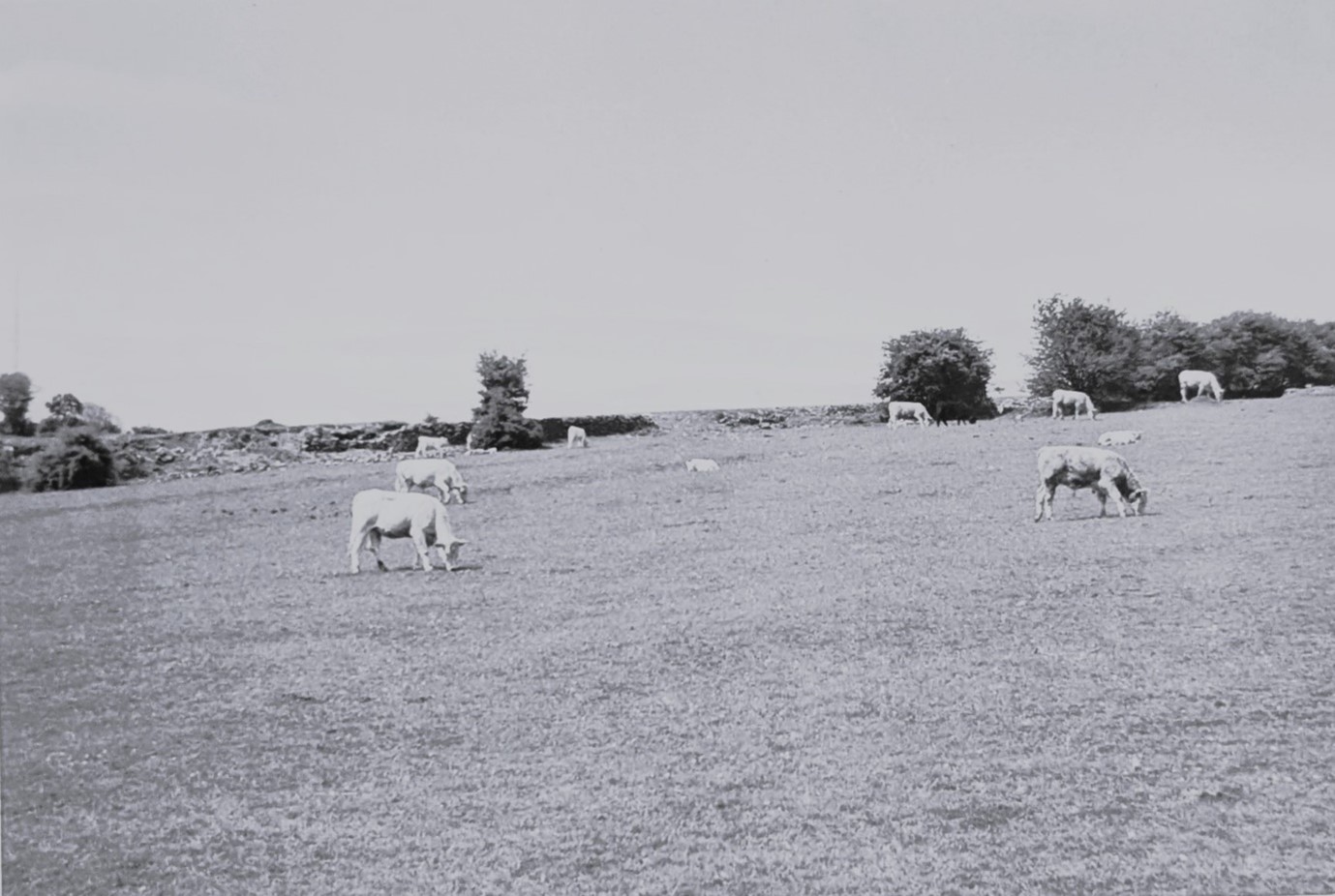
The natural beauty of the farm. A herd of cows grazing in one of the Portway Hill fields.
Dave also recalls there being a large pond just a little way in from the road at the summit of Portway Hill which held fish and was a popular spot for local anglers. The pond occupied land where the buildings and shafts of Lye Cross Colliery once stood. This ‘famous’ pit finally closed in 1923 and more on this later. Where Lye Cross Road now stands Dave can remember the army camp where German and Italian prisoners of war were held, and nearby the large gun to target enemy aircrafts on bombing raids over Birmingham and the Black Country.

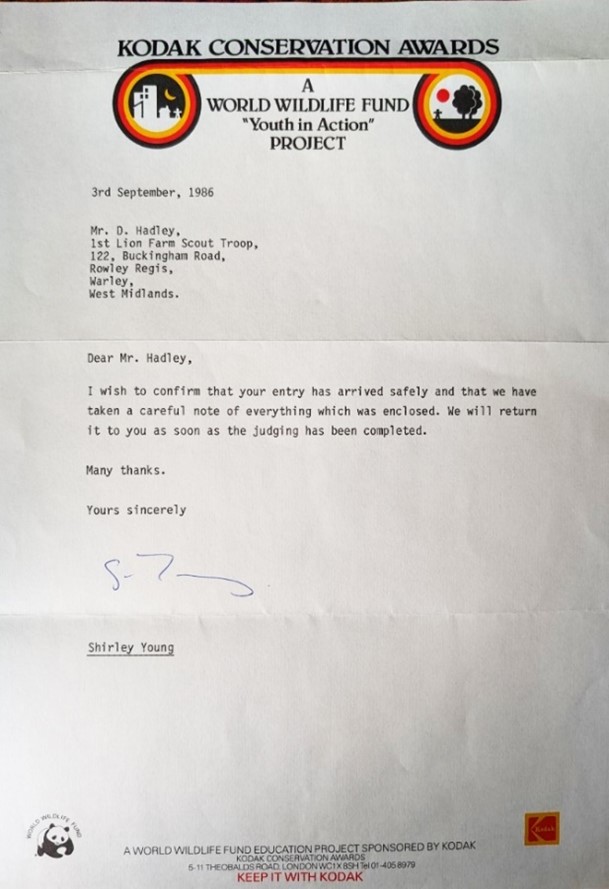
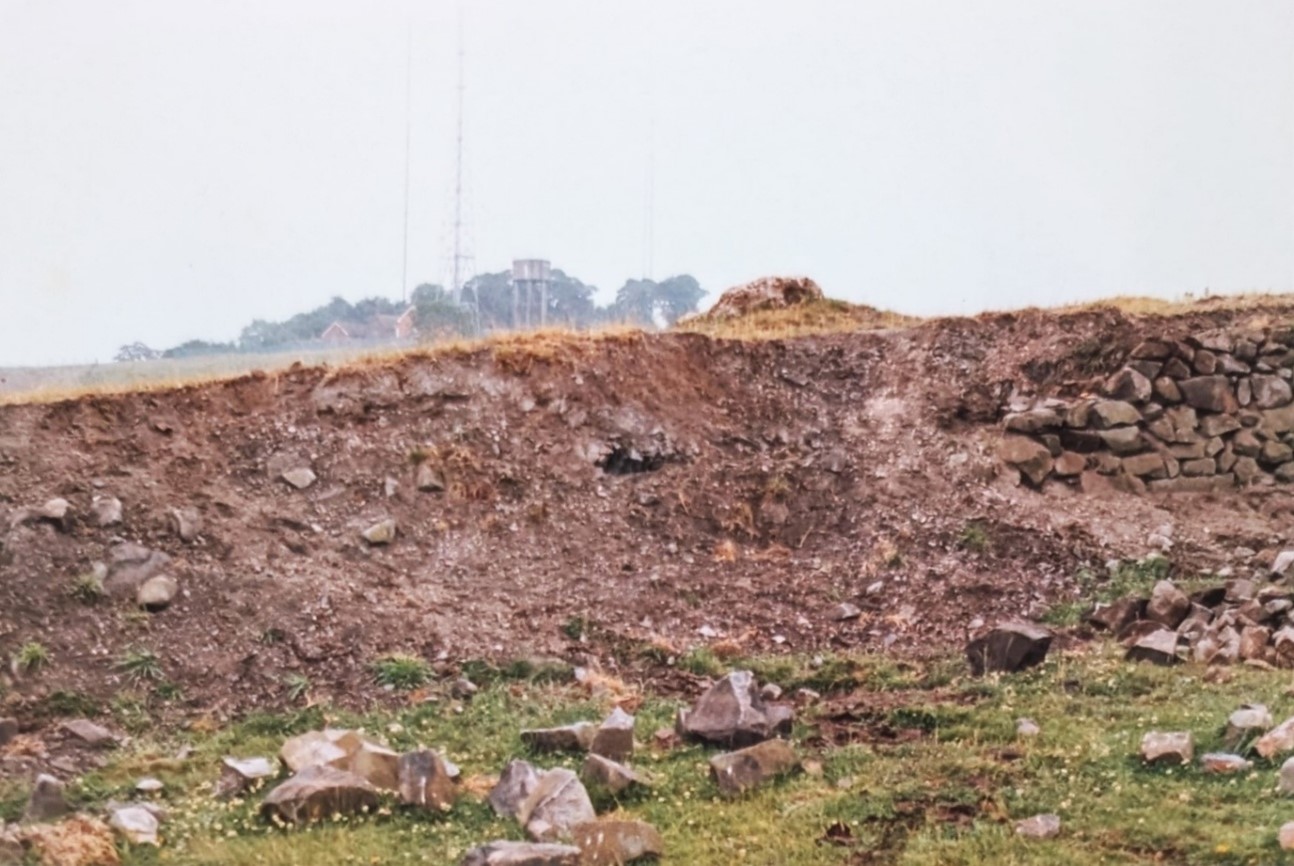
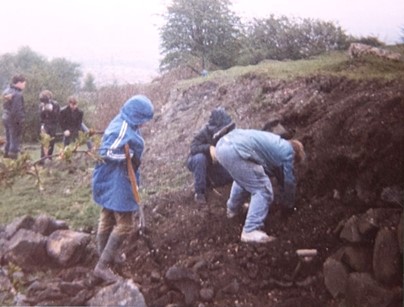
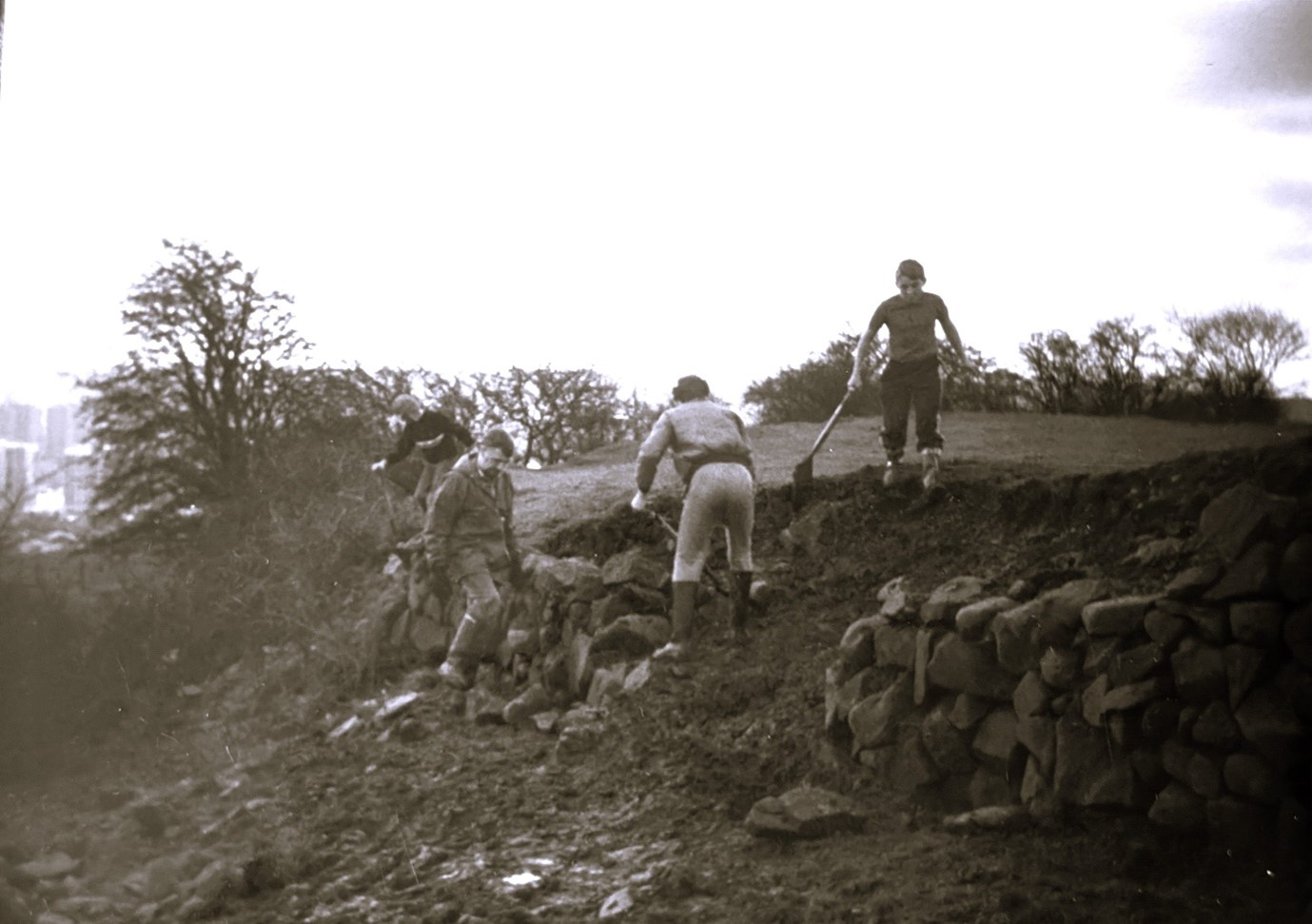
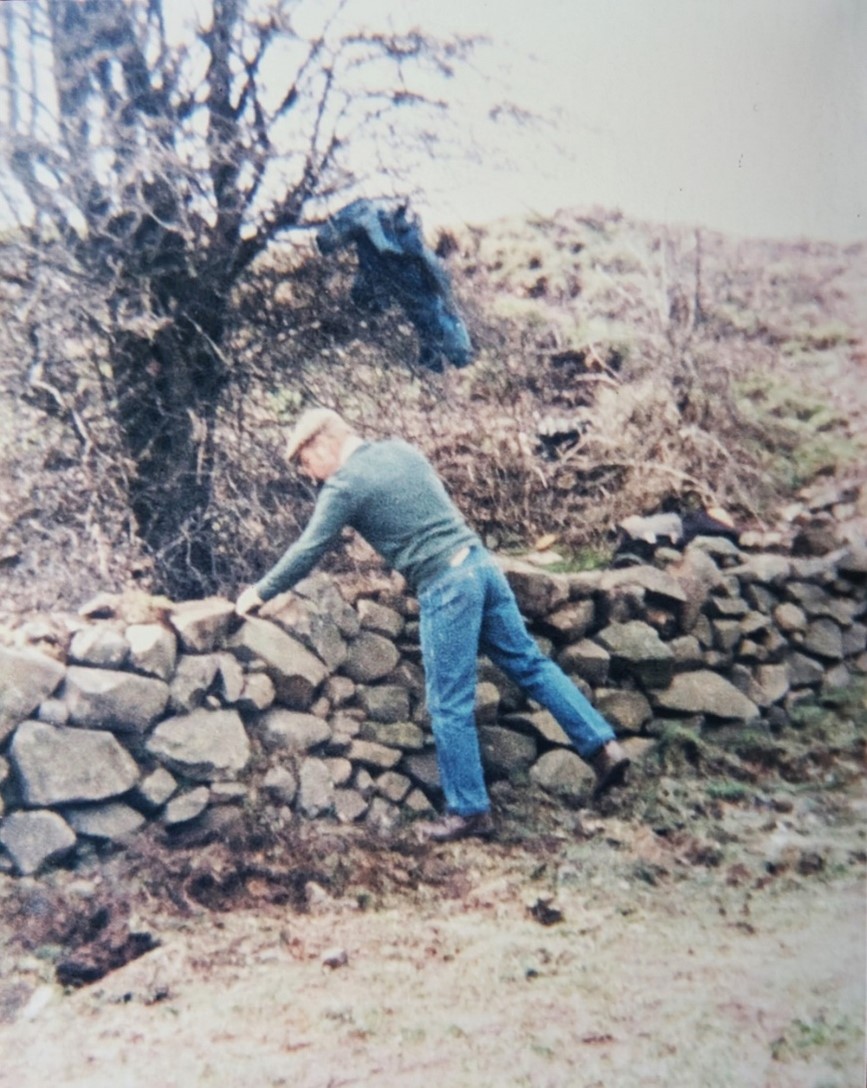
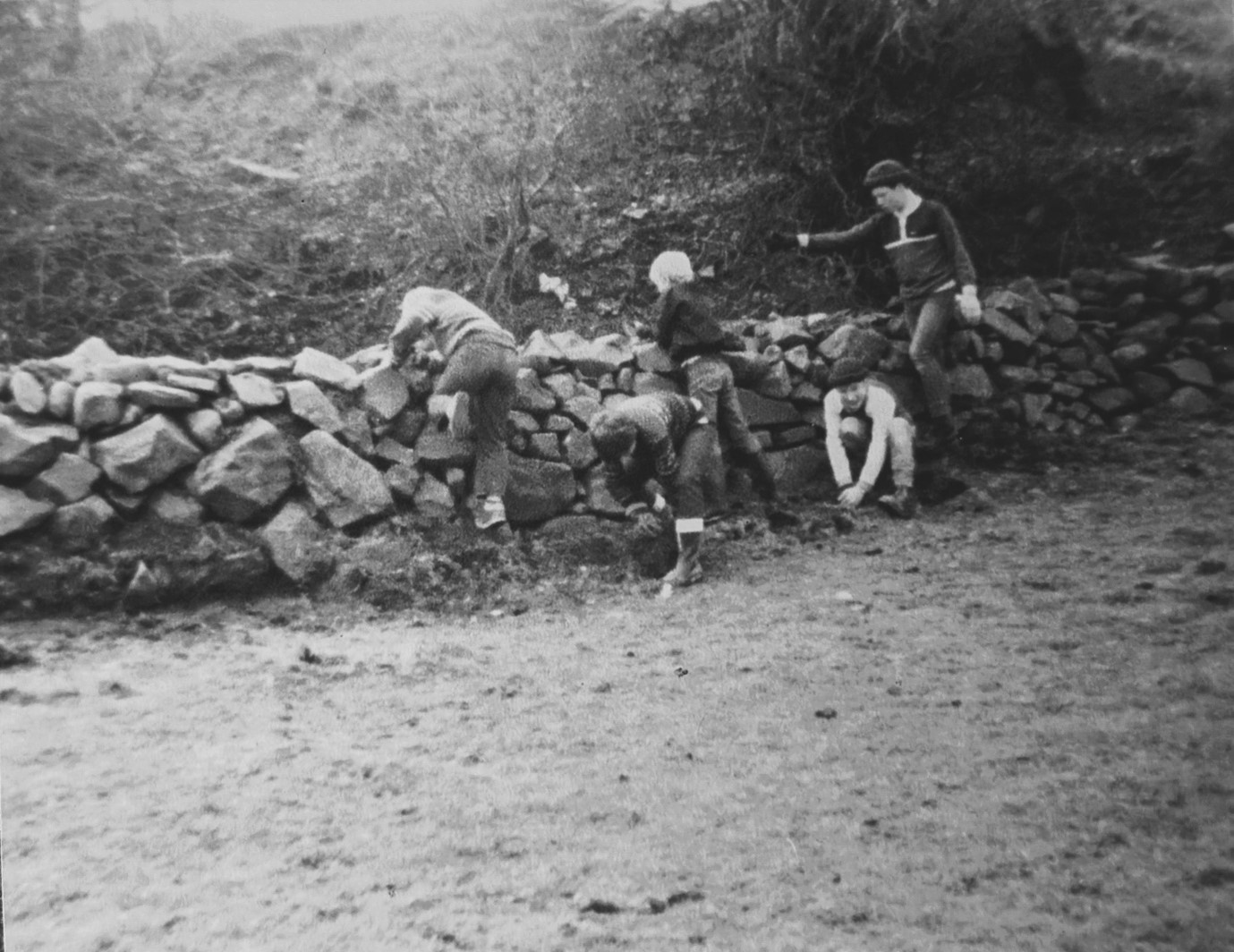
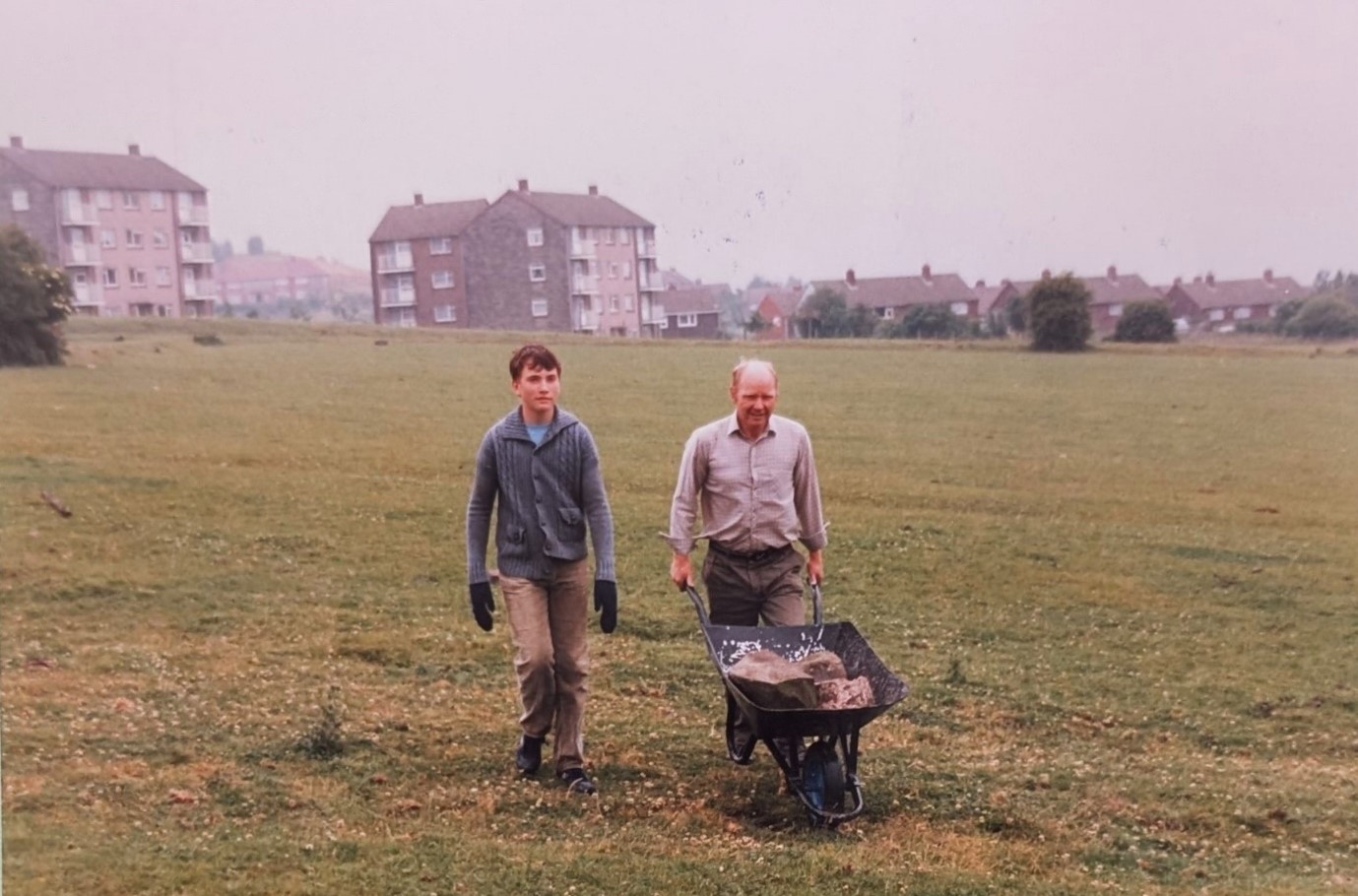
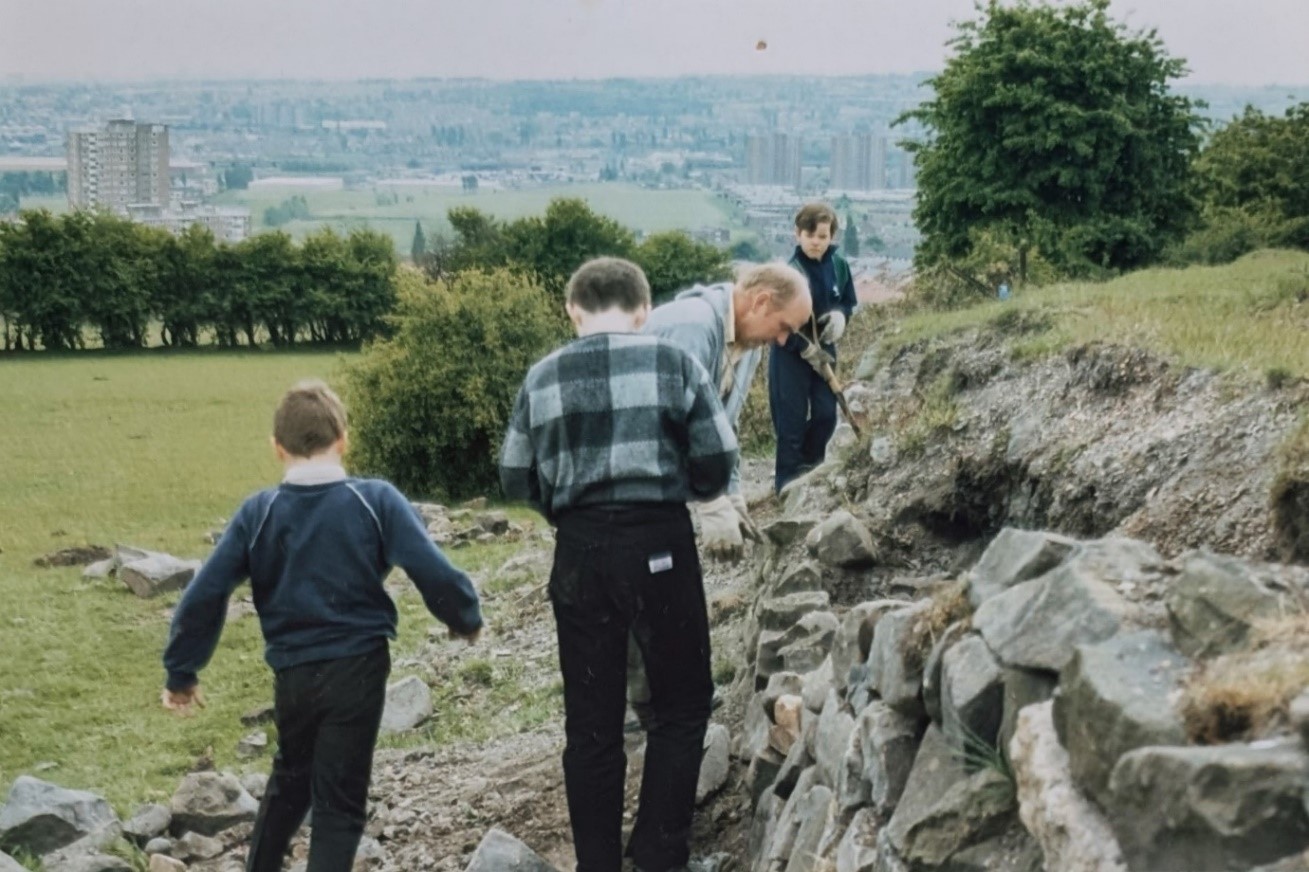
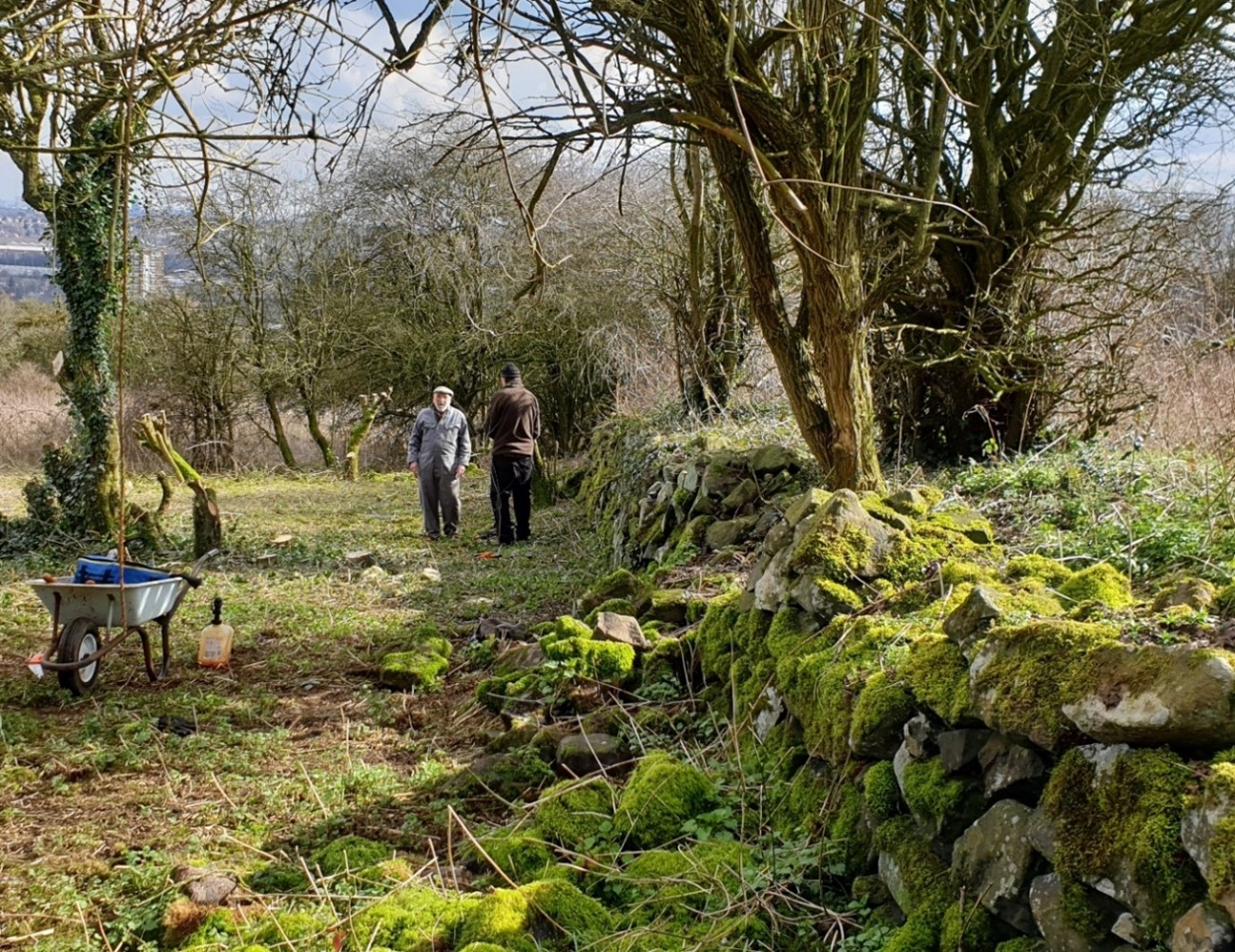
Back in the 1980s Dave was leader of the 1st Lion Farm Scout Troop, and Kath the Cubs Troop leader. Both troops were based on Lion Farm Estate. In 1986 Dave’s Scout troop entered the Kodak Conservation Awards, a World Wildlife funded ‘Youth in Action’ project for groups from around the country. The task taken on by the 1st Lion Farm Scout Troop was to rebuild a collapsed field boundary drystone wall on Portway Hill. The spoil that resulted from mining was spread out widely from the pithead and extended as far as the drystone wall field boundary. Banking soil and debris against the wall resulted in extensive damage with sections of the wall collapsing, and this is where the 1st Lion Farm Scout Troop comes in.

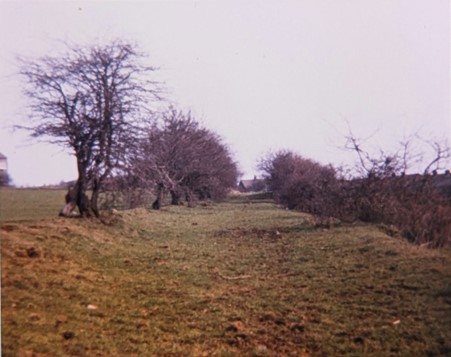
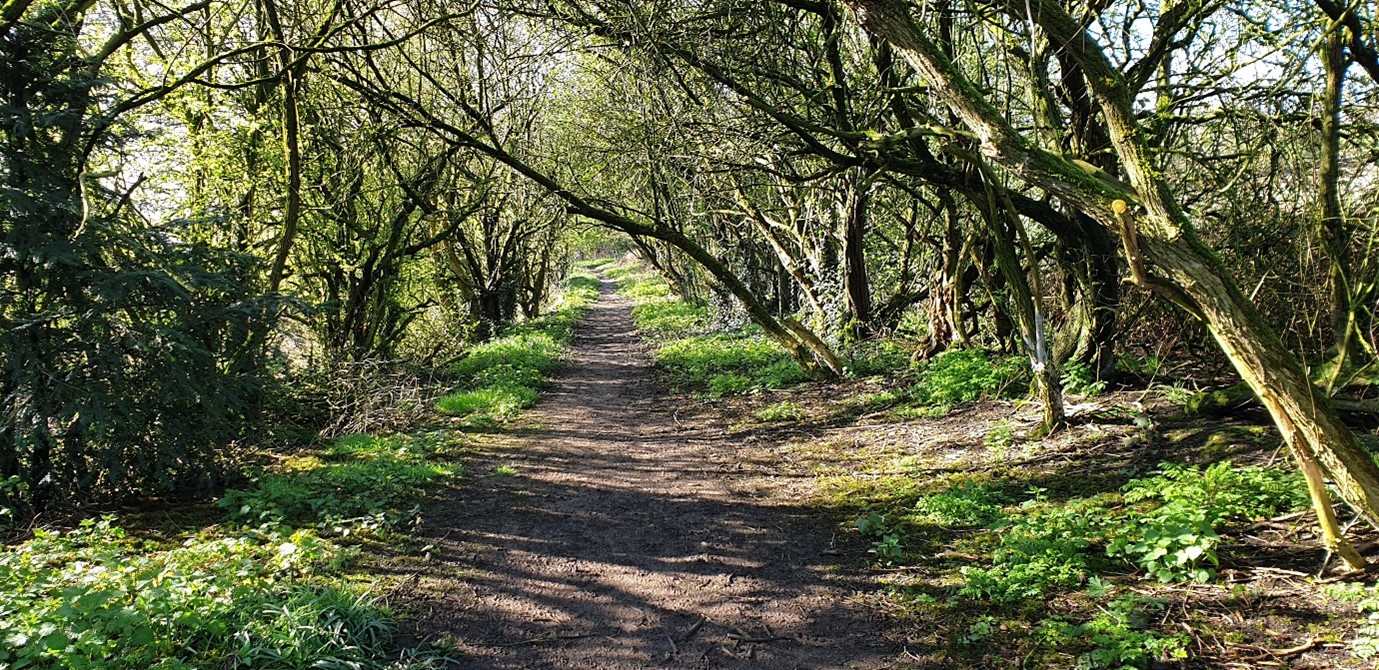
A second project undertaken by the scouts was to plant tree saplings in gaps along the nearby ‘Church Walk’ an old walkway which originally led  to Rowley Church, a half mile or so away.

Dave’s photographs tell the story, from the initial filling in of the entry form, to the completed tasks.

Confirmation of entry
Some famous faces on the judging panel!
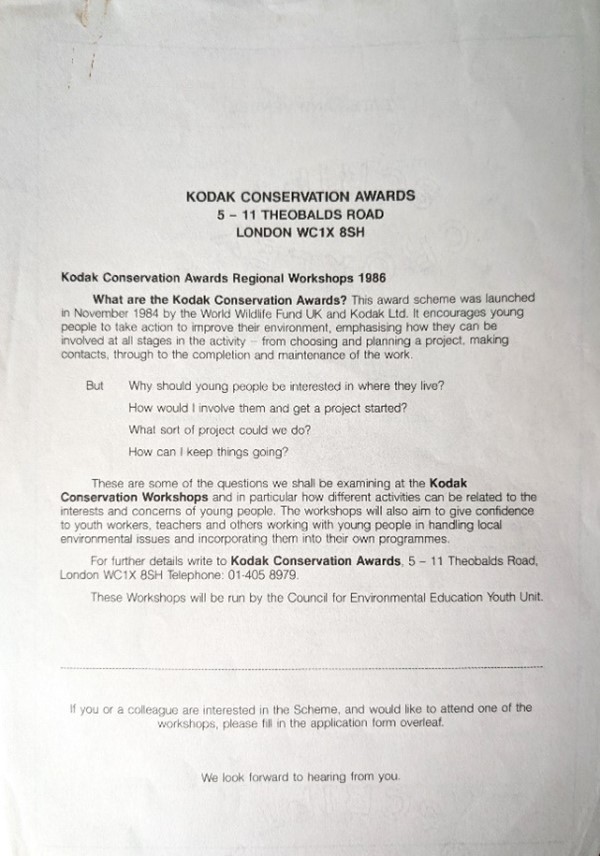
Information about the Kodak Conservation Awards
The completed entry form
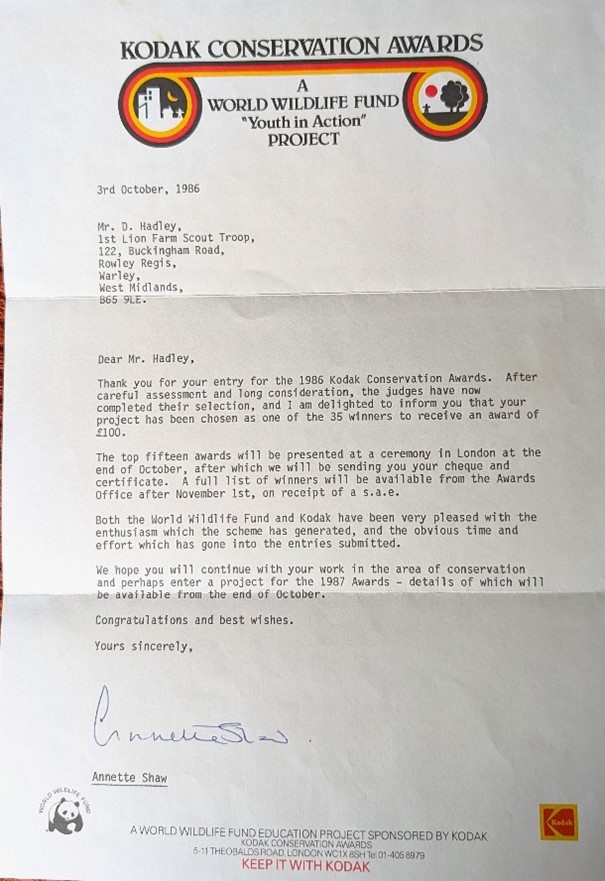
Confirmation of selection and award
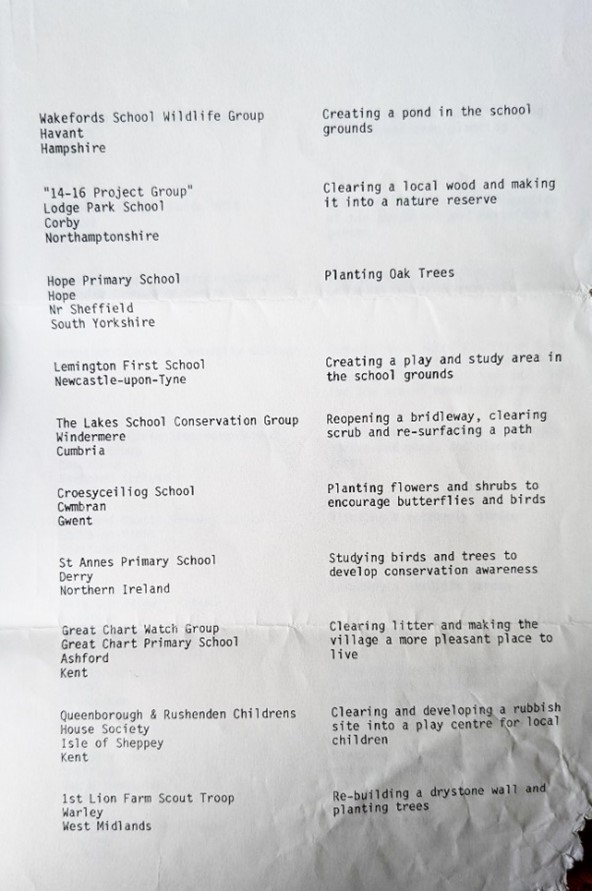
Tasks undertaken by other groups
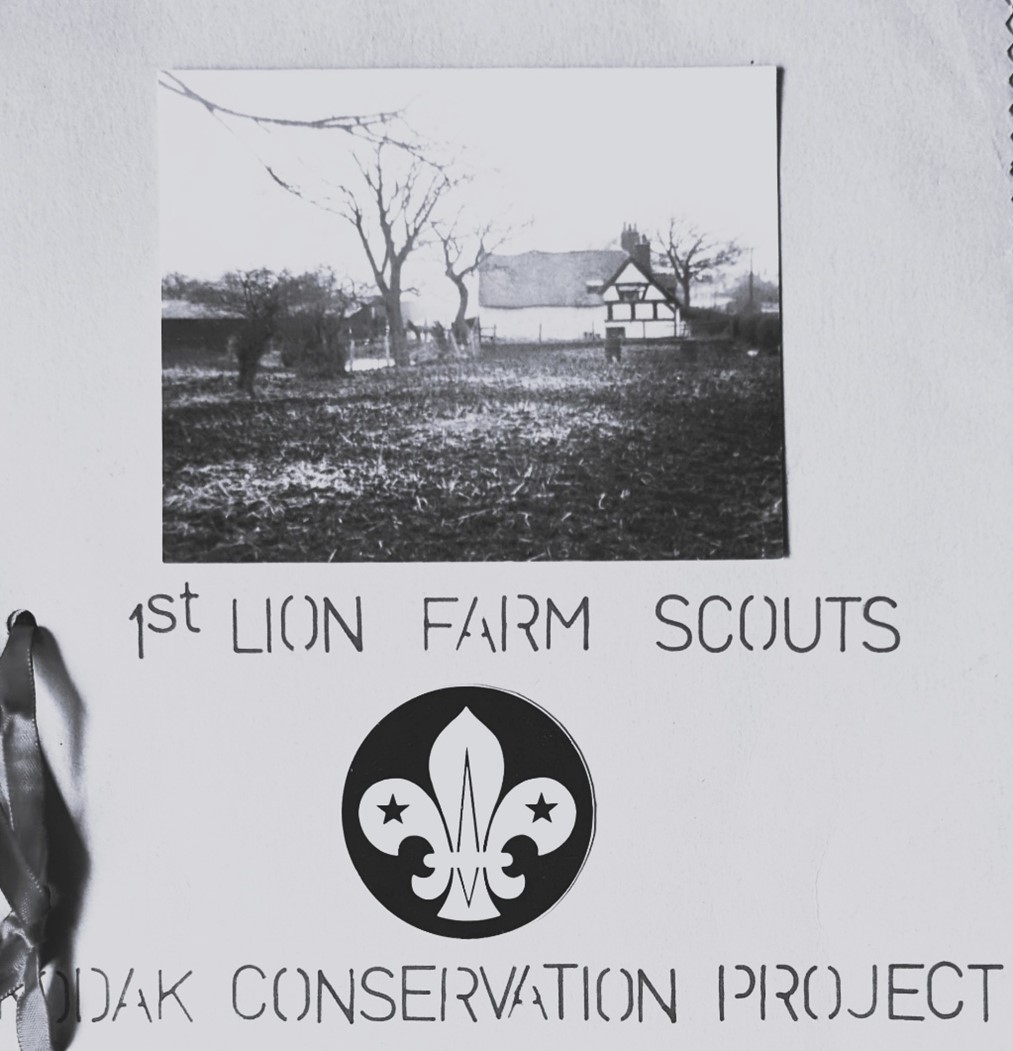
1st Lion Farm Scouts project poster
First Lion Farm Scout Troop
The badly damaged wall
Work underway
Scouts at work
The wall in progress
The finished wall
Well done 1st Lion Scout Group!

After several months of endeavour rebuilding of the wall was finally completed and the tree saplings along Church Walk planted. For their achievement the troop received £100 from the Kodak Conservation Awards, a substantial amount of money in 1986. The following year, to celebrate their achievement Dave hired a Wimpey Crew Bus and all those who took part in the Award Scheme were treated to an Easter break in Wales.

Comparison Photographs from then and today

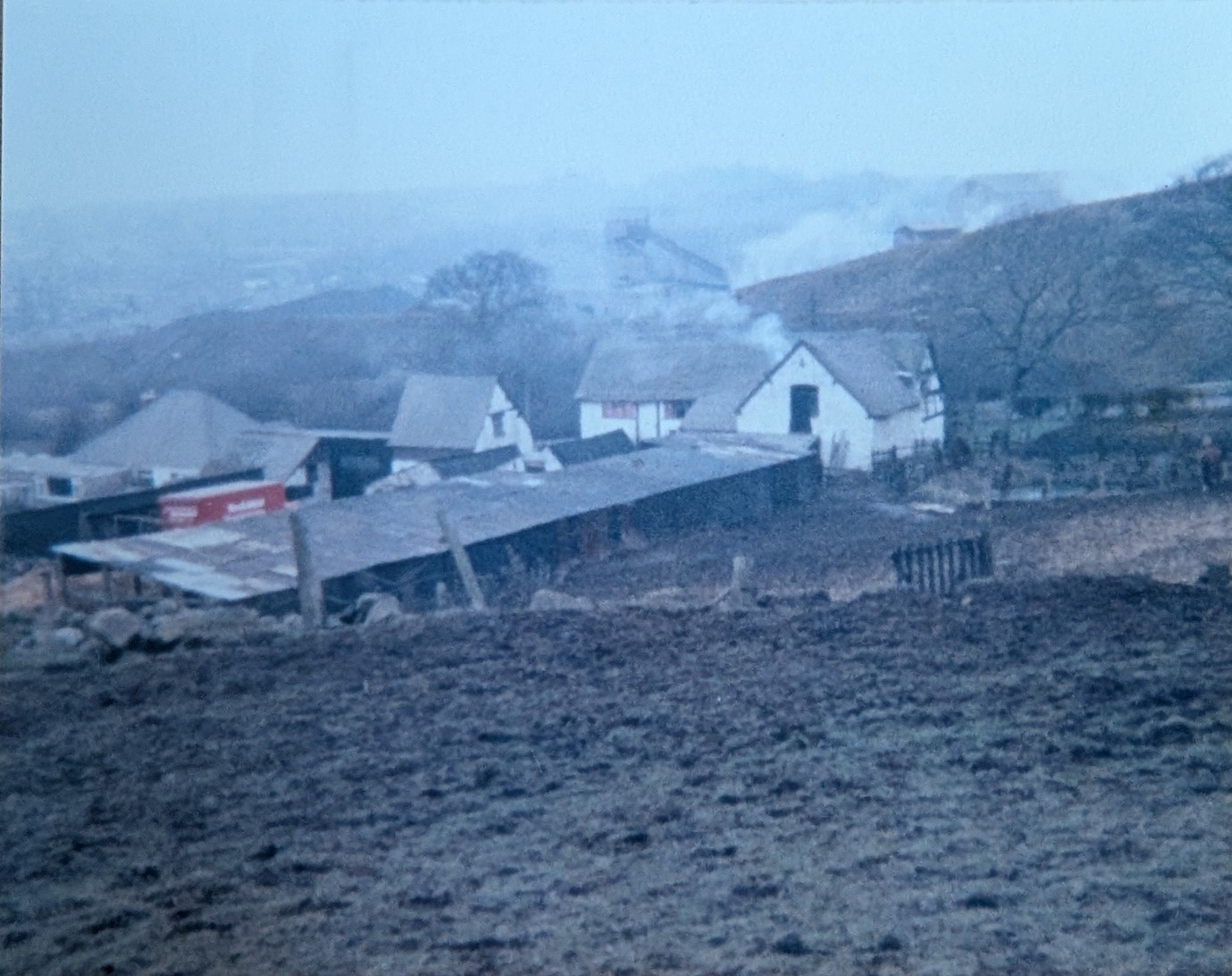
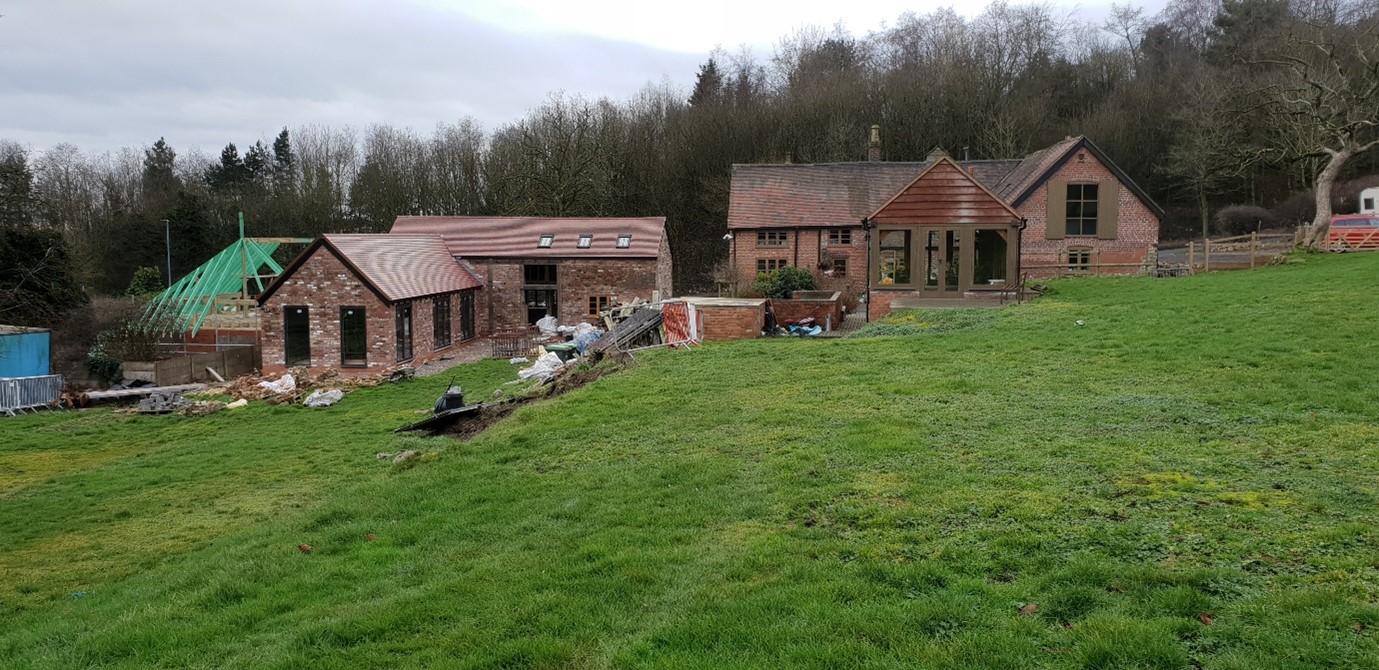
From some of Dave’s photograph collection taken 40 years or so ago, it has been possible to take a recent image from virtually the same spot to show how different things look now!

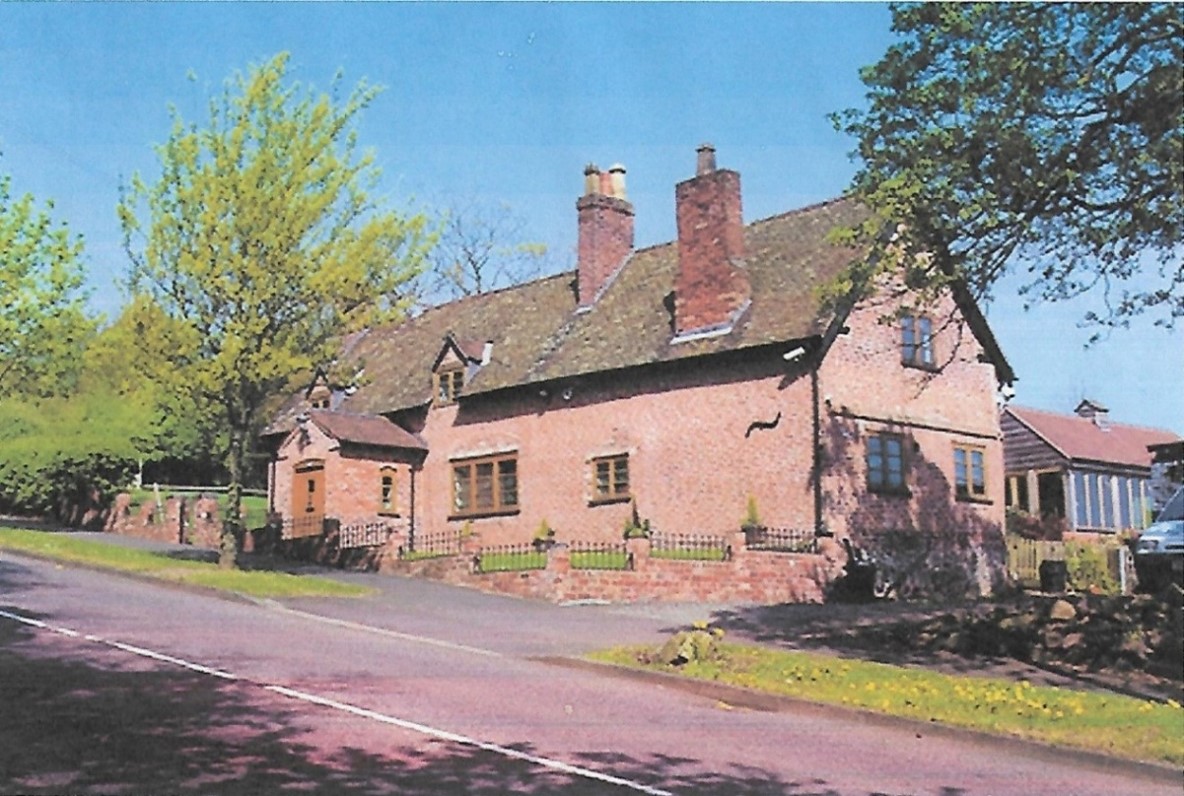
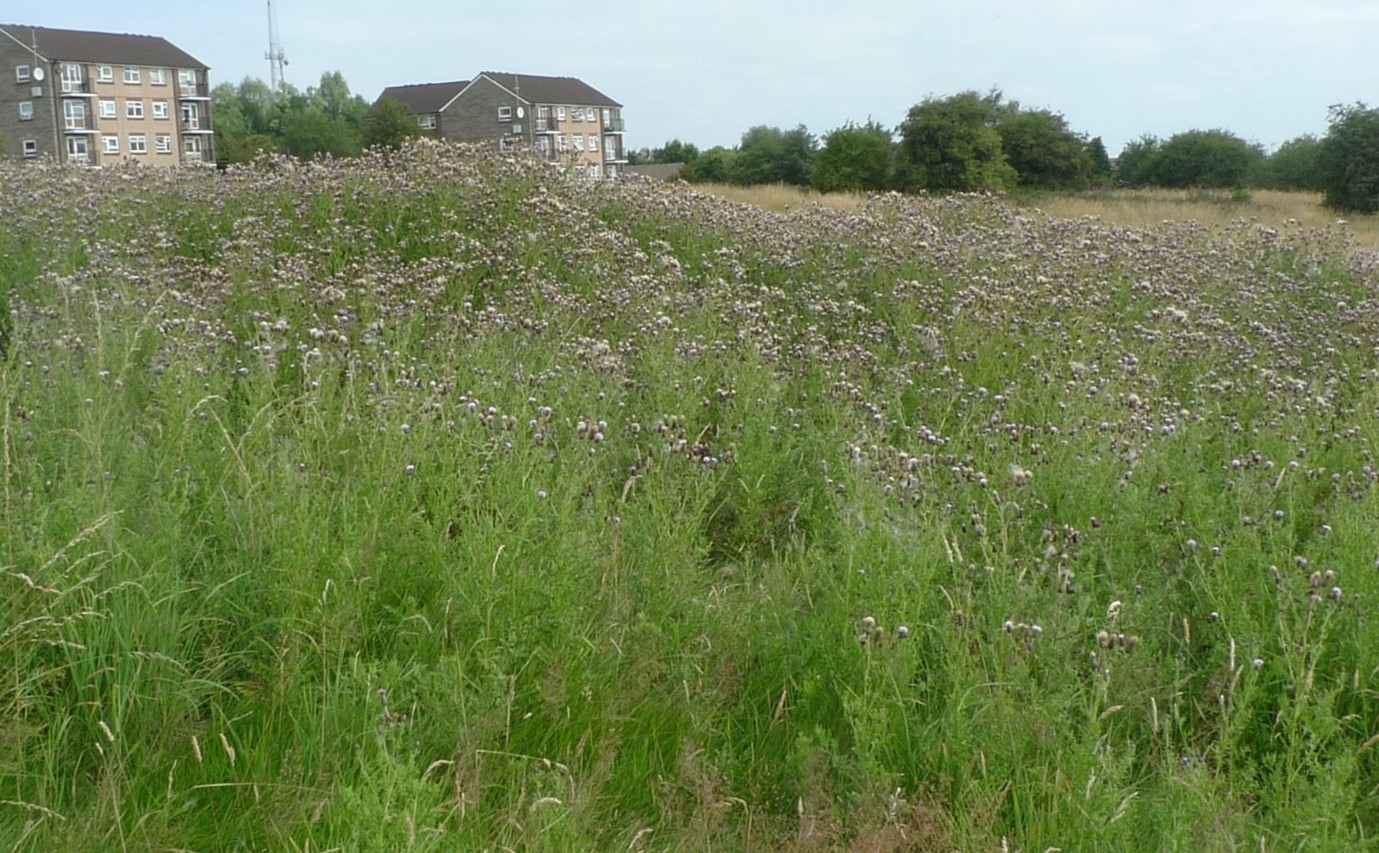
Portway Farm pre 1986
Portway Farm 2020s
Portway Farm pre 1986
Portway Farm 2020s
View across field towards Tower Road in 1986
The same field today
Church Walk in 1986
Church Walk today
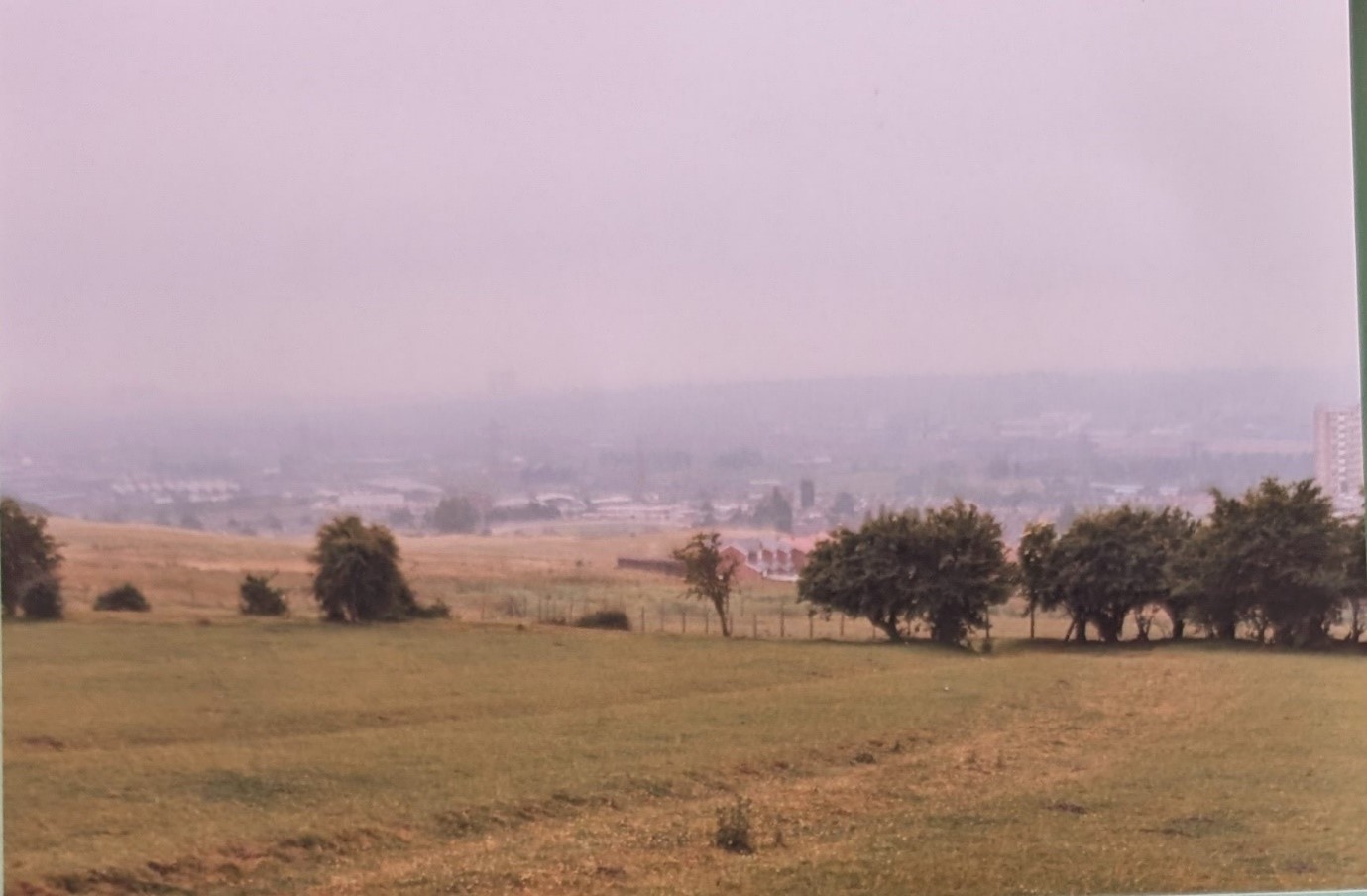
View towards Birmingham 1986
View towards Birmingham today
The drystone wall under construction in 1986
The drystone wall as it looked in January 2025

Fascinating facts about Lye Cross Colliery

Researching Grace’s Guide to Britain’s Industrial History, we can go back to the time when Lye Cross Colliery was a thriving concern. The pit closed in 1923 just over 100 years ago and no trace remains today. Were any photographs of the colliery ever taken? So far none have come to light.

Grace’s Guide provides the following information from the 1876 Institution of Mechanical Engineers magazine describing the sinking of the Lye Cross shafts and about the underlying geology. 1876 Institution of Mechanical Engineers: Visits to Works – Graces Guide

The Lye Cross Colliery is situated nearly in the centre of the basaltic mound constituting the Rowley Hills, to the south-east of Dudley, and forming a continuation of the chain of Silurian hills, consisting of Sedgley, Wren’s Nest, and Dudley Castle.

The starting of this colliery was the first attempt to sink through the basalt, to win the coal known to be lying beneath (although at two neighbouring collieries workings had been previously carried under the basalt), and was an undertaking of considerable magnitude, as it was not known what thickness of basalt covered the coal measures. The sinking has proved thoroughly successful, the thickness of basalt being considerably less than was supposed, only 68 yards of basalt having to be sunk through before the rock forming the upper portion of the coal measures was reached; and 92 yards further down (or 168 yards from the surface) the Two-foot and Brooch coal seams were struck, and 50 yards lower the Thick or Ten-Yard scam, and below that the other seams in regular succession, as in other parts of this coalfield. The basalt was followed by 10 inches of natural soil of a dark colour, and under this was the ordinary red brick-clay usually found in the district as the surface clay.

The Rowley hills owe their origin to an outburst of basaltic lava (whose funnel, or point of emergence from below, has however not yet been discovered) having spread over that portion of the coalfield, and protected it from the denudation which elsewhere removed some of the upper portion of the carboniferous strata. Dykes and sheets of intruded igneous rock occur between the coal seams in some places, similar to the basalt, except that there has been more or less mutual reaction between the molten basalt and the coal measures, whereby the former has become “green rock” and “white rock,” according to the nature and extent of the change it underwent whilst cooling, and the coal has become charred for several inches distance from the basalt.

The coal measures of the Staffordshire coalfield were deposited on a floor of Silurian rocks, peaks of which are seen protruding through the coal measures at Sedgley, Wren’s Nest, and Dudley Castle, and are quarried for the Silurian limestone of which they consist. The actual extent of the Staffordshire coalfield is not definitely proved; and, as sinkings to the east of the formerly supposed boundary of the coalfield have proved that it extends further and further eastwards, under the Permian rocks, there seem some grounds for supposing that it will ultimately prove to be continuous with the Warwickshire coalfield.

The sinking of the Lye Cross shafts was commenced in August 1872 and completed in July 1874. The downcast shaft is 12 ft. 6 in. diam. in the clear, and the upcast 8 ft.; they are sunk through the coal to a depth of 13 yds. below the coal before forming the “insets,” which are at the right level to meet the coal (which forms a saddle, dipping in both directions from the shaft) at sufficient distance to support the shaft firmly, namely 100 yds. from bottom of shaft. The insets are 13 ft. high and 25 ft. width, with four lines of rails, for some distance from the shaft.

Gate roads have been driven in different directions to the extent of 3 miles. The upcast shaft is sunk to the same level as the downcast, but the air drift follows the rise of the coal; • the shaft has a brick continuation about 40 ft. high above ground. Wire-rope guides are used, with screw adjustments at top and bottom.

    The thickness of the various strata passed through in sinking the shaft was as follows: –

    • Made ground and surface soil – 8.5yds.
    • Rowley Rag or Basalt – 68yds.
    • Rock and Binds – 91.5yds.
    • Two-foot and Brooch Coal – 2yds.
    • Rock and Binds – 48yds.
    • Thick or Ten-Yard Coal – 10yds.
    • Gubbin Ironstone – 3yds.
    • Heathen Coal – 2yds.
    • Whitestone Rock and Measures – 7.5yds.
    • Pennystone Measures – 3yds.
    • New Mine Coal – 1yd.
    • Fire Clays and Binds- 13yds.
    • Bottom Coal – 1yd.
    • Total – 258.5yds.

    The first 3 yds. of the Rowley Rag was partially decomposed, and the rest was in the form of very large boulders, the outside crust of which was in many cases much decomposed. When this bed was nearly passed through, a large quantity of water was met with, which suspended sinking operations for about three weeks. As the coffering for keeping back the water seas required to extend to a depth of 75 yds., and there was no sufficient foundation for it, 4 ft. headings were then driven into the sides of the shaft, and six large oak timbers inserted to form a seating for the curb to rest upon, and the coffering made with hydraulic lime effectually kept back the water; this lime was a mixture of black and white lime, coke-dust, and clinkers (without ash), ground in a mortar mill, mixed with water, and applied hot. The brickwork of the shaft is 2 ft. to 3 ft, thick in some portions. The water from behind the coffering is carried down into the pit by a pipe under sufficient pressure for feeding the underground boiler; it also supplies two drinking fountains for the men. The water is remarkably pure and fresh for drinking; when first drawn it contains a large quantity of minute air bubbles, giving a milky appearance to the water, which gradually escape.

    The roads in the pit are very wide and high, and heavily timbered with oak 16 x 14 in. Underground is a manager’s office where the men are paid, a dining room for the colliers, and stables for the pit horses.

    The winding engine is horizontal, with a pair of cylinders, 26 in. diam. and 6 ft. stroke, working to about 240 H.P. The winding drum is 14 ft. diam. parallel, and is fitted with a powerful differential steam break, which is worked by the ordinary foot treadle, and dispenses entirely with the ordinary break. Round wire rope is used 1 in. diameter. The pit frames are 45 ft. high, with pulleys 14 ft. diam. The boilers are three in number, plain cylindrical, with hemispherical ends, 5 ft. 6 in. diam. x 39 ft. long, and working at a pressure of 40 to 50 lb. per sq. in. An underground engine is used for hauling coal up an incline of 17 in. per yd. or nearly 1 in 2 from the lower workings to the bottom of the shaft; horizontal engine, with 15 in. cylinder, 3 ft. stroke, winding on a 6 ft. drum with a round wire rope. Steam is supplied by an underground boiler, plain cylindrical with hemispherical ends, 4 ft. 6 in. diam. x 32 ft. long, working at 50 lb. per sq. in. The flue of this boiler passes into the upcast shaft, thus forming the furnace for the ventilation of the mine; but an auxiliary furnace is provided, which can be used to assist the ventilation if required.

    Au electric signal is used from the pit bottom to the engine room at the surface, and from the underground winding engine to the bottom of the incline, worked by a Leclanche battery. In any case of a tub getting off the rails on the incline, the two electric wires are arranged to make contact and give a signal for stopping the hauling engine, so as to prevent damage to the road.

    The colliery is worked on the pillar and stall system, with pillars 10 yds. square, and stalls 8 to 9 yds. wide. A stall about 80 yds. long by 8 yds. high was shown specially illuminated, presenting a striking scene.

    Taken from ‘Rowley Rag’ magazine

    The following account describes an excursion made by members of the Midland Union of Natural History Societies in 1878 and includes their visit to Lye Cross Coal Pit and illustrates the scale of the pit.

    ‘Members of the Union and their friends, to the number of nearly 400, made an excursion to Dudley and the neighbourhood, under the auspices of the Dudley and Midland Geological and Scientific Society and Field Club, representatives of which received the party at the Tipton Station of the Great Western Railway, and conducted them in the first instance to the Open Coal Work at Foxyards, where the Ten-yard Coal Seam exposes its point of outcrop on the east side of the obstruding ridges of the Dudley Castle Hill and the Wren’s Nest. Mr, Thomas Latham, the Earl of Dudley’s Mine Agent, gave interesting information as to the mode of getting the coal, and under his direction a fall of coal was displayed.’
    ‘After Luncheon came the crowning event of the day – the descent by more than 400 persons, including many ladies, of the famous Lye Cross Coal Pit at Rowley, which was superintended by Mr. Latham. This pit is remarkable as the first sunk through the Basalt, or Rowley Rag. Where the pit was commenced the thickness of the basalt was unknown; it proved to be no more than 68 yards, when the rock binds of the coal measures were reached. At 168 yards the Two-foot and Brooch coals were met with, and at 228 yards the Thick coal was cut into. The pit is 258½ yards deep.’ (Anon.,1878).

    Rowley Hills Review of 2024

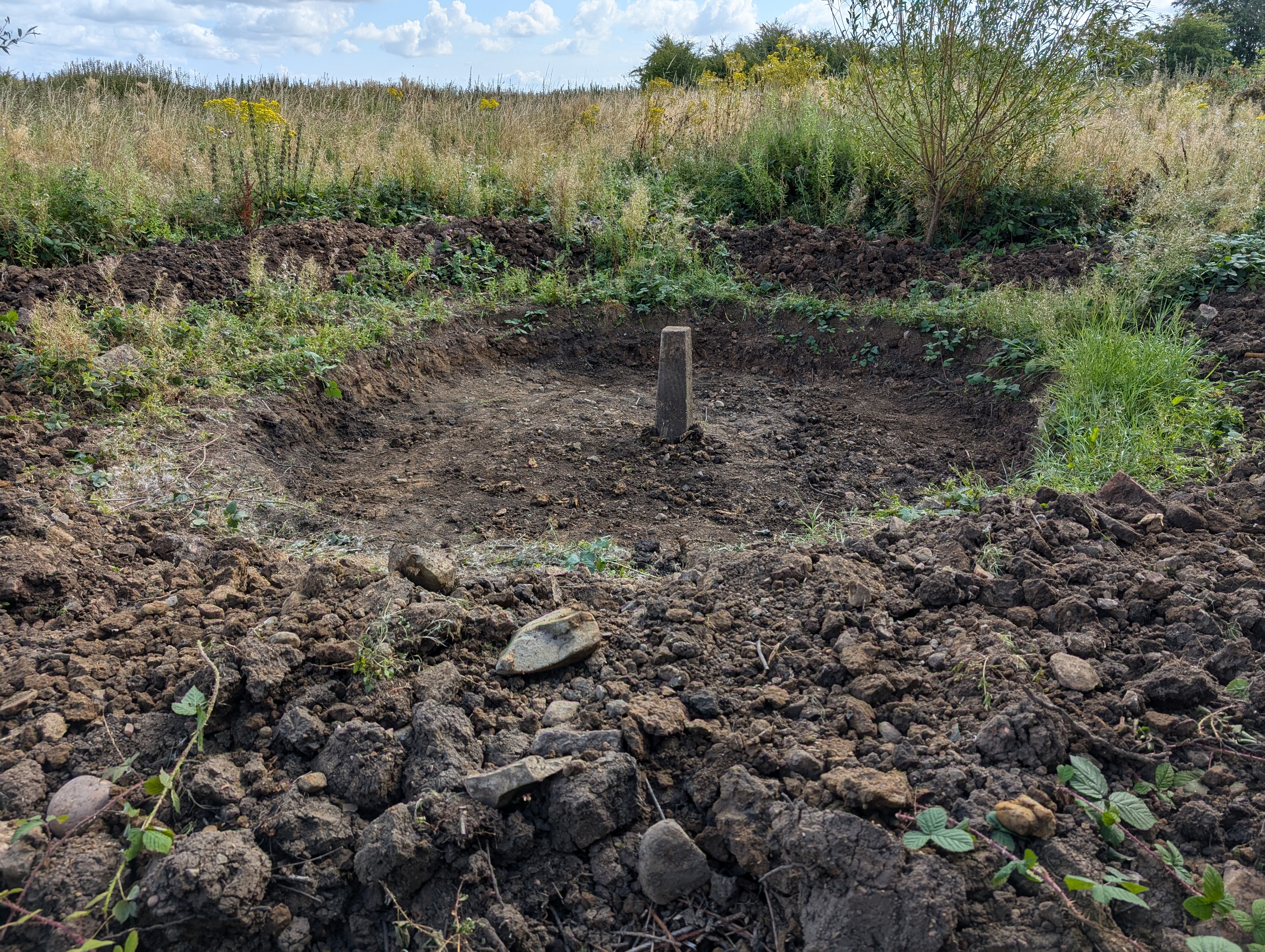
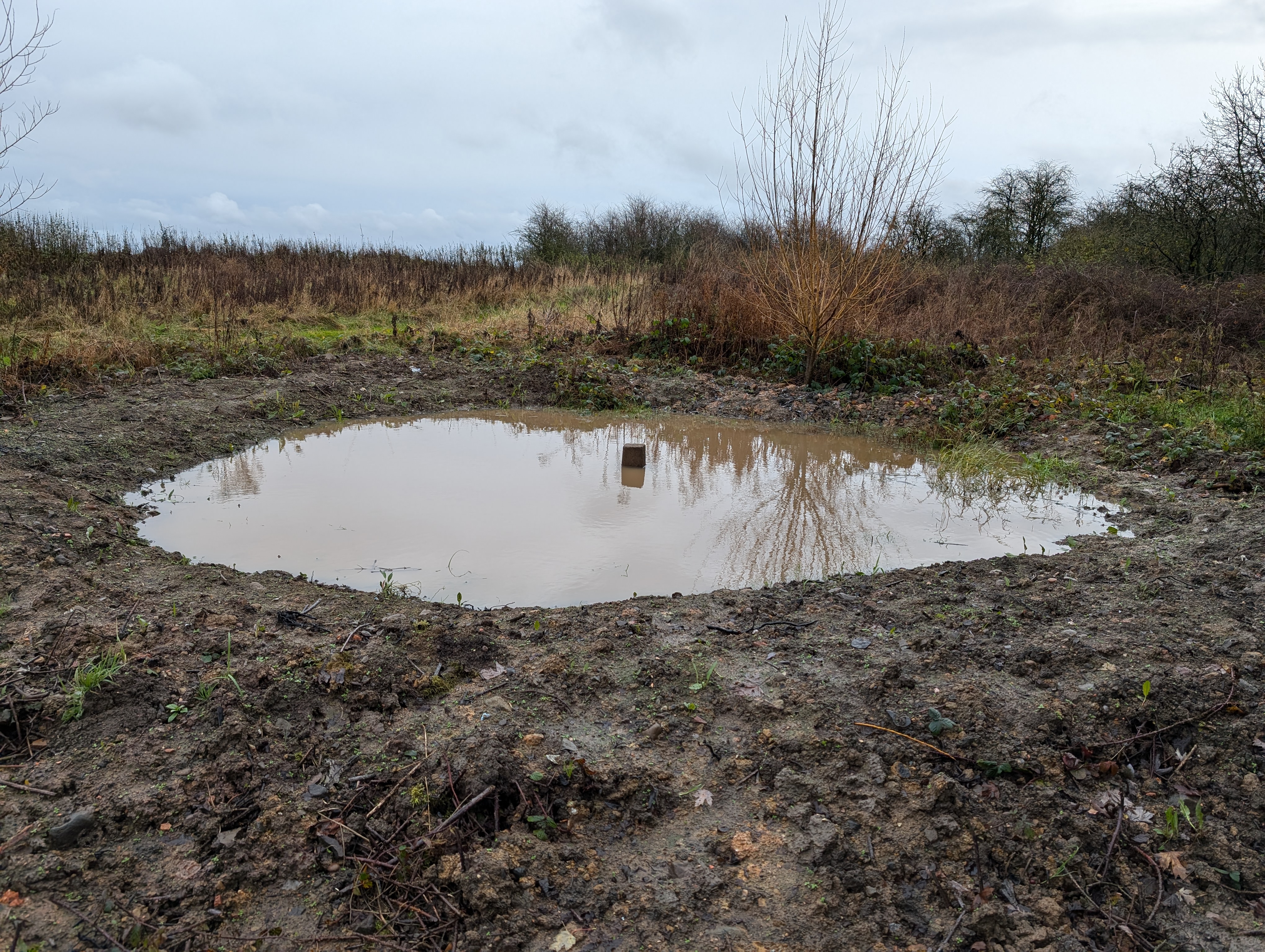
    A project carried out this year was to create a small pond near the summit of Portway Hill a short distance in from the road. We were told by residents who had lived in the area for many years that there was once a pond here although nobody could be sure of the exact spot. A site was chosen for the new pond, and the first task was clearing the area of brambles and course vegetation. Once this was done, we set to work digging. The top foot of soil was removed relatively quickly but we soon came to clay which was more time consuming to dig out. With a great deal of effort over several weeks the task was completed. Clay soils are made up of small, fine particles that retain water and
    drain slowly, so by treading down the bottom and sides, known as ‘puddling’ the pond was made as watertight as possible. Although the pond is likely to dry out during the summer it is hoped that some water will remain long enough for tadpoles of any amphibians that might be present to metamorphosise. A concrete post, uncovered while digging, was placed upright in the middle of the pond to provide a perching post for birds and to give us an idea of the depth of the water at any given time. Within no more than a week from completion, and after heavy rain, the water level in the pond slowly started to rise, and by late summer the water-level had almost risen to the top of
    the post.

    Portway Pond – November 2024

    In early May the Wildlife Trust for Birmingham and the Black Country were given the green light to deliver the ‘Dudley’s Path to Nature Recovery Project’. This new project, funded by the West Midlands Combined Authority, will help to connect local communities to nature across Dudley’s rich landscape of hills through five interlinked activities; conservation work, community engagement, citizen science, partnership development, and the creation of new walking routes. Community engagement will include working with local schools and community groups, and Conservation works will be undertaken at sites along Dudley’s hills, specifically; Rowley Hills, Saltwells National
    Nature Reserve, Castle Hill, and Sedgley Beacon. Part of the project was to establish and facilitate a Birmingham and Black Country Invertebrates Recording Group (BIG) with surveys carried out at various sites during the summer. Two of the surveys were carried out on Rowley Hills, the first on Dudley Golf Course, and the other on Portway Hill. Both surveys were well attended, and a wide range of invertebrates were recorded, some of them new for Rowley Hills.

    Dudley Golf Course survey
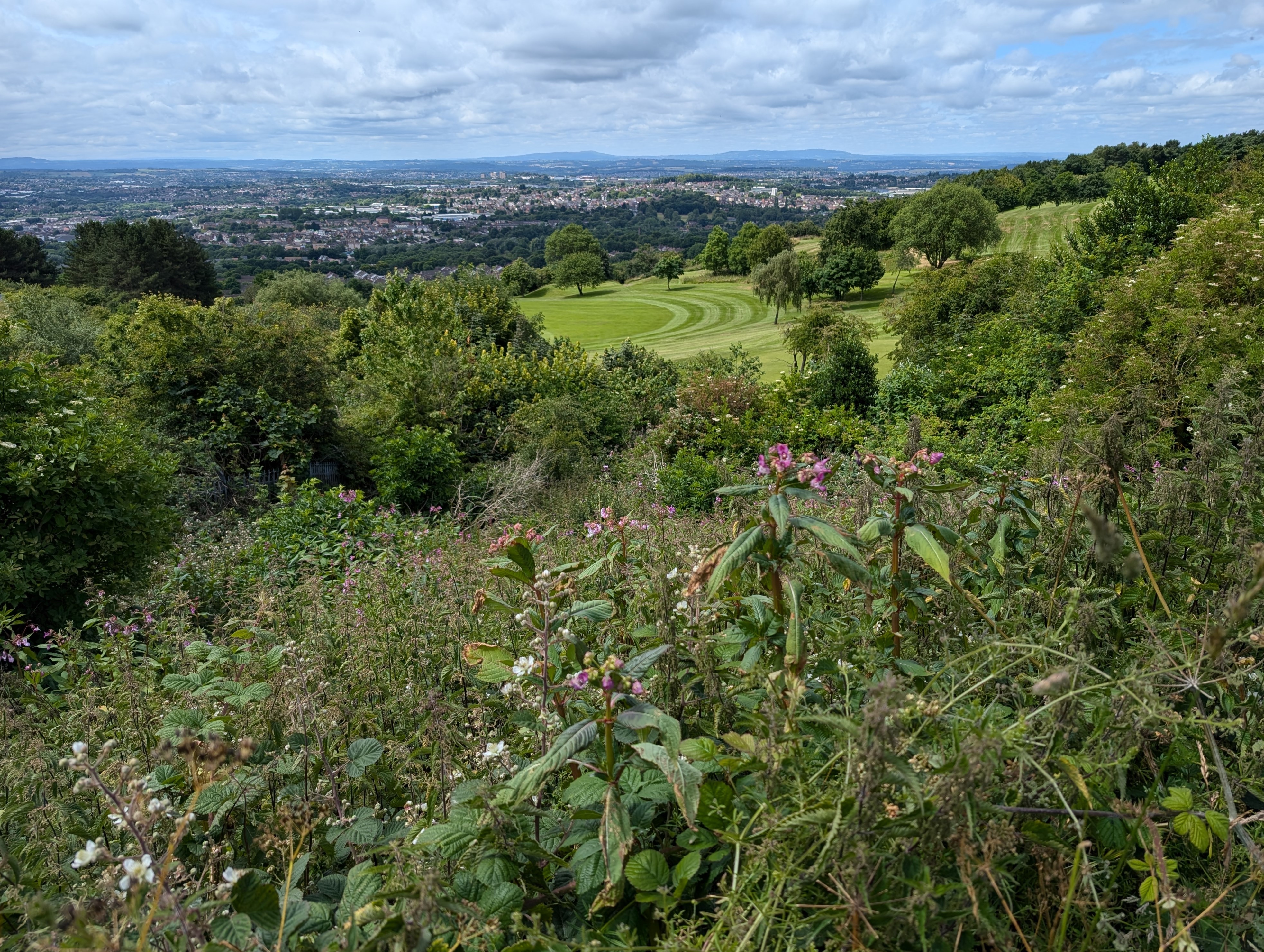
    Turners Hill is the highest point in the county of West Midlands standing at 271 metres above sea level. Dudley Golf Club therefore has the distinction of being the highest golf course above sea-level in the West Midlands, and the views from the course on clear days can be quite exceptional. The undulating fairways of this 18-hole course are separated by narrow bands of deciduous and coniferous semi-mature trees. Banks of native wildflowers and grasses surround the fairways, and in spring the wooded slopes are turned blue from 1000s of native bluebells. Sympathetic management is the key, and credit for this goes to Stewart Marshall and his colleagues who manage the course. Nothing is perfect, and in places Himalayan Balsam has become a pest and has formed a monoculture, shading out the native vegetation. On the plus side, the numerous flowers of this invasive annual do provide a valuable nectar source for invertebrates.

    Himalayan Balsam on Dudley Golf Course – July 2024

    Dudley Golf course is on the watershed, with rain falling on one side of the course eventually ending up in the Bristol Channel via the rivers Stour and Severn, and rain falling on the other side of the course ending up in the Humber Estuary via the Tame and Trent.
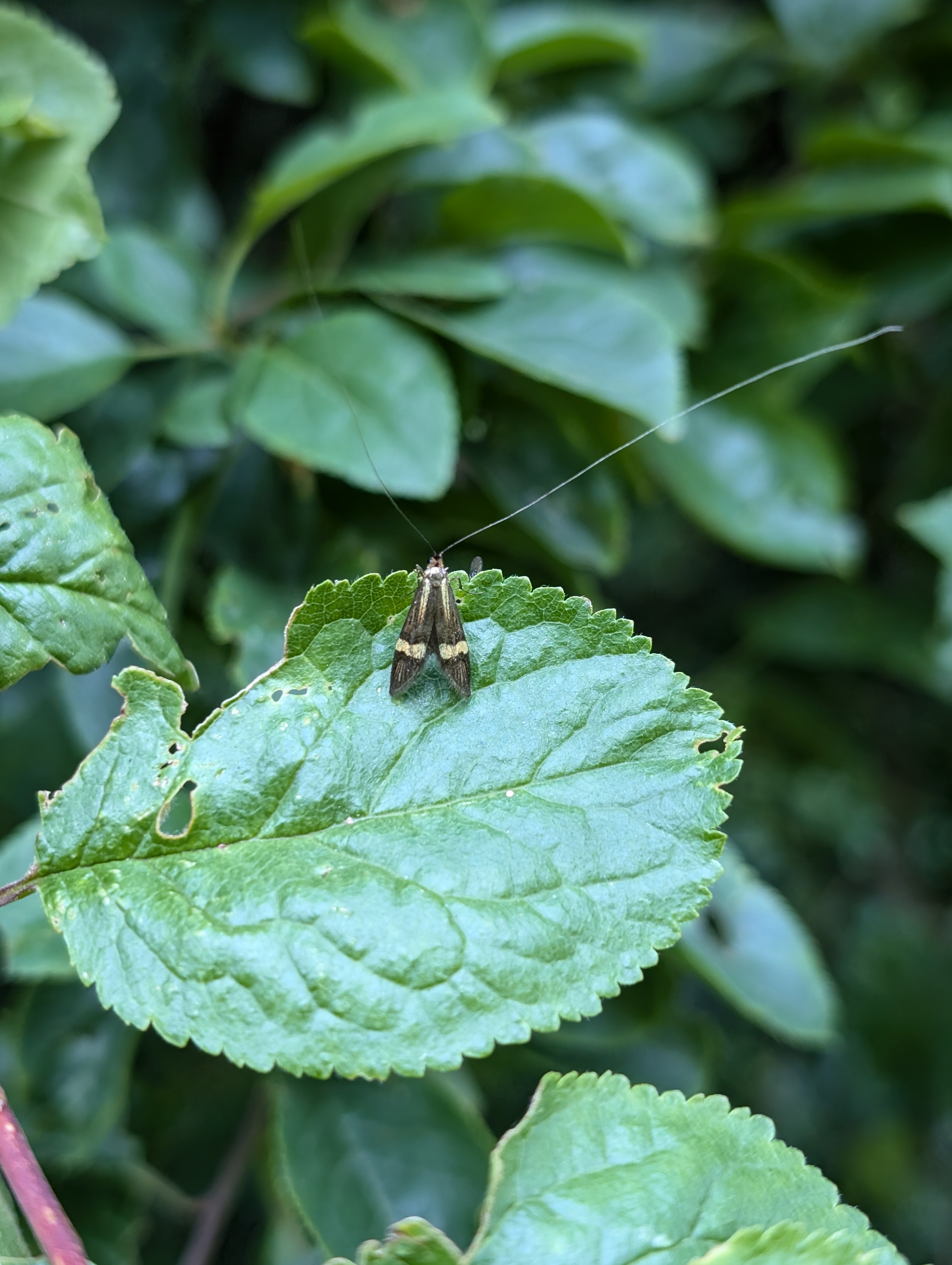
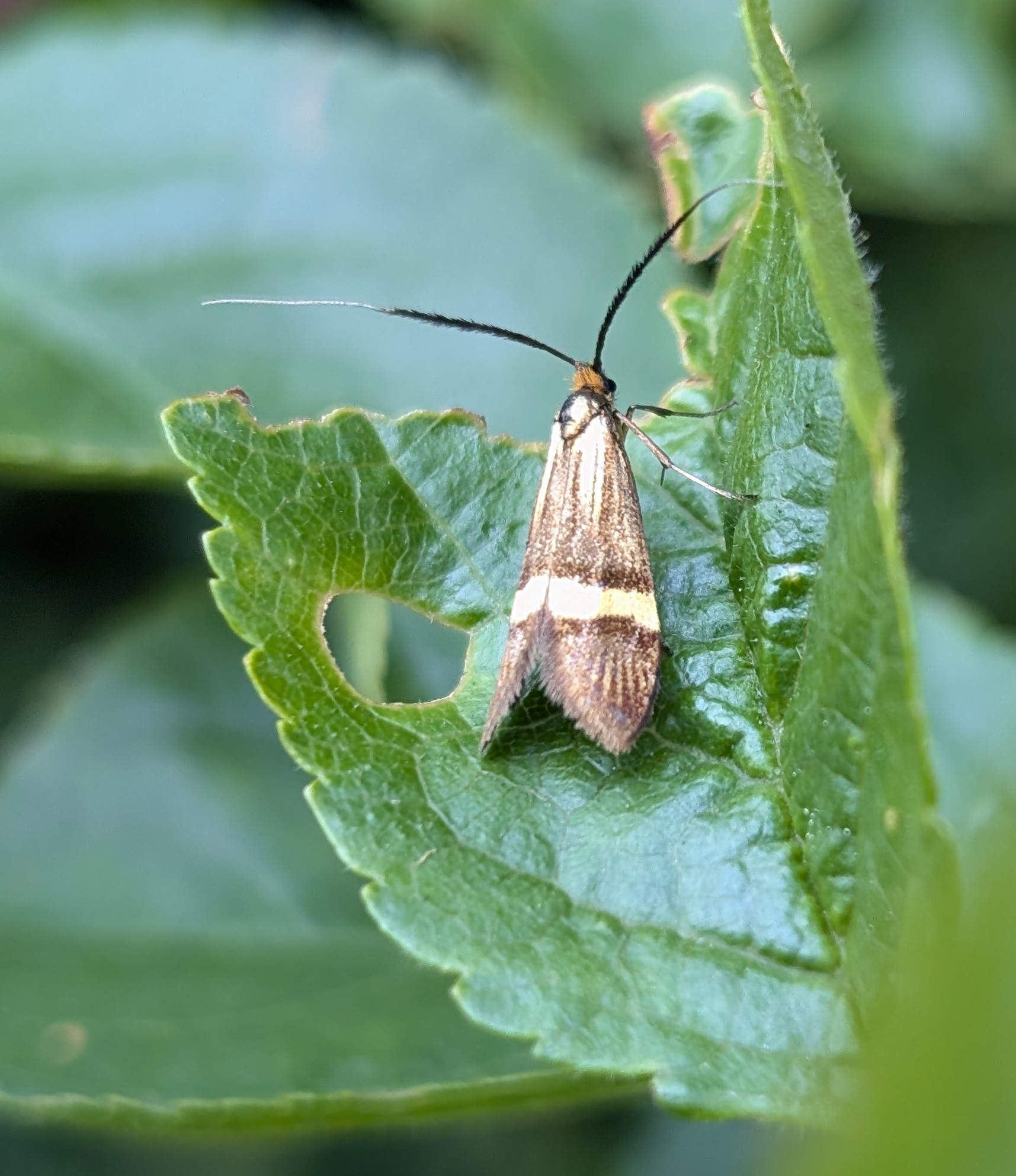
    On June 28th a BIG survey took place within the boundary of the golf course. During the day 76 invertebrates species were recorded, several previously not recorded before on Rowley Hills. One insect of particular interest was the Yellow-barred Longhorn Nemophora degeerella which was recorded in several places. The male of this small day-flying moth has antennae that are several times the length of its body.
    A full list of species recorded can be found at https://uk.inaturalist.org/observations?nelat=52.50055797022656&nelng=-2.049092586178558&on=2024-06-28&place_id=any&subview=map&swlat=52.492719809196856&swlng=-2.059735591549652


    Yellow-barred Longhorn Nemophora degeerella male – Dudley Golf Course BIG Survey June 2024

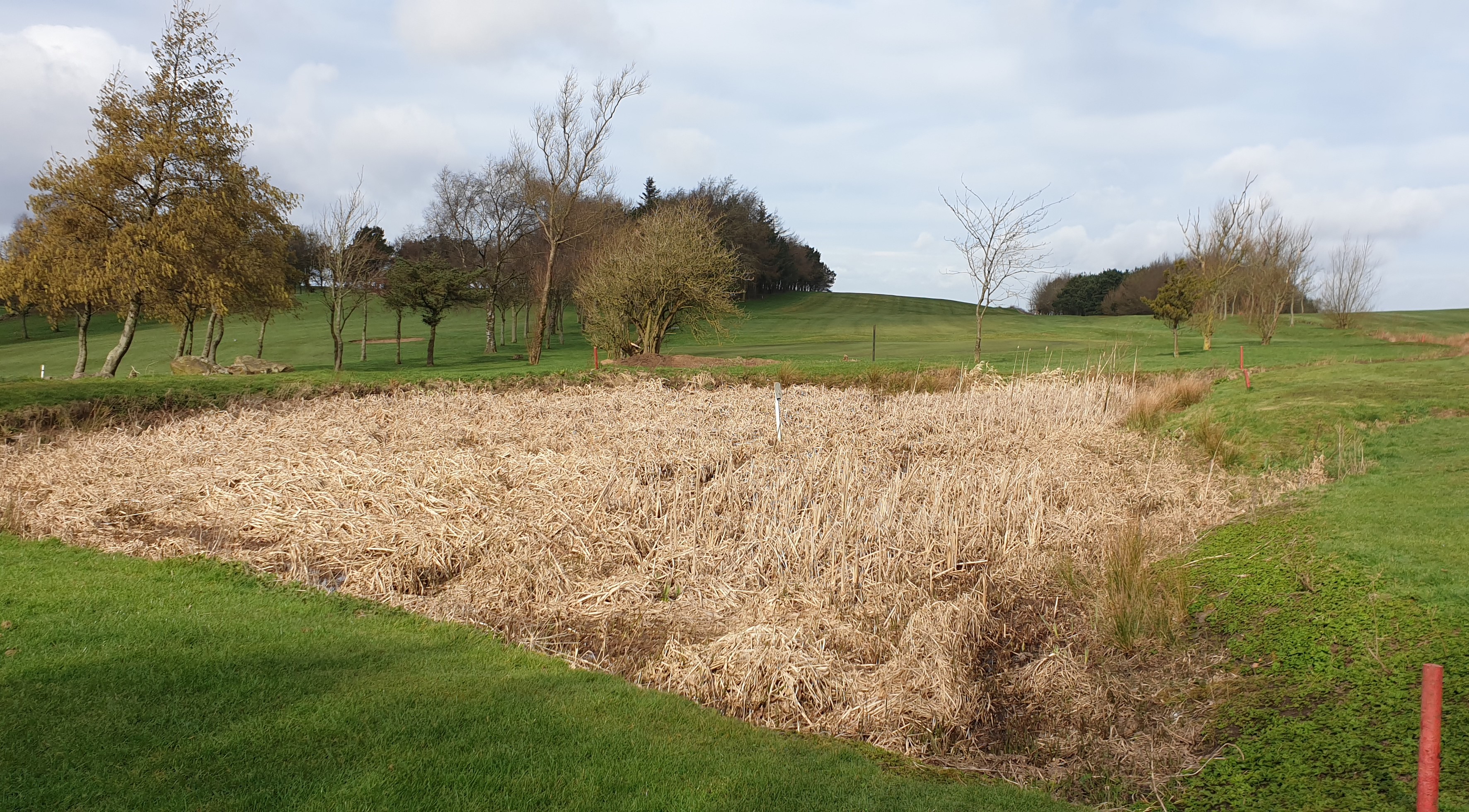
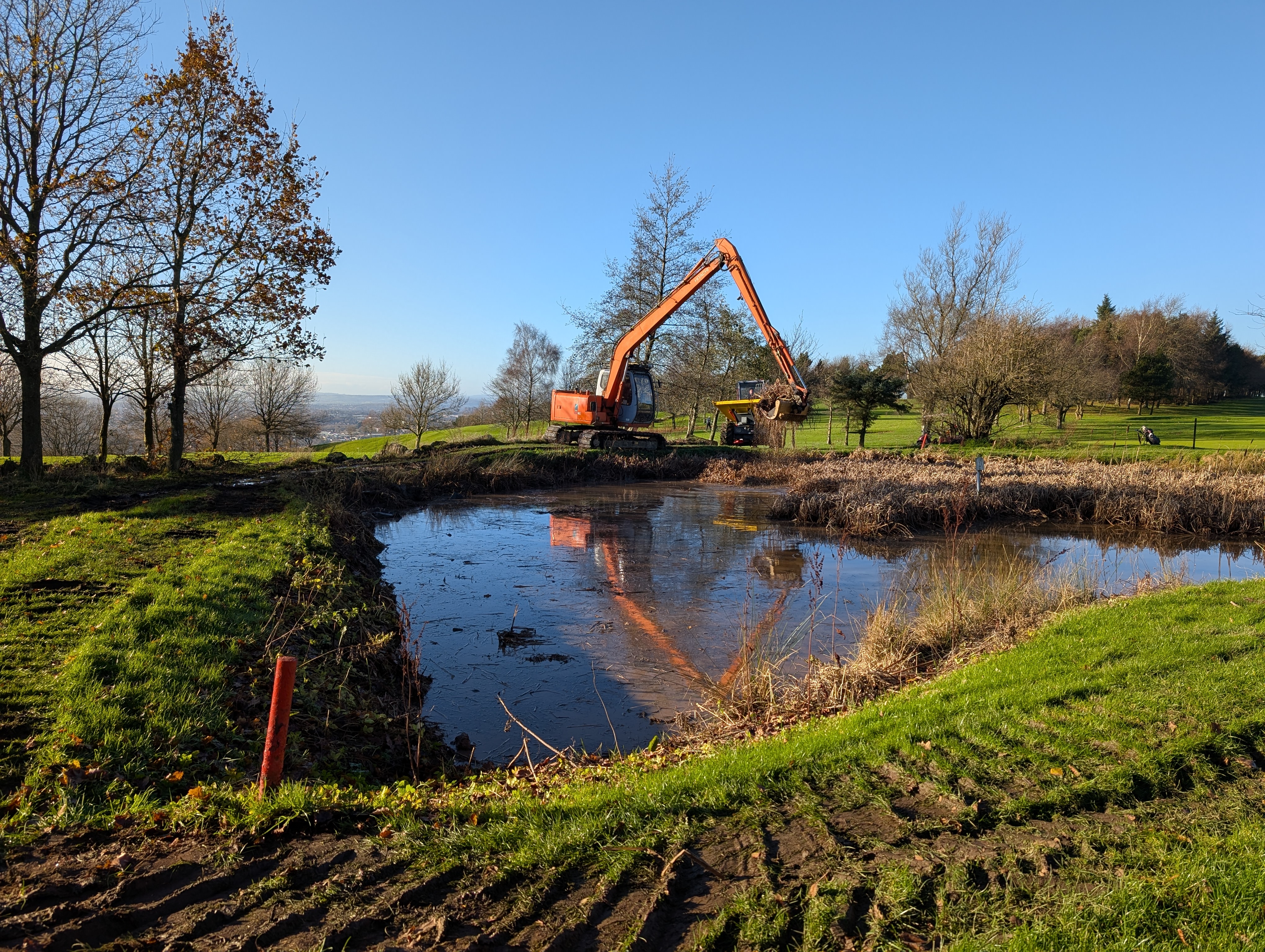
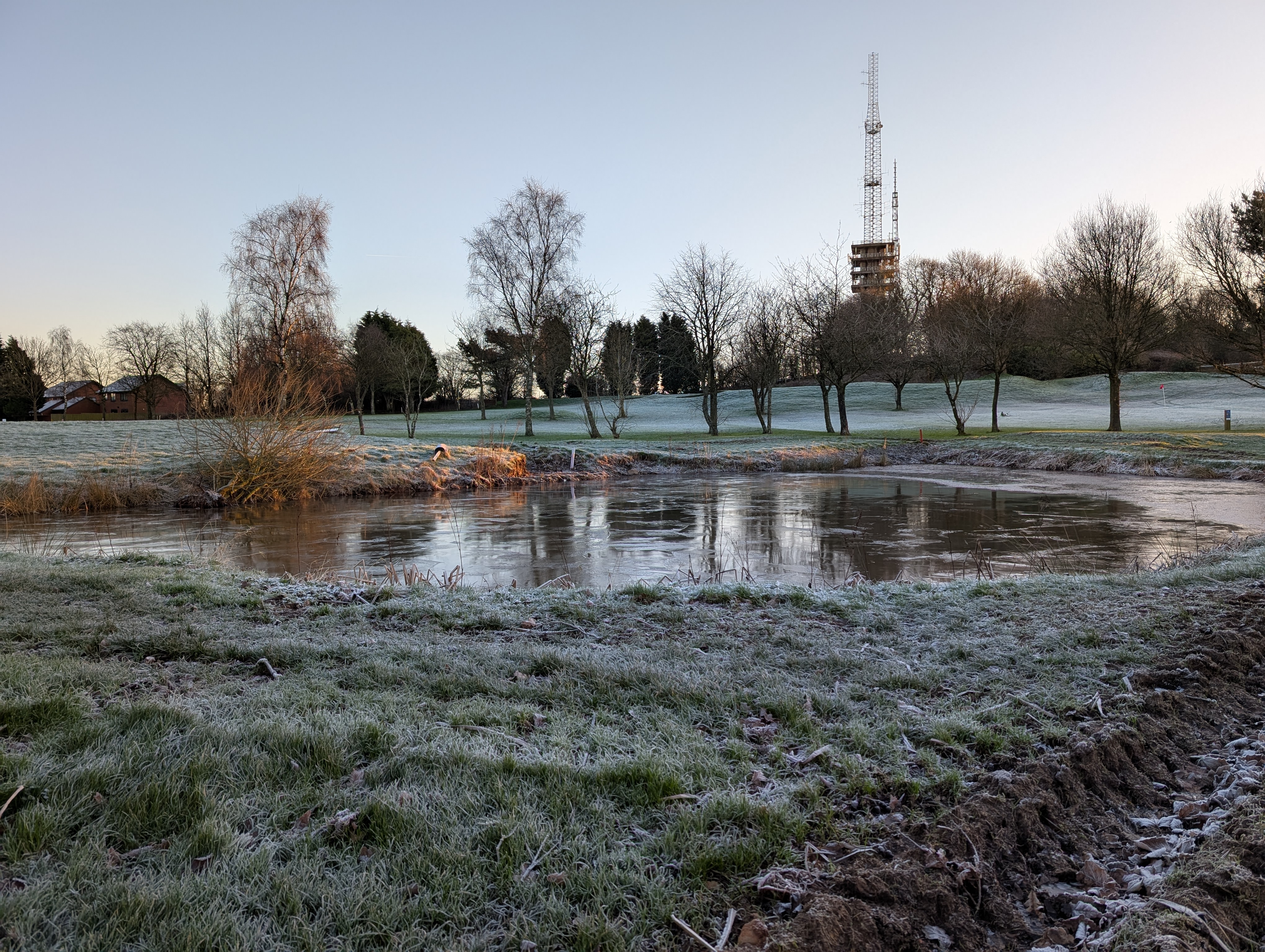
    Funding from the Dudley’s Path to Nature Recovery Project was used to provide manpower and machinery for dredging the two choked up ponds on the golf course. Spring fed they are linked by narrow drainage channels. As both Common Toad and Smooth Newt are known to occur on the golf course land. The restoration of the pond to open water will enable spawning to hopefully take place in the spring.

    Dudley Golf Club pond prior to dredging
    Dredging taking place – November 2024
    Cleared pond – December 2024

    Portway Hill Survey
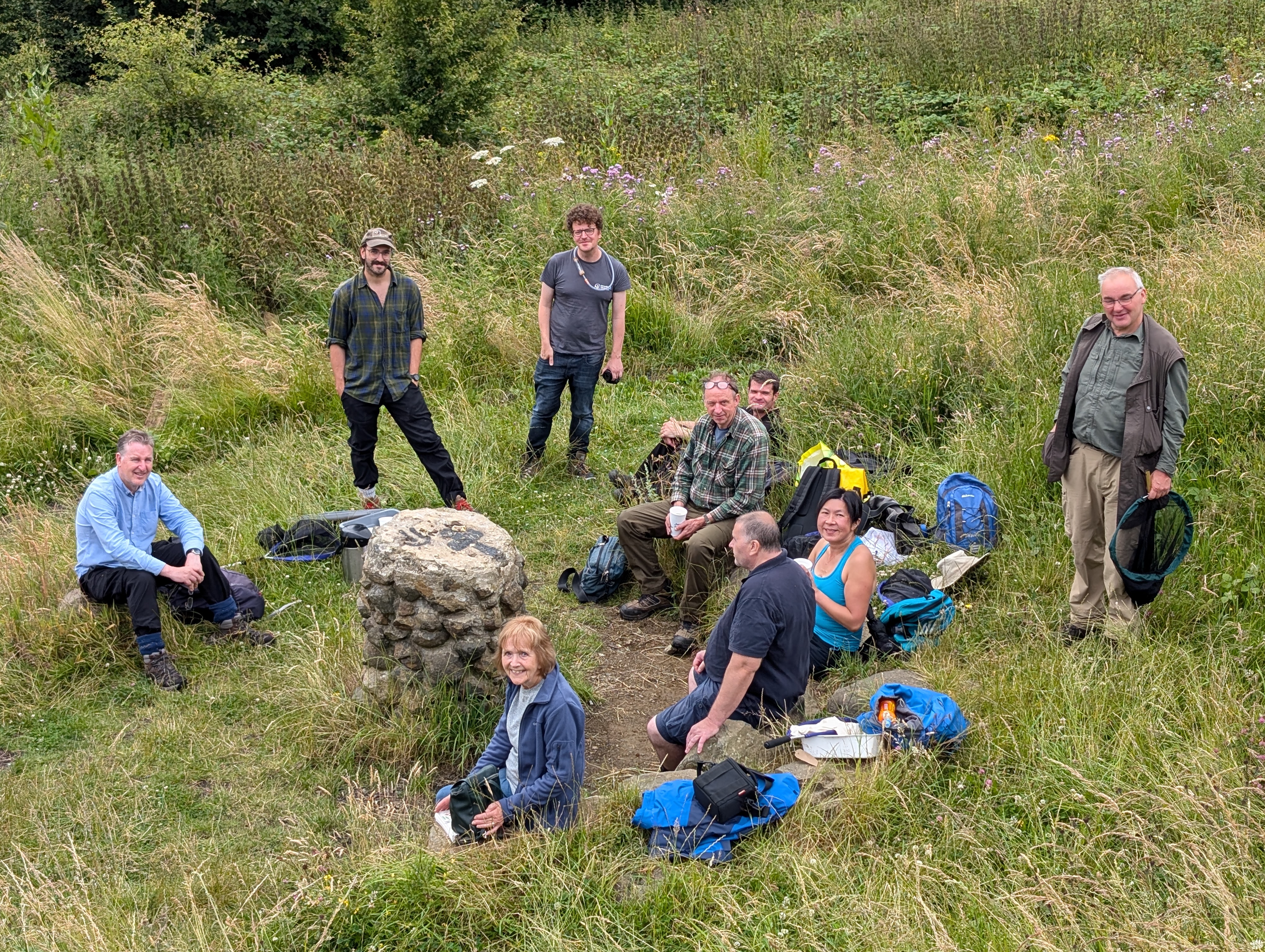
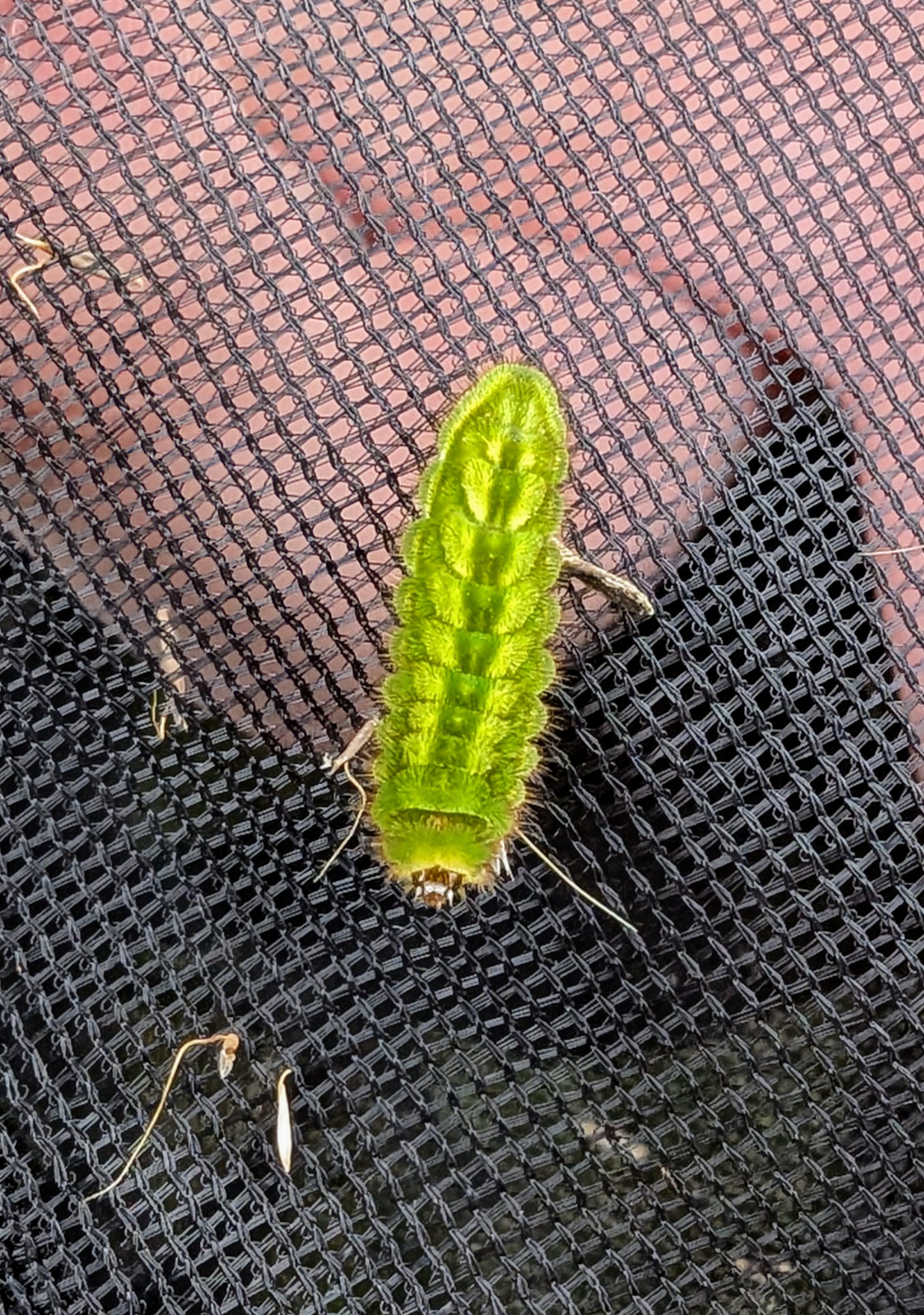
    The second of the two Rowley Hills BIG surveys was carried out on Portway Hill on July 13th. This was a well-attended event and resulted in 139 different species of invertebrates being recorded, including several ‘first’ records for the site. The capture of a larva of a Green Hairstreak butterfly caught in a sweep net was a bonus as both caterpillar and butterfly are seen rarely on this site. Common Toad is the only amphibian known to reside here and as the survey progressed one eagle-eyed recorder spotted a well camouflaged toadlet clinging to the rockface on the Wildlife Trust
    owned land.

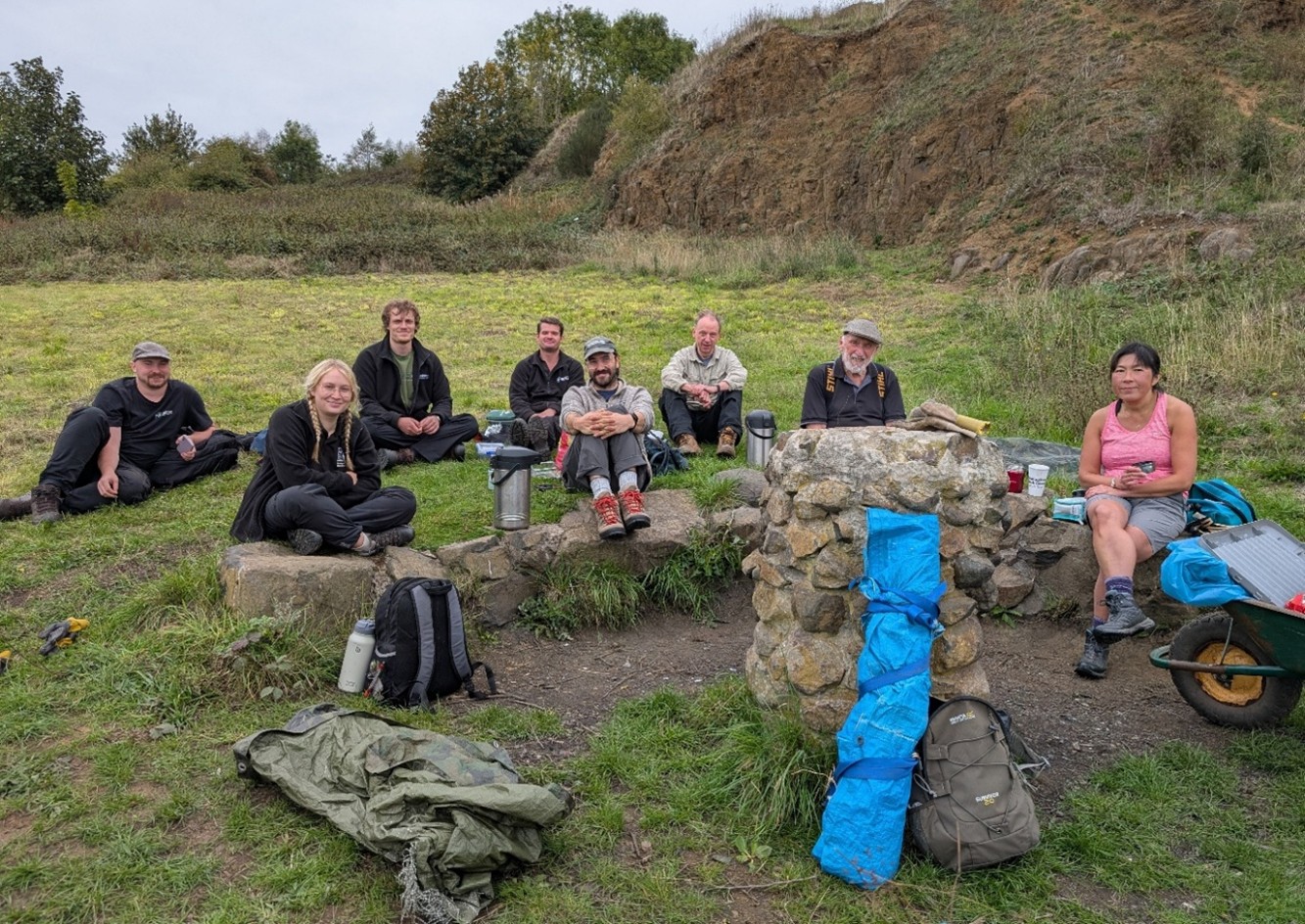
    BIG survey group – Portway Hill July 2024
    Green Hairstreak Larva – Portway Hill BIG survey July 2024
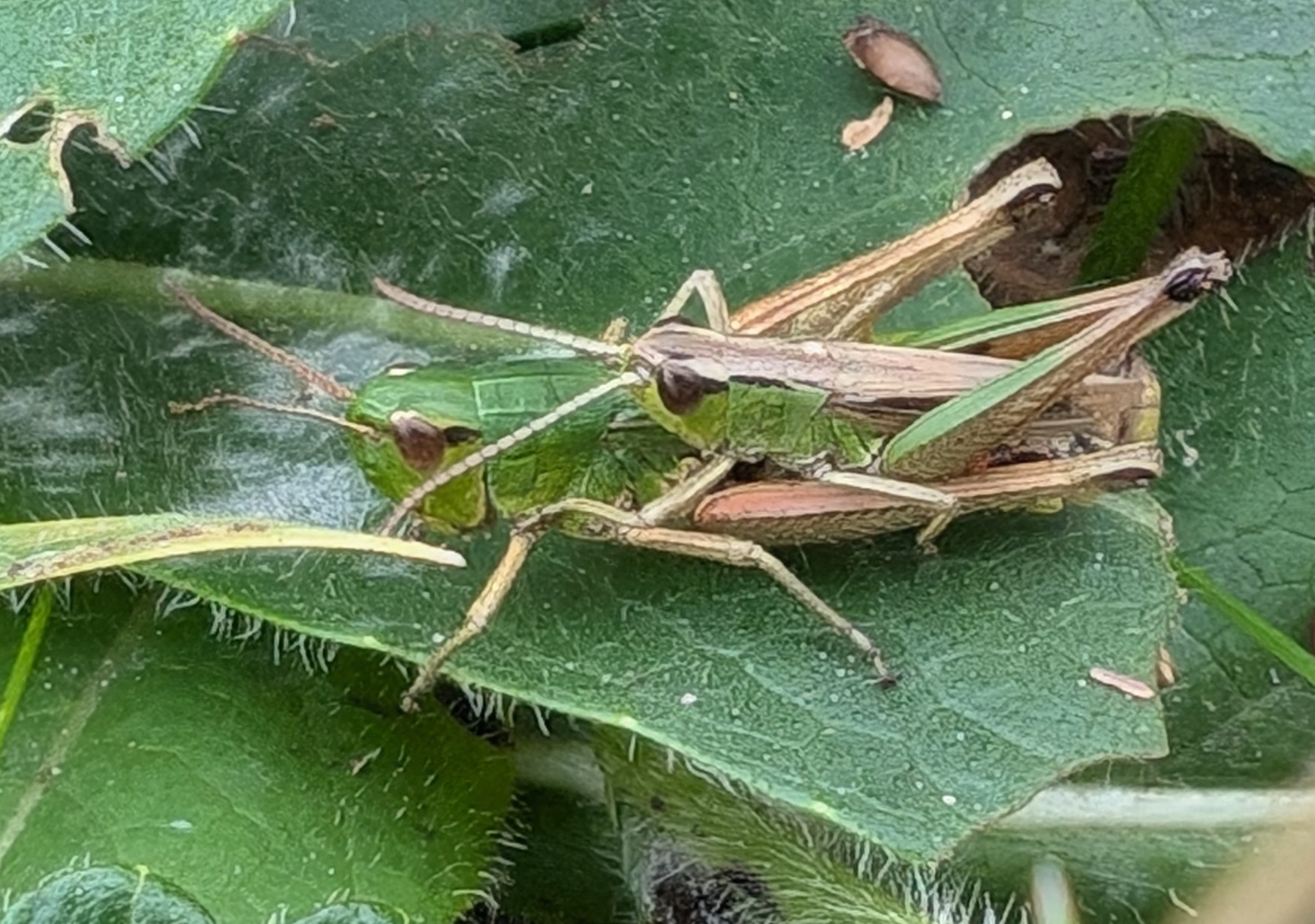
    Meadow Grasshopper Pseudochorthippus parallelus – Portway Hill BIG survey July 2024
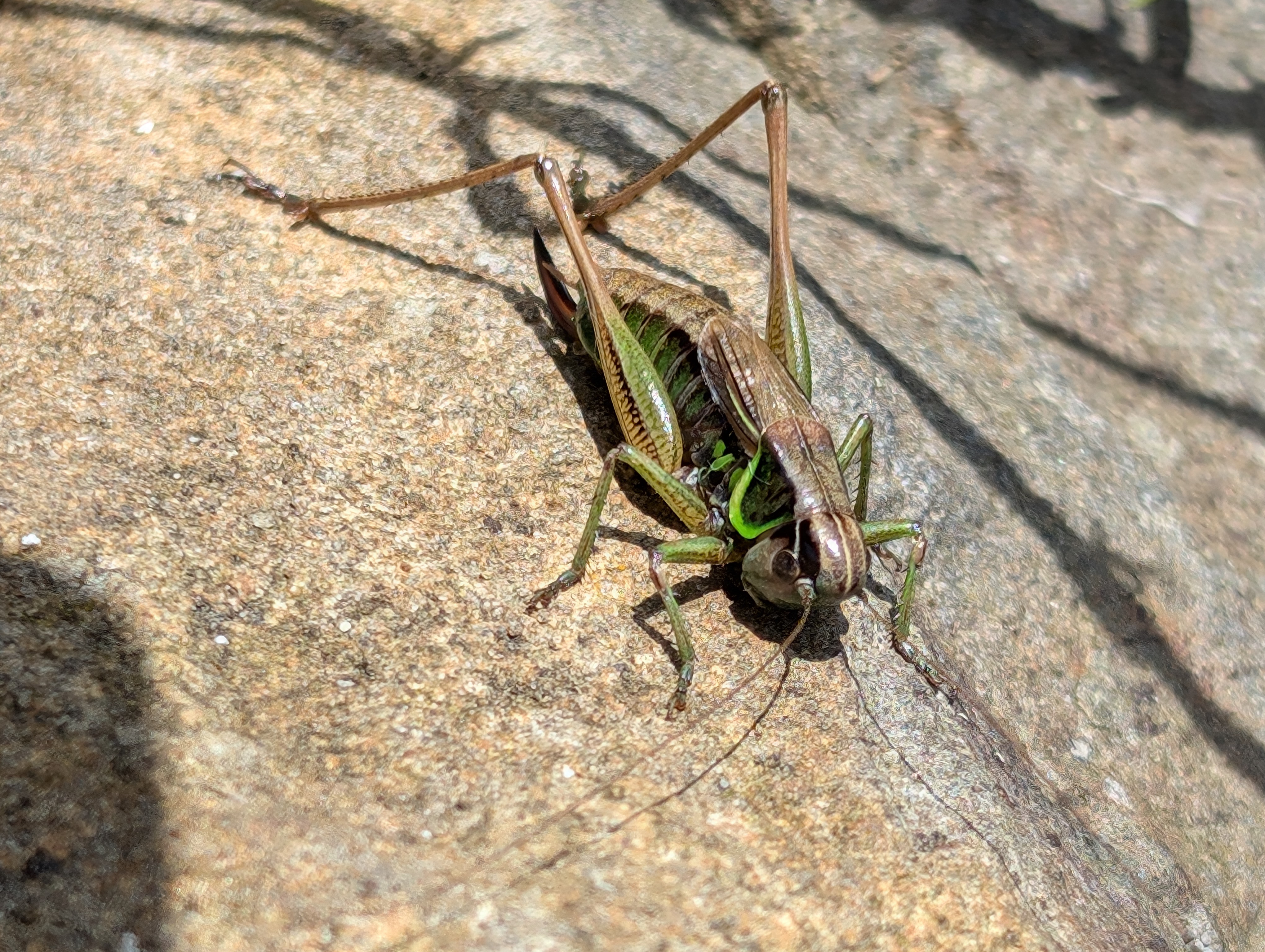
    Roesel’s Bush-cricket Metrioptera roeselii – Portway Hill BIG survey July 2024

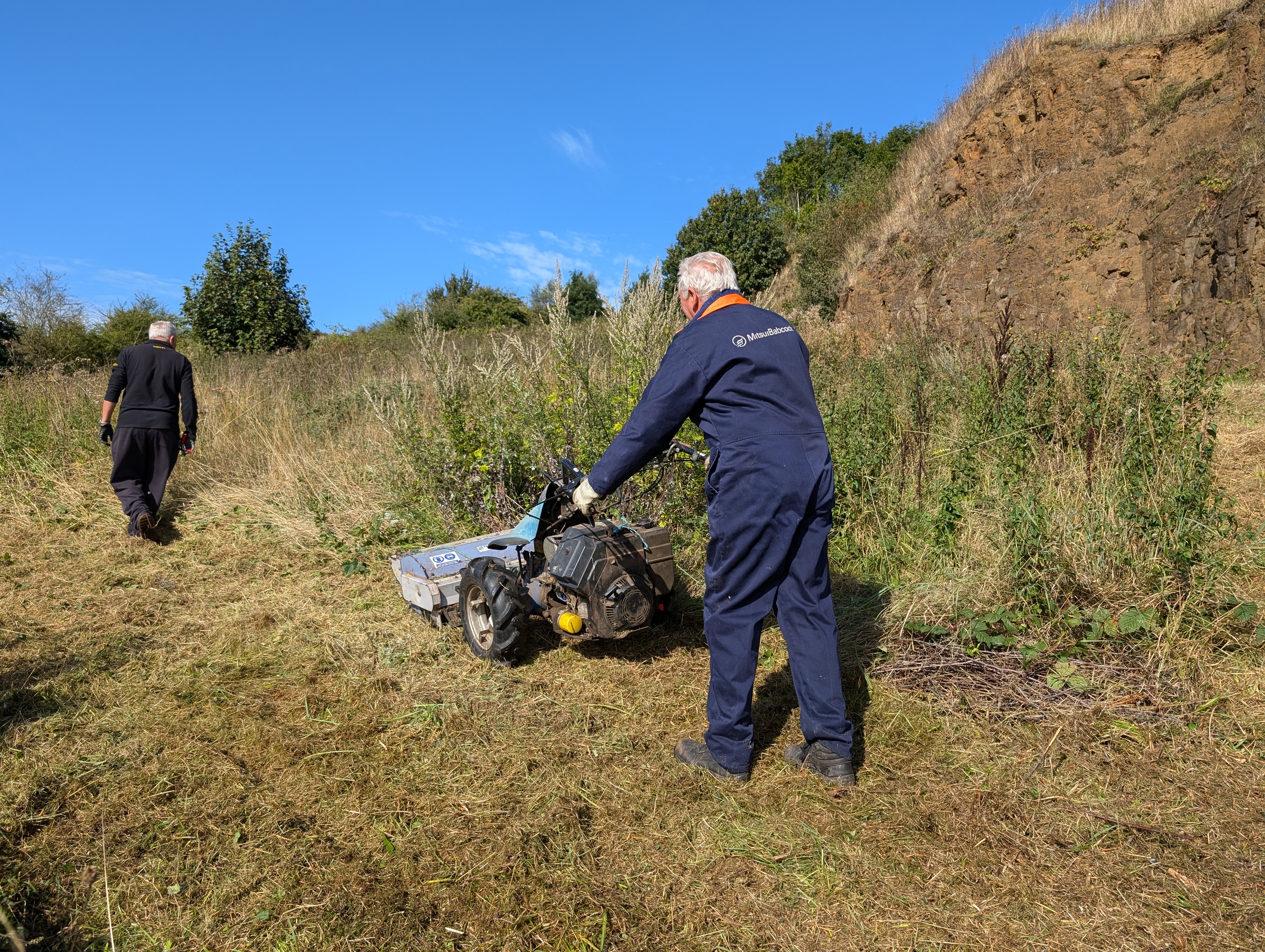
    2024 will be remembered for the record rainfall experienced in many parts of the UK, resulting in damaging floods in some parts of the country. Here on Rowley Hills, there is very little likelihood of this ever happening, but in some places the ground does become waterlogged, making some of the paths difficult to negotiate. Widening the paths with the Tracmaster does help to make negotiating the wet areas a little easier, but to do this first requires the removal of any protruding rocks, stones, and lumps of buried concrete to be removed first to prevent damage to the cutters. Carrying out this task is a reminder that most of the Portway Hill site was quarries that were landfilled. The
    Tracmaster has also been put to good use in reducing the height of the vegetation in front of the rockface, now enabling visitors to get up close to look at the interesting exposure.

    Removing buried materials from path on Portway Hill
    Tracmaster in action clearing the way at the bottom of the rockface

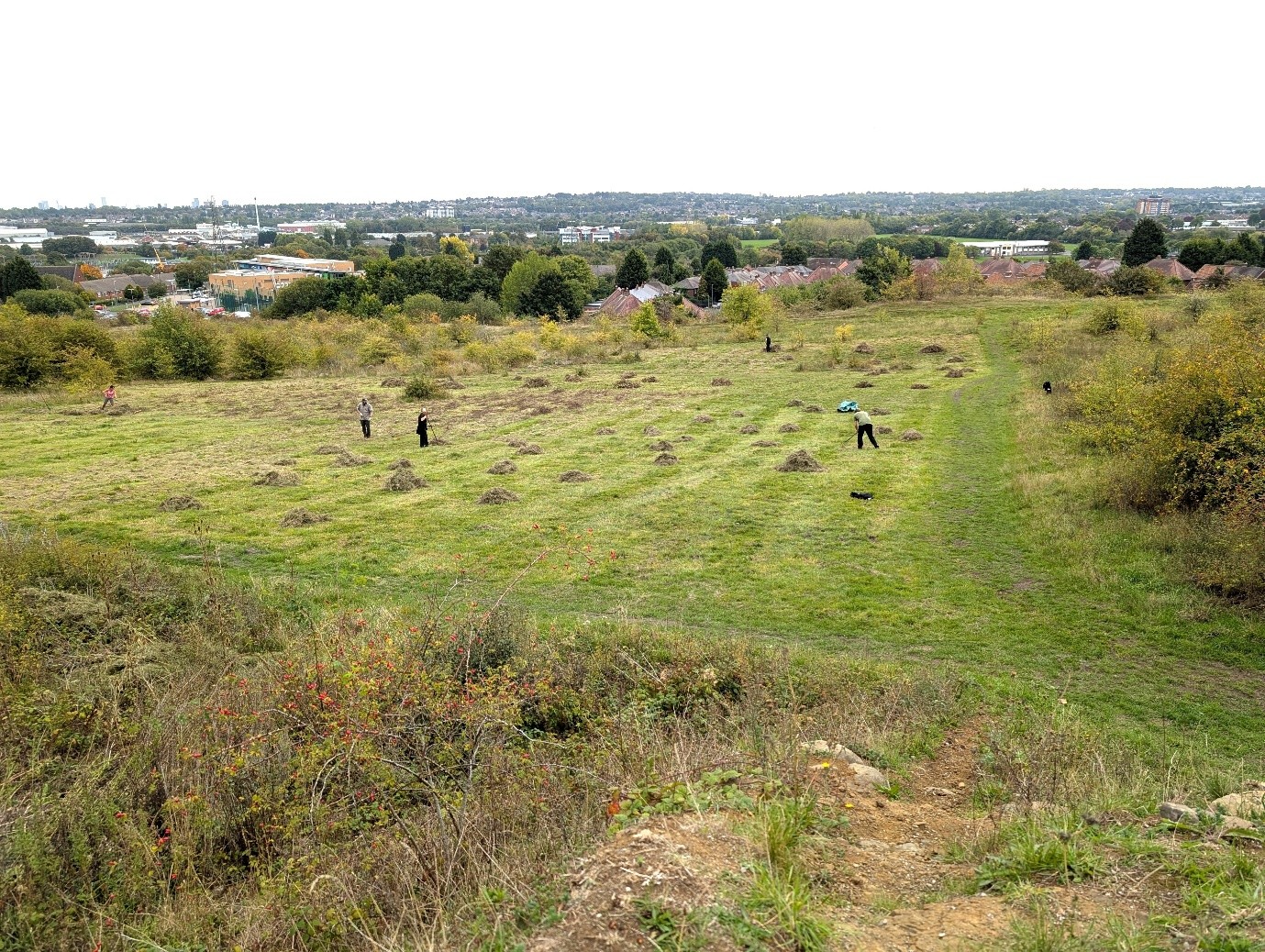
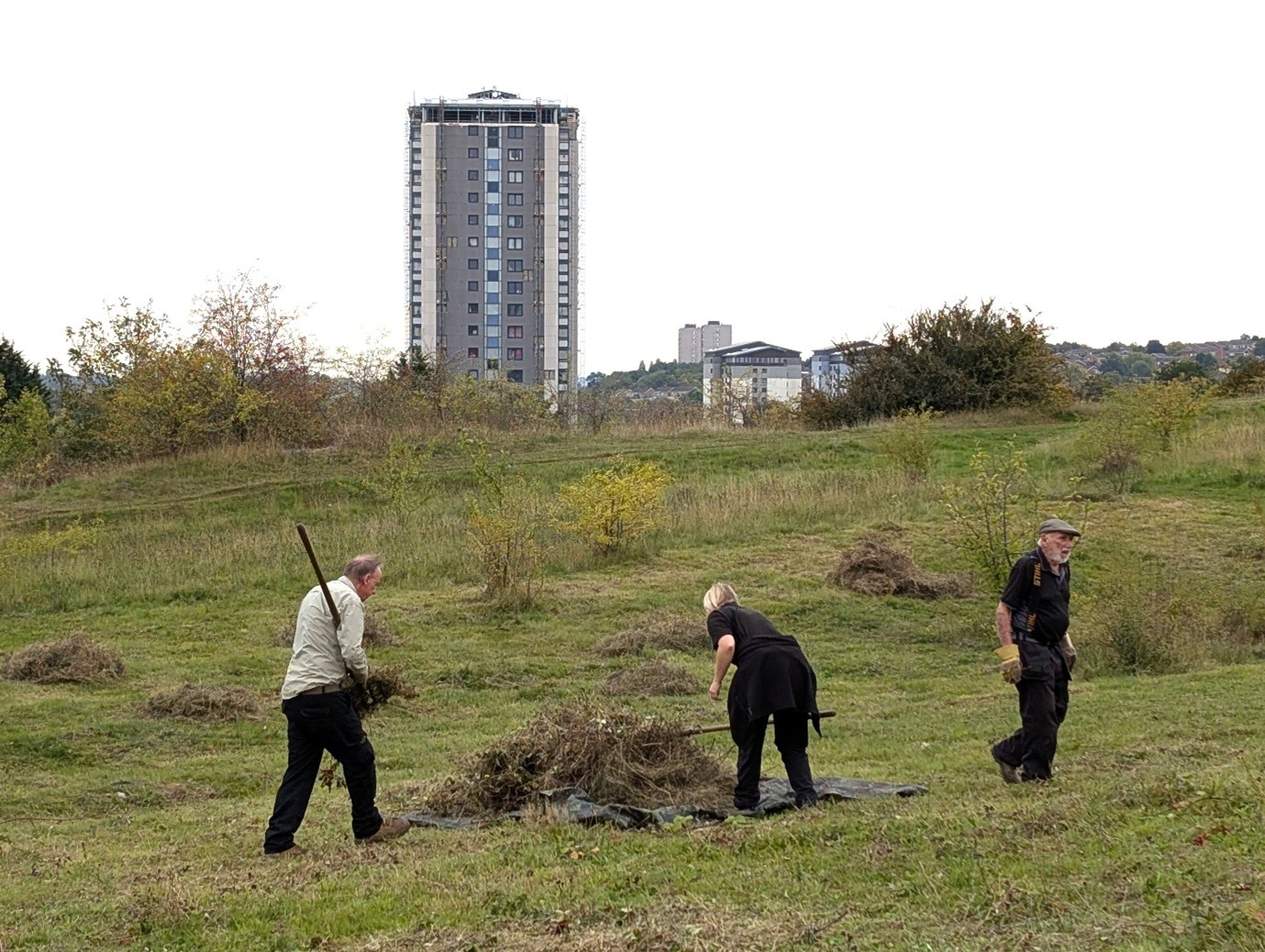
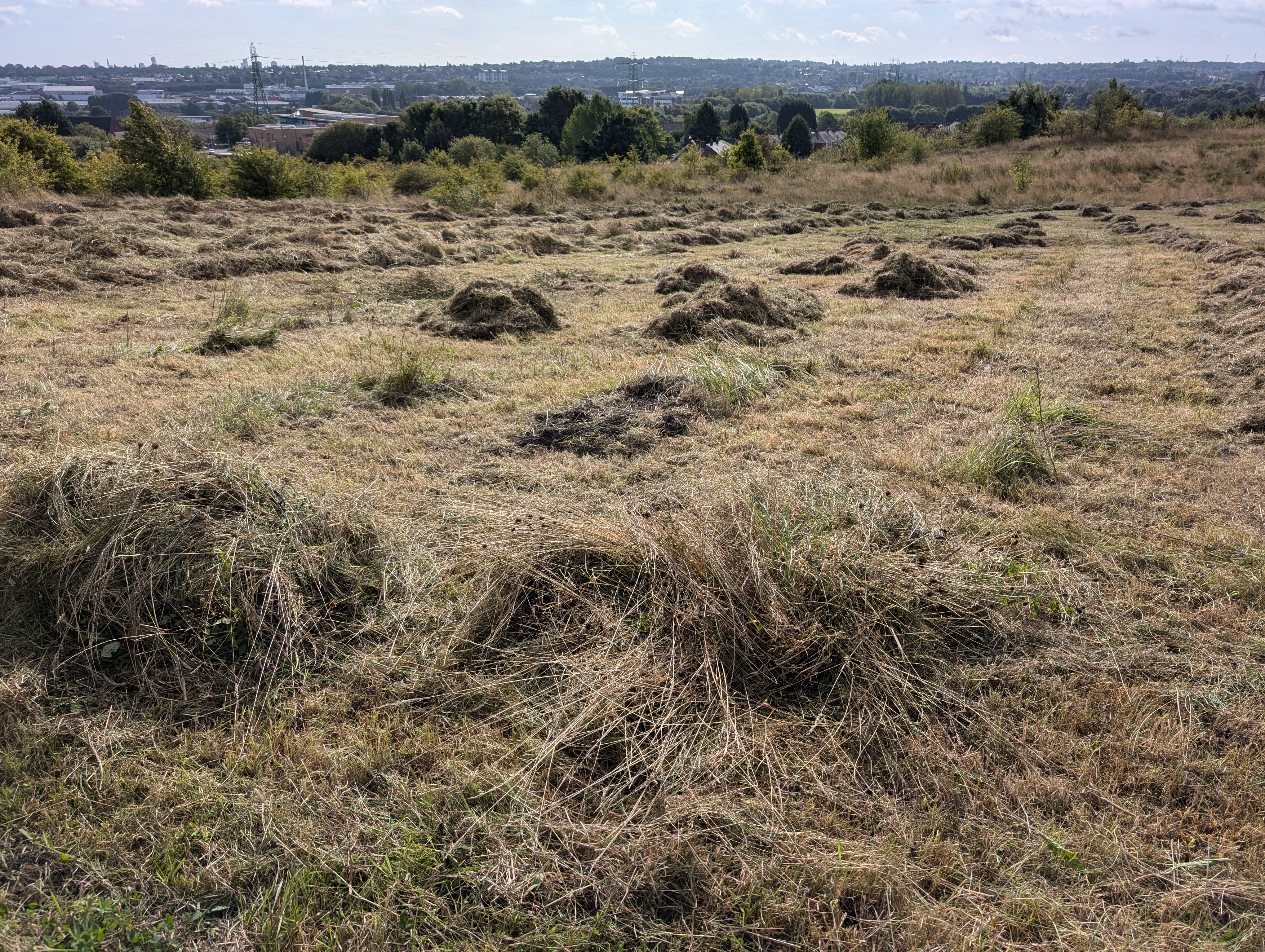
    To maintain a species-rich wildflower meadow involves cutting and removing the arisings on an annual basis at an appropriate time of the year. The Wildlife Trust meadow is now a well-established wildflower meadow and by the early part of September when flowering and seeding was at an end, the meadow was ready for its annual cut. Volunteers set to work, and the resulting hay was raked into piles and then moved off the site. Reducing fertility is a key part of managing a wildflower meadow, as the poorer the soil the better it is for native wildflowers and grasses. During the raking and piling up process any seeds present will fall to the ground. Over time pernicious
    weeds such as nettles, docks, ragwort, brambles, and thistles become less problematic as their preference is for ground left undisturbed.

    Cutting the meadow – September 2024
    Arisings piled awaiting removal – September 2024
    Arisings being removed from the site – September 2024
    Meadow after final rake – September 2024

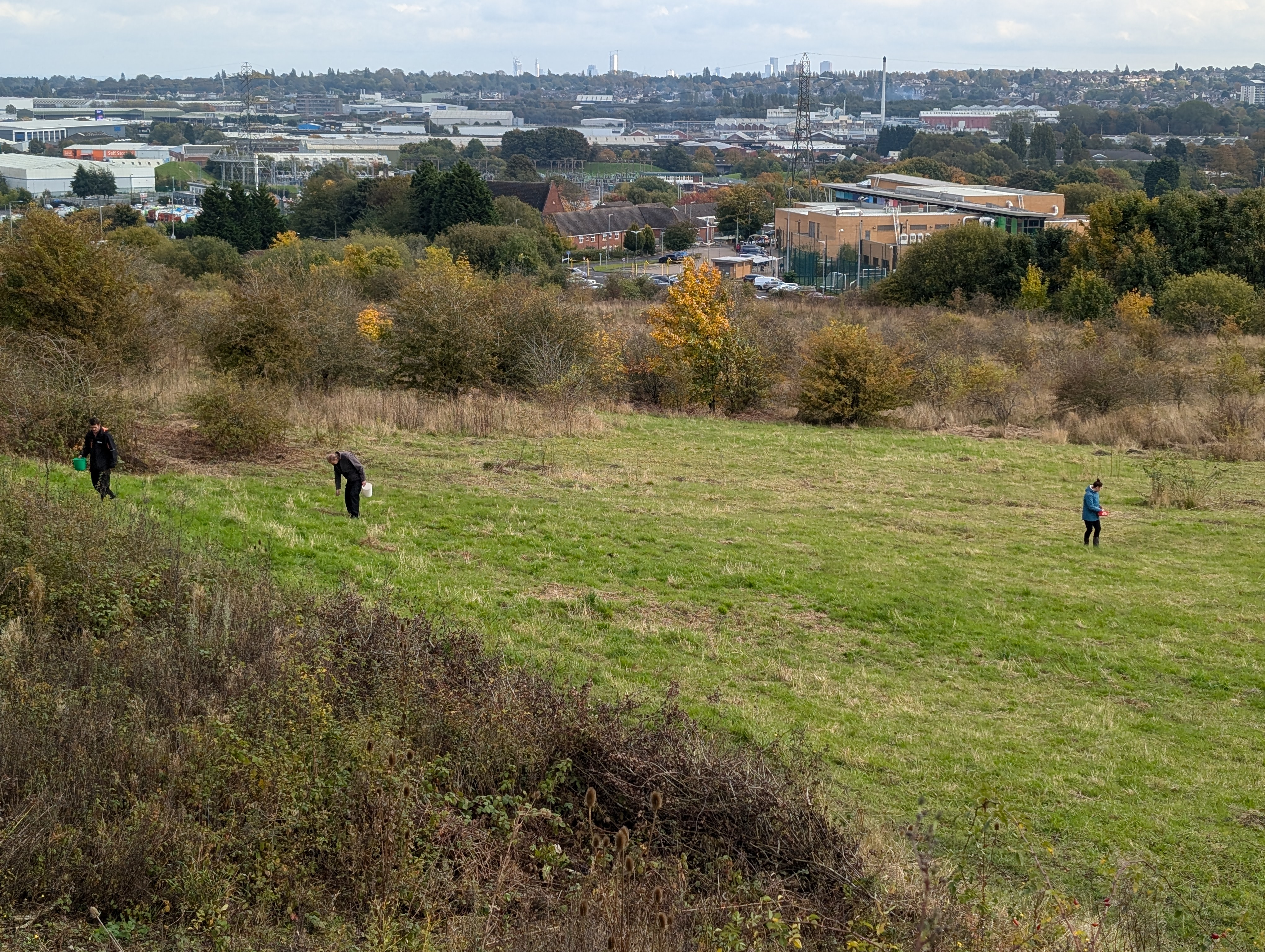
    To further reduce the vigour of more dominant meadow grasses, a sowing of Yellow-rattle seeds is made. The roots of this semi-parasitic annual, germinates in spring and their roots attach to grass roots on which they are dependent for water and mineral
    nutrients, thus reducing the host grasses vigour. Yellow rattle is already well-established in the meadow from previous sowings but is still poorly established in parts of the meadow, particularly in the extended parts only recently cleared of bramble and hawthorn, so following the meadow cut a sowing of Yellow-rattle seeds was carried out in these areas.

    Sowing Yellow Rattle Seeds in the meadow

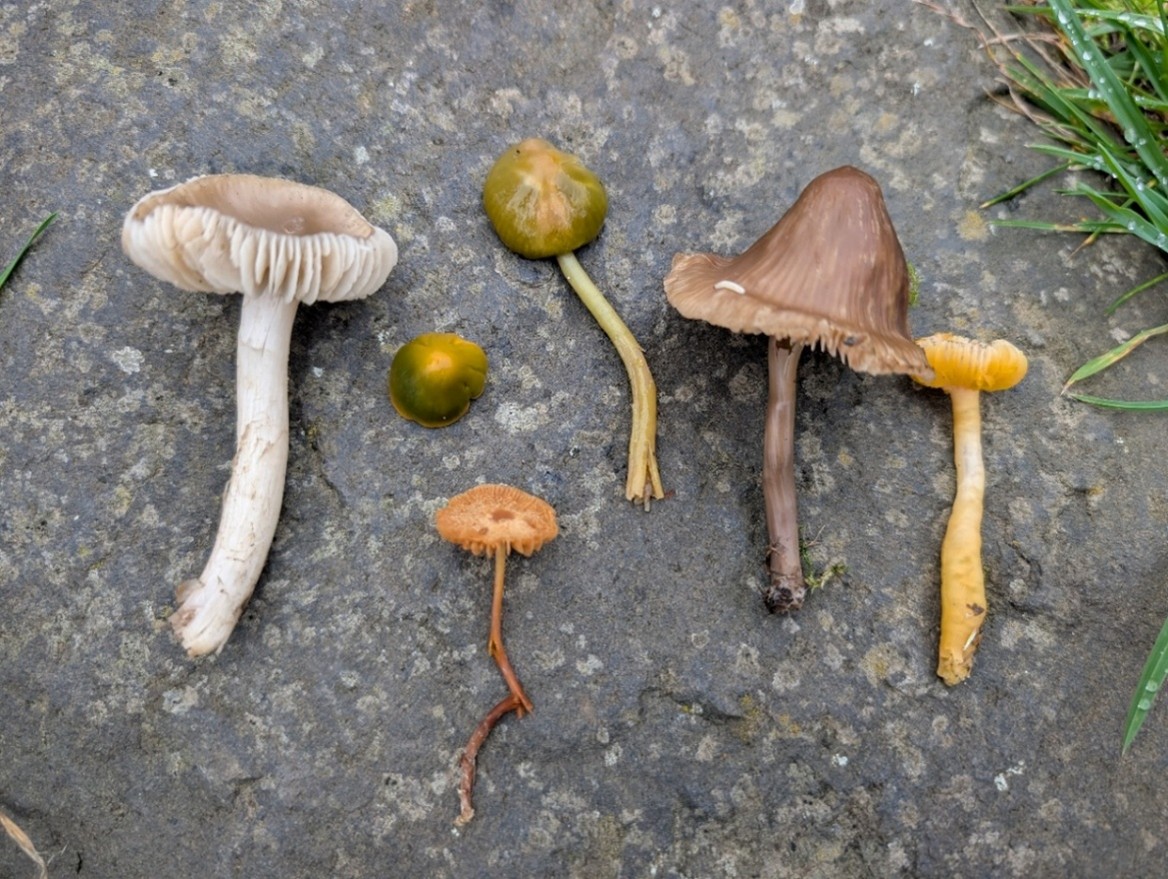
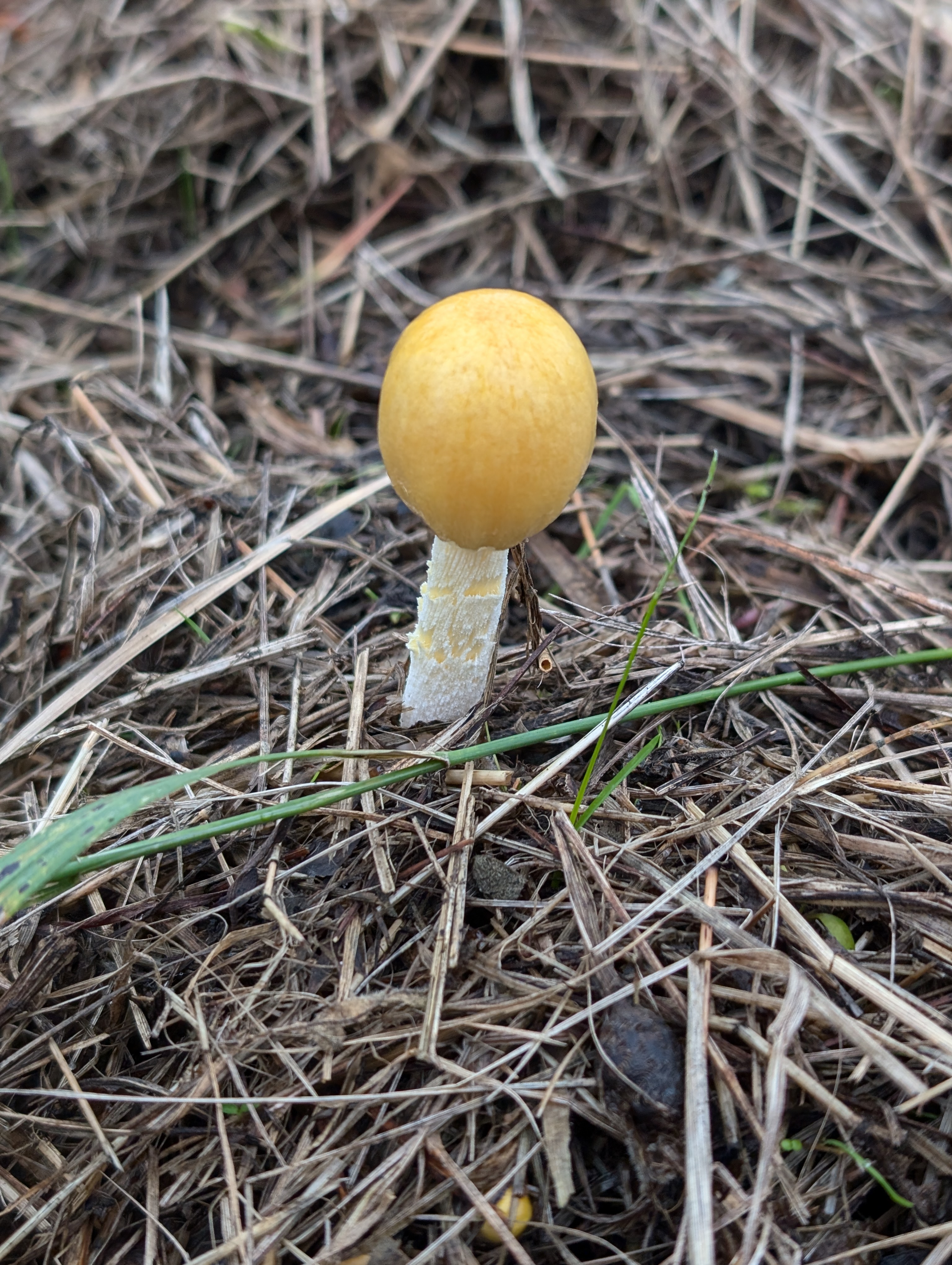
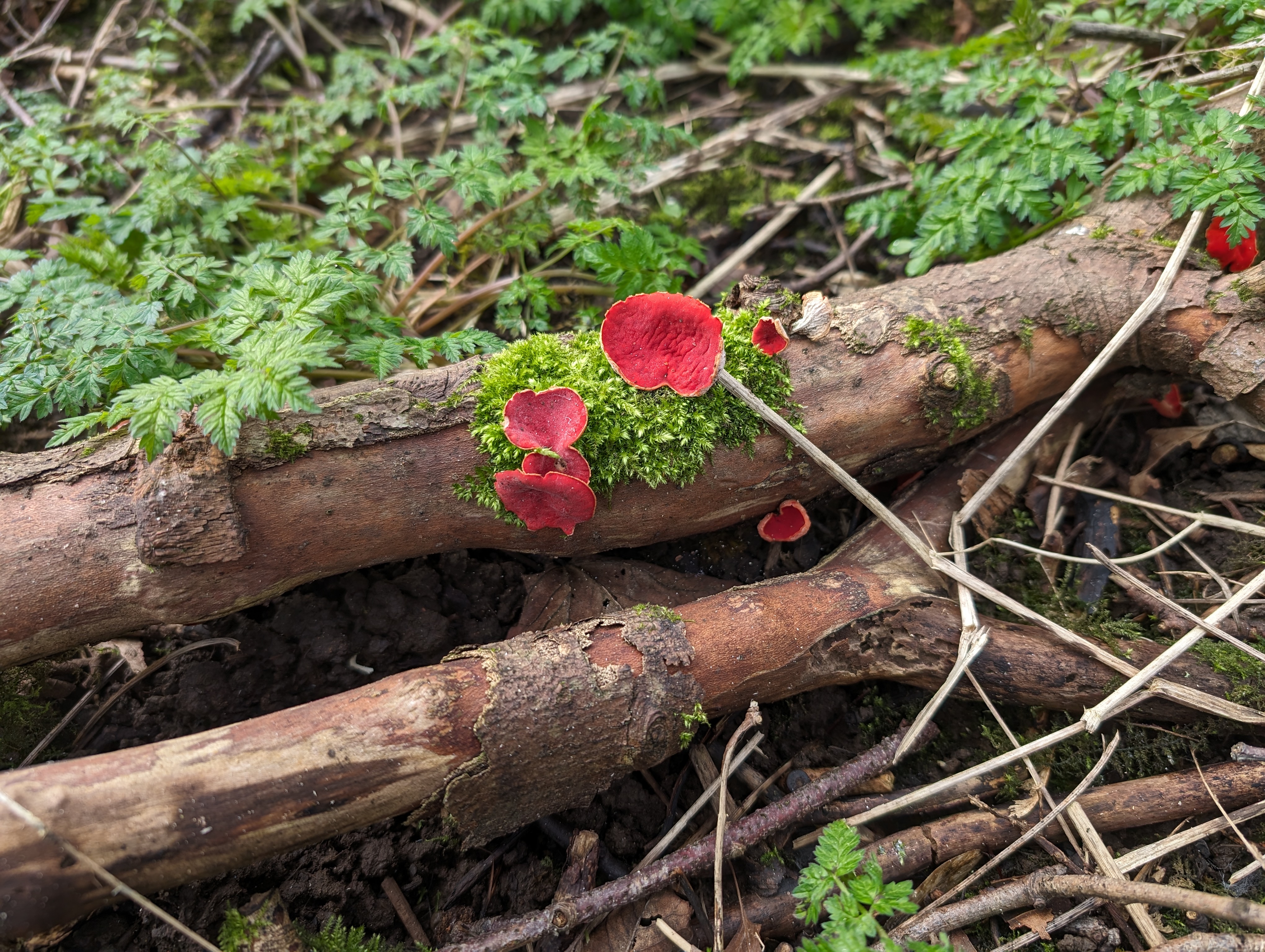
    As autumn approached fungi started to appear. Those that caught our attention were
    photographed and shown below along with some of the interesting lichens found on trees and shrubs.

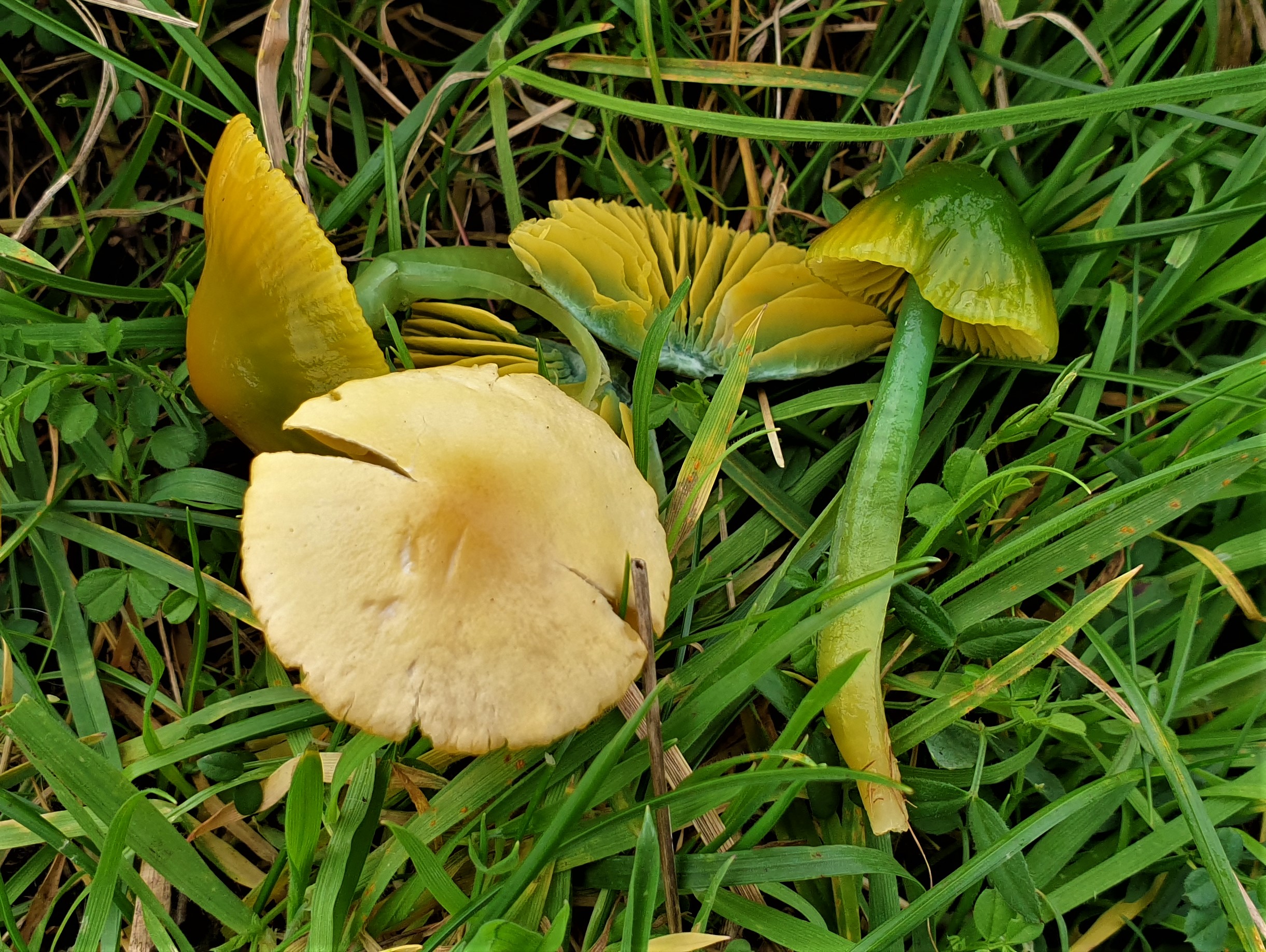
    Yellow Fieldcap Bolbitius titubans
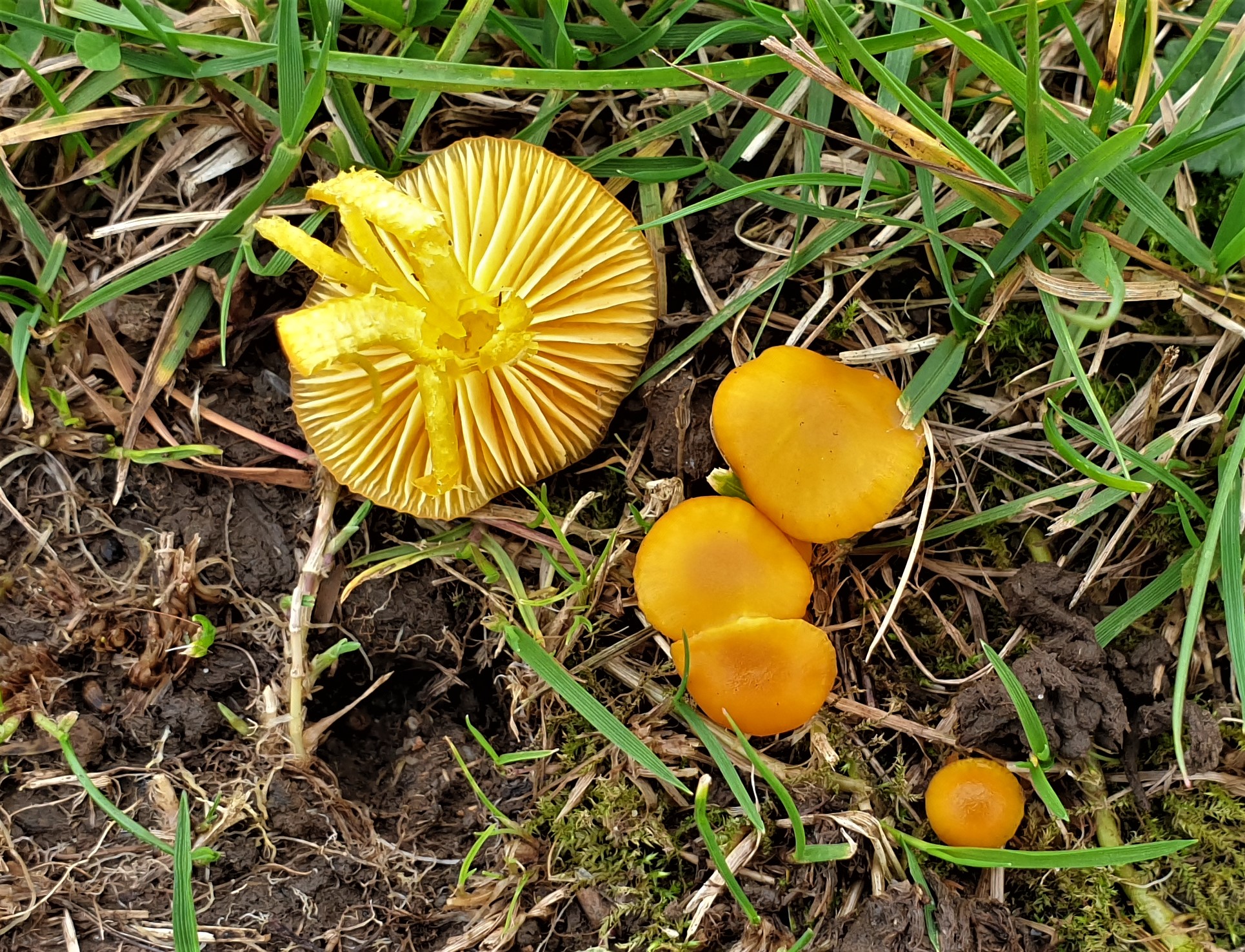
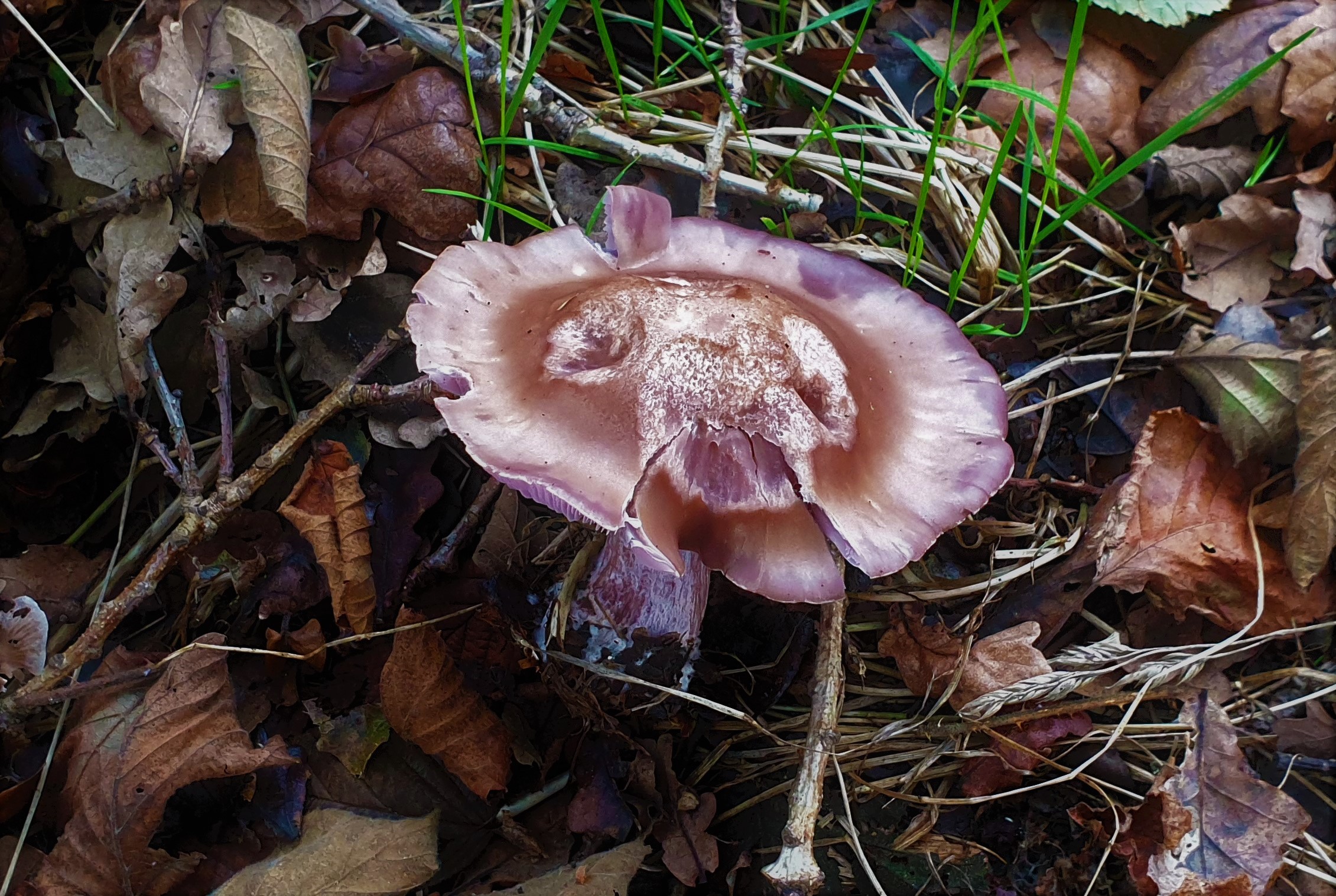
    Wood Blewit Lepista nuda
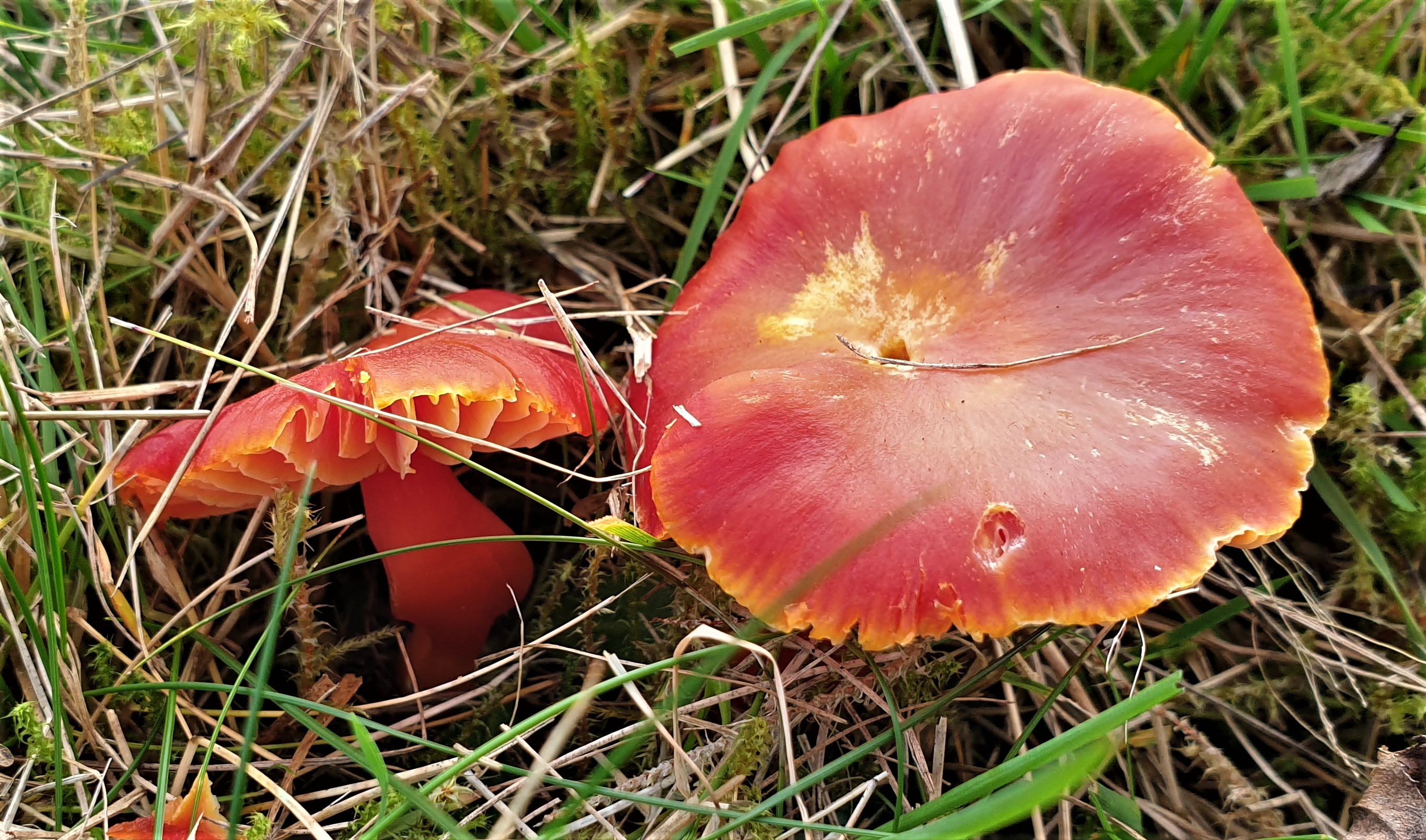
    Scarlet Elf-Cup Sarcoscypha coccinea
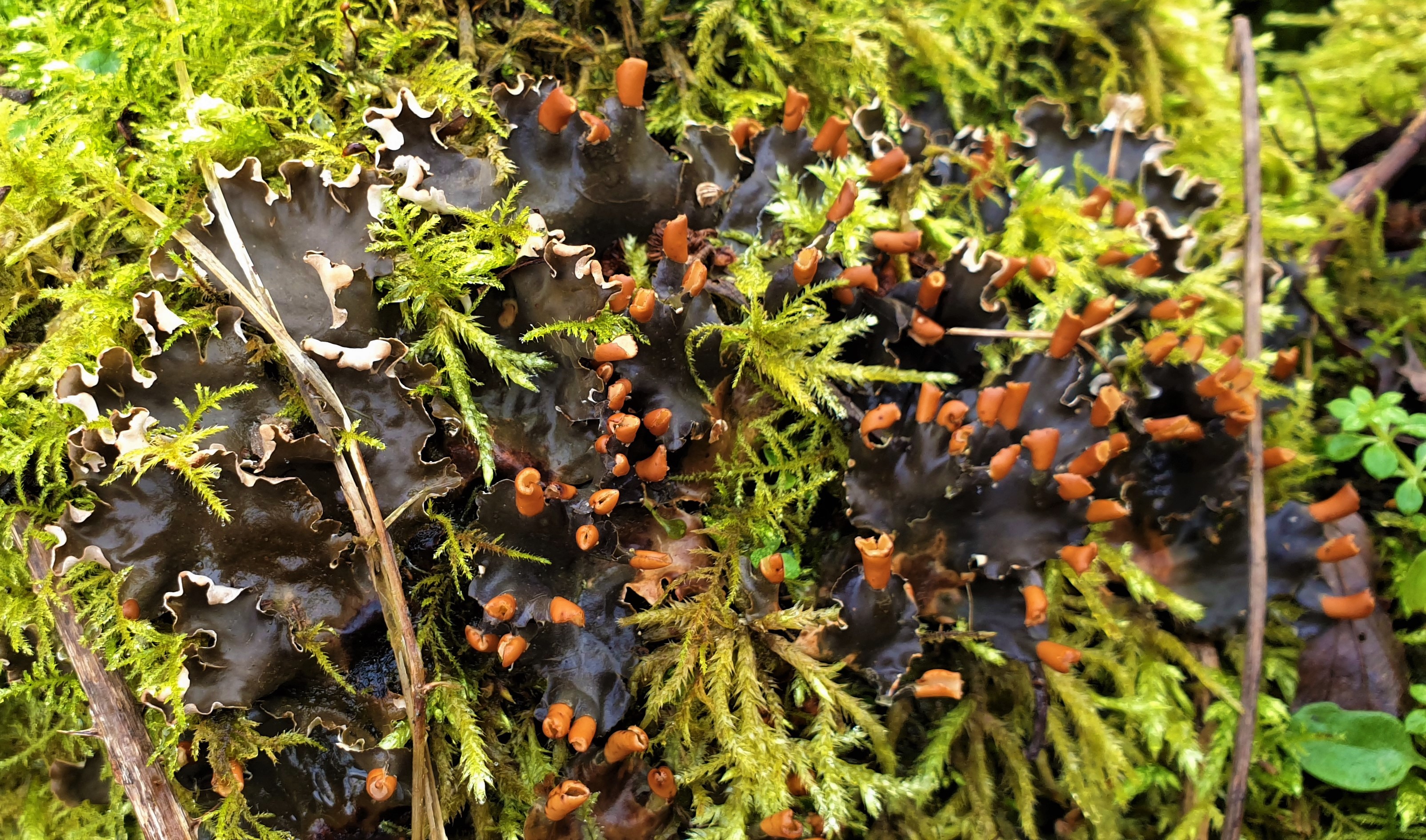
    Peltigera sp. a Dog Lichen – on drystone wall – Portway Hill
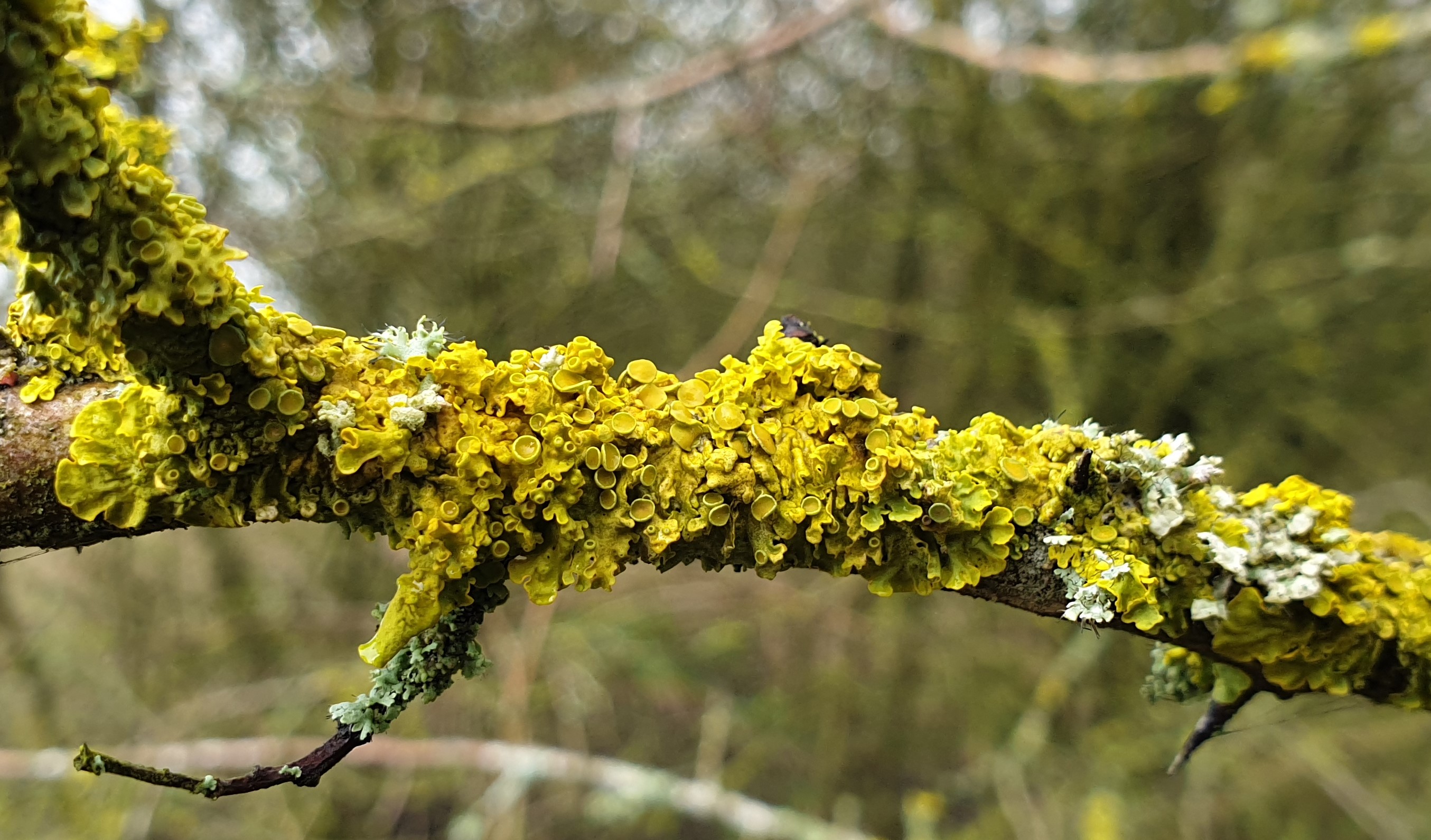
    Xanthoria parientina and Physcia tenella on Hawthorn branch

    In December a joint meeting of the Black Country Geological Society and the Wildlife Trust was held on Portway Hill. Over the day another section of spheroidal weathering on the rockface was revealed.

    Black Country Geological Society/Wildlife Trust joint meeting on Portway Hill – December 2024
    Black Country Geological Society working on rockface – Portway Hill – December 2024

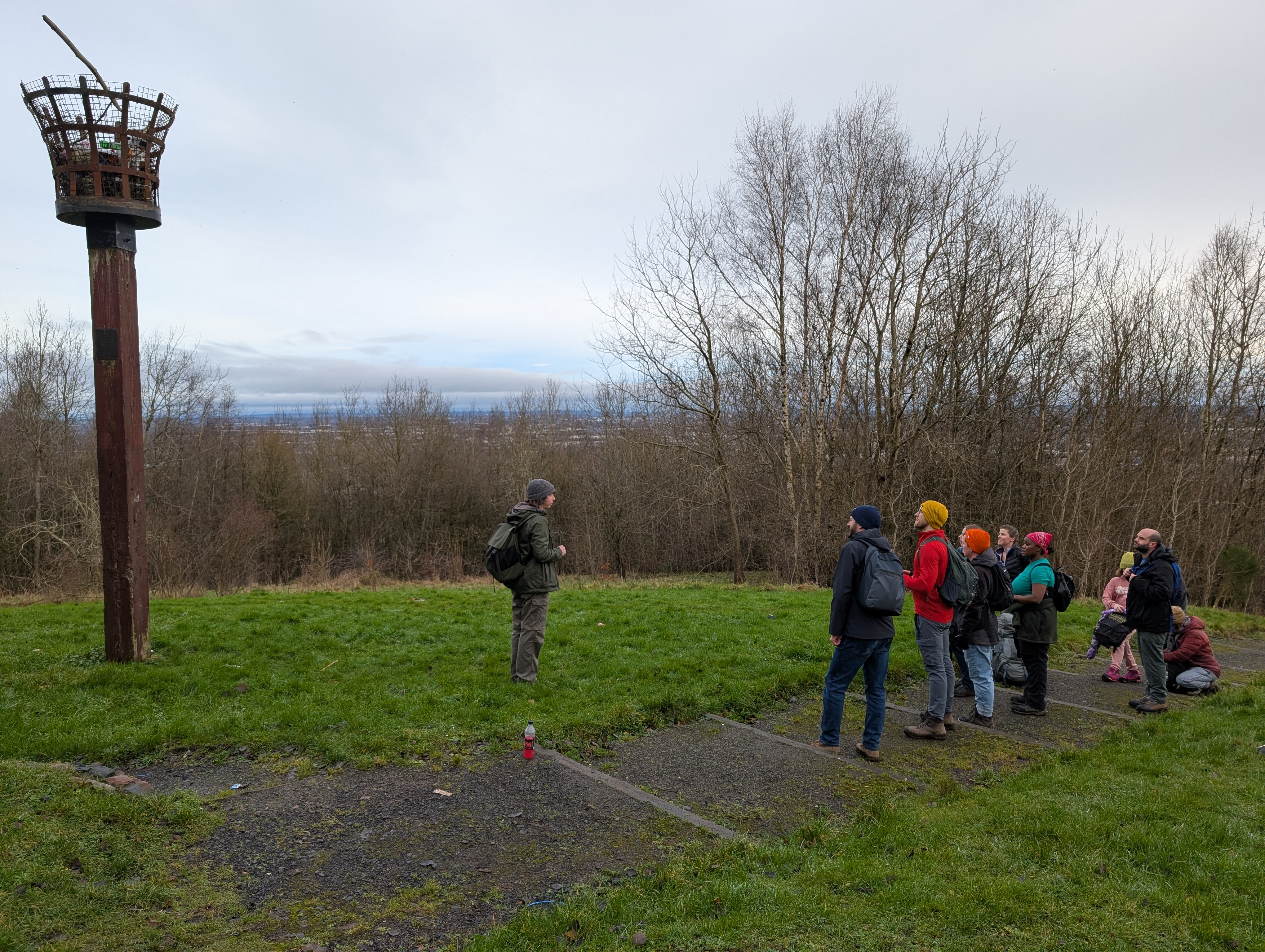
    On 15th December, as part of the Dudley Path’s for Nature project, an EventBright walk entitled ‘The Peaks and Dales of Dudley’ took place, partly on the Rowley Hills starting from Bury Hill Park, and eventually ending in the centre of Dudley. After introductions by our two joint leaders Andy and Daniella, the group first took in the view towards Birmingham and beyond from the summit of the park, and then headed downhill through Bob’s Canyon to the cairn on the Wildlife Trust’s land, where Andy talked about Dudley born mountaineer Bert Bissel’s accomplishments and the peace cairn on the summit of Ben Nevis, the highest mountain in the UK. The next stopping place was the
    Millennium Beacon on Massey’s Bank where we looked at engravings on the large boulders. From here we moved on to the landscaped Council managed Darby’s Hill Quarry where Andy pointed out the methane vents disguised as street lampposts. After taking in a different landscape from the hill at the top of Darby’s Hill Road we headed towards Warrens Hall Riding School and onwards towards Bumble Hole, eventually ending up at the fountain in Dudley marketplace.

    Andy and Daniella, leaders of the Eventbrite ‘Peaks and Dales of Dudley’ walk
    Eventbrite ‘Peaks and Dales of Dudley’ walk – Millennium Beacon

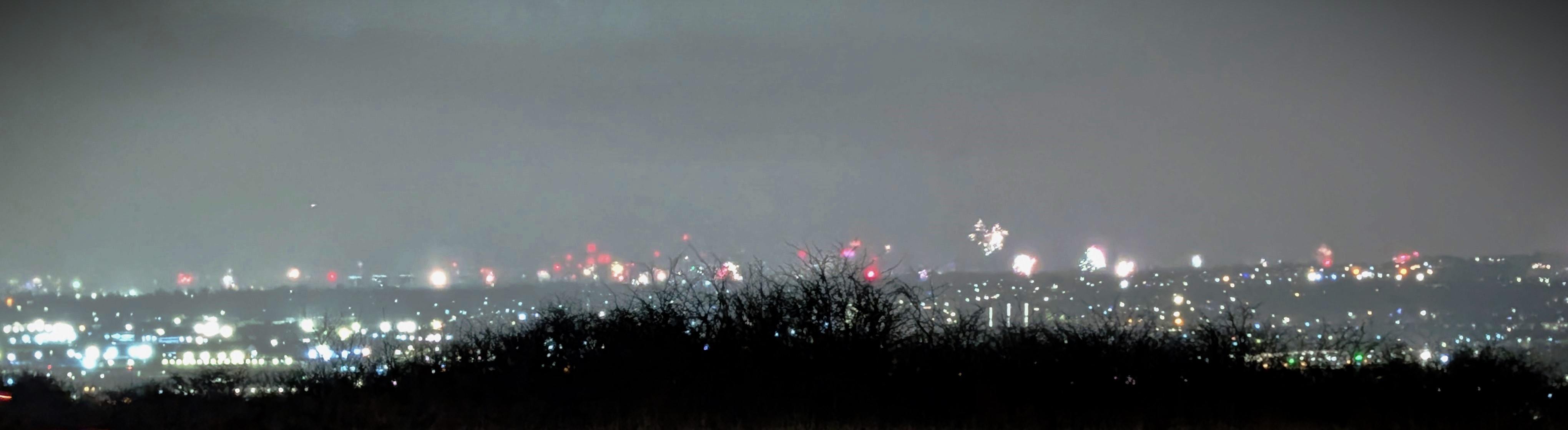
    To end the year, on New Year’s Eve a group of us assembled at the top end of Portway Hill, and on the stroke of midnight looking in the direction of Birmingham we were treated to a spectacular display of fireworks that lit up the whole horizon. A memorable occasion enjoyed by all who were there.

    New Year’s Eve celebrations seen from the top of Portway Hill

    Nick Horton’s 2024 Rowley Hills Bird Report

    2024 overall was a disappointing year for birds on the Rowley Hills but there were some highlights and surprises. Here is Nick’s birds sightings on Rowley Hills in 2024. He has given a total number to birds not that common in Rowley.
     
    Gulls 
    Lesser Black Back Gull 
    Herring gull
    Black Headed Gull 
    Common Gull (2)
    Waterfowl 
    Mallard 
    Teal (5)
    Canada Geese 

    Goosander (3 male, 5 female)
    Coot 
    Moorhen 
    Water Rail (1)
    Mute Swan 
    White-fronted Goose (skeen of approx. 200 heading south following M5 towards Severn estuary in November)
    Pochard (1 female at Bumble hole)
    Tufted Duck (10+ at Bumble hole)
    Little Grebe 
    Cormorant (over flying)
    Little Egret (1 at Bumble Hole)
    Grey Heron 
    Birds of prey 
    Kestrel 
    Sparrowhawk
    Buzzard
    Merlin (1 sighting high above Dudley Golf Course)
    Red Kite (lots of sightings between January 24 and April 24, none after mid-April)
    Peregrine (sightings down on passed years)
    Tawny Owl (1 male, 1 female calling on Portway)
    Waders 
    Lapwing (flock of 40+ forced to land during Storm Kathleen on Portway Farm Fields, absent the next
    day)
    Woodcock (regular winter visitors)
    Snipe (2 at Warren Hall Stables larger pool)
    Pigeons and Doves 
    Feral Pigeon 
    Wood Pigeon 
    Stock Dove (4 at Warren Hall Stables)
    Collared Dove 
    Corvids 
    Magpie 
    Jay (two adults feeding two young on Turner’s Hill)
    Carrion Crow 
    Jackdaw (2 near to the derelict Wheatsheaf p. h.)
    Raven (sightings down on passed years)
    Finches, Tits and Sparrows
    Goldfinch 
    Chaffinch 
    Bullfinch (numbers seem to be increasing)
    Greenfinch (only one male and one female seen all year)
    Long-tailed Tit 

    Great Tit 
    Blue Tit 
    Coal Tit
    House Sparrow 
    Dunnock 
    Warblers
    Blackcap (overwintering)
    Chiffchaff 
    Willow Warbler (only one singing male this year)
    Whitethroat.
    Thrushes 
    Blackbirds
    Song thrush
    Mistle Thrush (1)
    Others
    Robin 
    Wren
    Reed Bunting 
    Kingfisher (over flying towards Edale Pool)
    Green Woodpecker 
    Great Spotted Woodpecker 
    Ring necked Parakeet 
    Swallow 
    House Martin (several nests around Newbury Lane)
    Swift (4) Once a bird that would fly over the hills in large flocks each evening now reduced to just a handful.
    Birds on migration and nice surprises 
    Red wings (100+)
    Fieldfare (10+)
    Redstart (1 in spring 3 in Autumn)
    Whinchat (2 in spring 1 in Autumn)
    Tree Pipits (3 in Autumn)
    Meadow Pipits (2 in Winter. Once a common bird on Rowley Hills
    While it was disappointing to have not seen any Lesser White Throats, Stonechats, Linnets or Garden Warblers on site, the Water Rail on the small pool at Warren Hall Stables, the grounded flock of Lapwing at Portway Farm and the Kingfisher heading to Edale Pool meant that three birds could be added to the site list. Also, the number of visiting winter woodcocks is a real delight early on a winters morning.

    Andrew Cook’s 2024 Butterfly Transect on Portway Hill SINC

    01/04/24 – 29/09/24

    This year, as observed elsewhere, has not been good for butterflies and day flying moths on The Rowley Hills. With a cold, wet and windy start to the season it was well into June before sightings climbed to anything approaching previous years.
    The first five weekly counts were below 20, week 4 being zero, with no species on weekly counts getting into double figures. The main species recorded during this early period were Peacock (14) and Small Tortoiseshell (24), with low number sightings of Brimstone (3), Comma (1), Green-veined White (1), Orange-tip (3) and Speckled Wood (2). Weeks 6 to 11 were slightly better with counts in the 30’s with an increase in week 12 to a count of 47, this was primarily due to Small Heath (28) peaking for the season.
    With an improvement in the weather sightings noticeably increased in week 13, beginning 26/06/24, with an increase in numbers to 232, over half of this number being the emergence of Ringlet’s (139) supported by the first Marbled White’s (38) of the year, Meadow Brown (31) and Small Heath (22). This was followed by the peak of the year in Week 14 with 360 butterflies and day flying moths recorded. Ringlets accounted for 267 of this number, with 41 Marbled White, 26 Meadow Brown, 11 Small Skipper and 10 Small Heath.
    Weeks 15 to 19 bobbed up and down between 180 & 258 recordings, Ringlet numbers began to slowly decline along with Marbled White whilst Meadow Brown were slowly increasing during this period. Gatekeepers appeared during Week 16 with numbers peaking at 95 during Week 19 after which sightings began to decline with none recorded after Week 22.
    Apart from Gatekeepers and Meadow Browns, other species were seen in single figures from Week 19 onwards along with a decline in the number of species observed. This trend continued for the remainder of the season with the number of total sightings for the year being well down when compared to the previous two years of recording.
    Total sightings for 2024 came in at 2198, compared to 2022 & 2023 with 2740* & 3171
    respectively. The number of species observed at 31 is slightly down on 2022 (33) but noticeably down against 2023 (36).

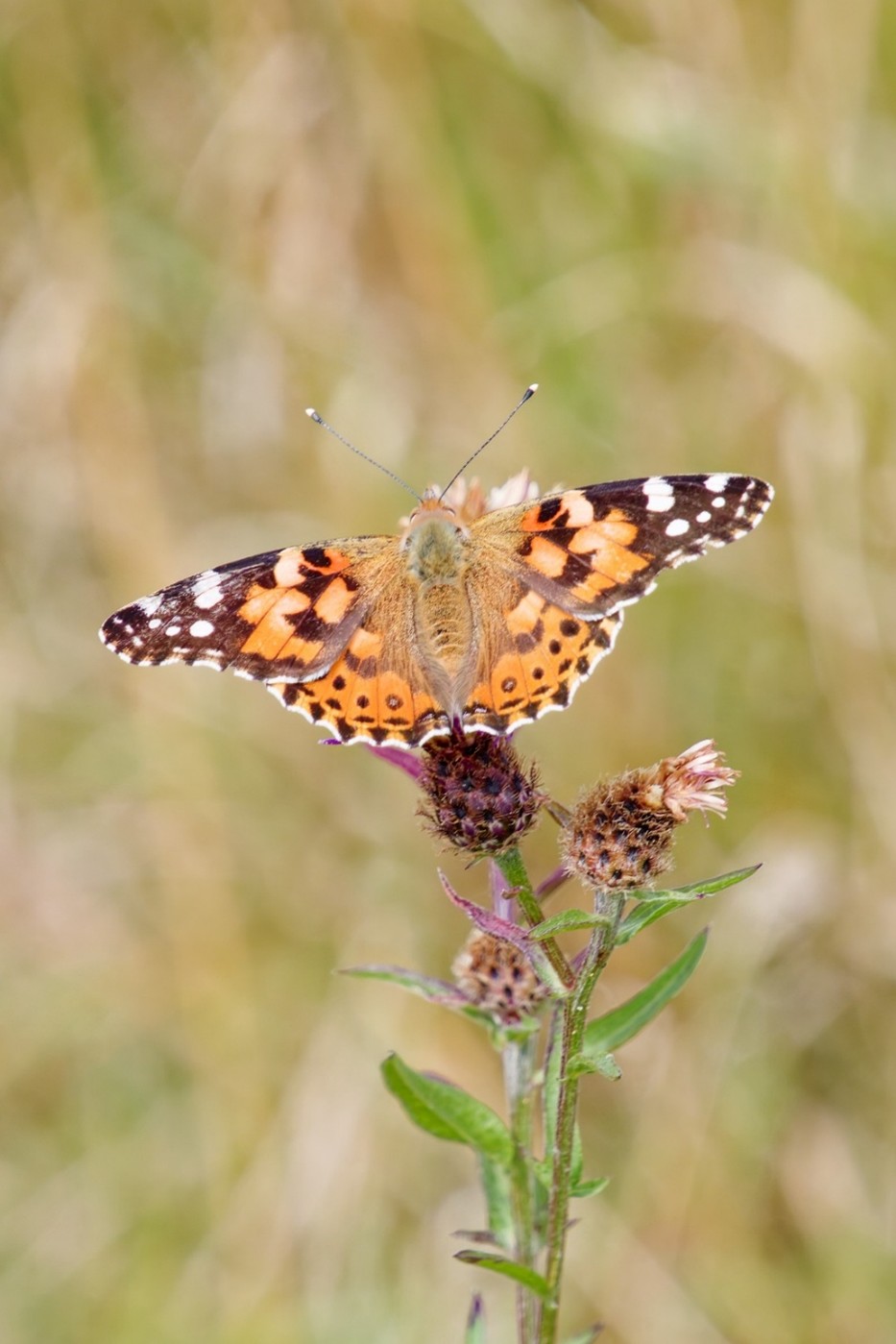
    Notable species absent from this year’s recording were Painted Lady, Mother Shipton and Green Hairstreak, although I had been reliably informed of the latter being seen by Mike Poulton on the B&BC Wildlife Trust’s Portway Hill Nature Reserve during a volunteer day in mid-May. On a more positive note, Ringlet numbers were higher this year than the previous two with 641 recorded, compared to 589 in 2022 and 413 in 2023. This was a surprise considering that other species were generally all down in numbers.
    Two firsts for the site were the recording of a Scarlet Tiger Moth and Small Blue. The Scarlet Tiger was seen on the top area of Portway Hill during Week 13. The Small Blue was seen at the end of August, Week 22, on the hillside near to Kenford Close struggling against the wind on the pathway. Hopefully there will be an improvement in both sightings and weather in 2025.

    • Please note during 2022 recording did not begin until Week 5 which contributed to a slightly lower figure.

      Comparison of 2023 to 2024

      Position 23 Species Recorded Position 24 Species Recorded
      1 Meadow Brown 596 1 Ringlet 641
      2 Gatekeeper 468 2 Meadow Brown 459
      3 Marbled White 464 3 Gatekeeper 349
      4 Ringlet 413 4 Marbled White 145
      5 Small Heath 201 5 Small Heath 111
      6 Small Skipper 126 6 Small Skipper 64
      7 Large White 109 7 Burnet Companion 53
      8 Small Tortoiseshell 86 8 Speckled Wood 54
      9 Peacock 78 9 Small Tortoiseshell 45
      10 Small White 70 10 Large White 36
      11 Common Blue 65 11 Small White 41
      12 Burnet Companion 54 12 Peacock 32
      13 Speckled Wood 52 13 Essex Skipper 29
      14 Essex Skipper 47 14 Common Blue 20
      15 Comma 45 15 Orange-tip 16
      16 Latticed Heath 45 16 Latticed Heath 15
      17 Orange-tip 42 17 Six-Spot Burnet 14
      18 Red Admiral 51 18 Large Skipper 10
      19 Large Skipper 30 19 Silver Y 10
      20 Green-veined White 29 20 Green-veined White 10
      21 Shaded Broad-bar 20 21 Red Admiral 11
      22 Six-Spot Burnet 18 22 Comma 9
      23 Small Copper 16 23 Shaded Broad-bar 6

      24 Green Hairstreak 6 24 Narrow-B’d 5-spot Burnet 5
      25 Narrow-B’d 5-spot Burnet 6 25 Brimstone 4
      26 Brimstone 6 26 Holly Blue 3
      27 Holly Blue 5 27 Small Copper 2
      28 Silver Y 4 28 Common Carpet 1
      29 Chimney Sweeper 3 29 Scarlet Tiger 1
      30 Hummingbird Hawk Moth 1 30 Yellow Shell 1
      31 Large Yellow Underwing 1 31 Small Blue 1
      32 Mother Shipton 1 32 –
      33 Painted Lady 1 33 –
      34 Small Yellow Underwing 1 34 –
      35 Yellow Shell 1 35 –
      36 Common Carpet 1 36 –
      Total 3171 Total 2198

      Rowley Hills – The first six months of 2024

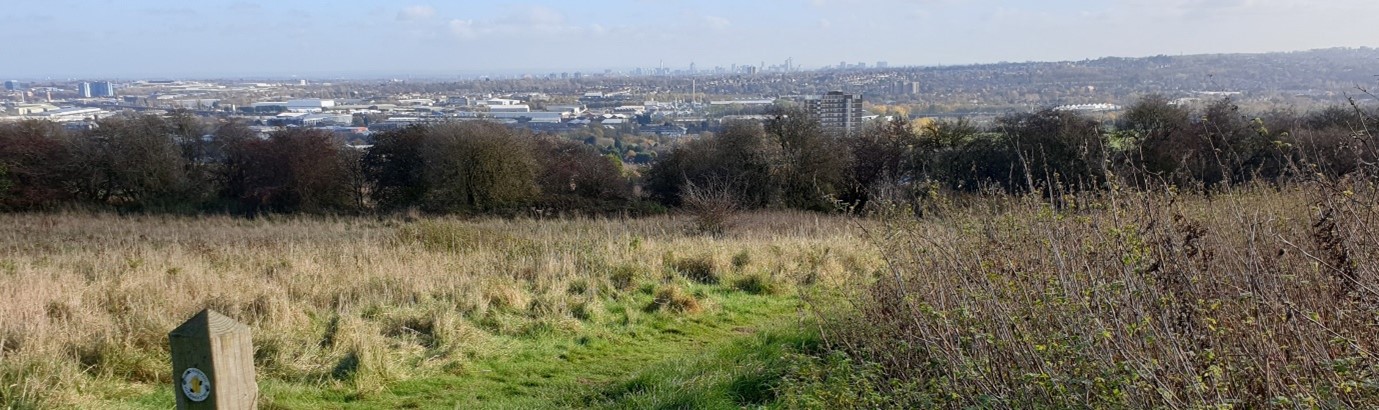
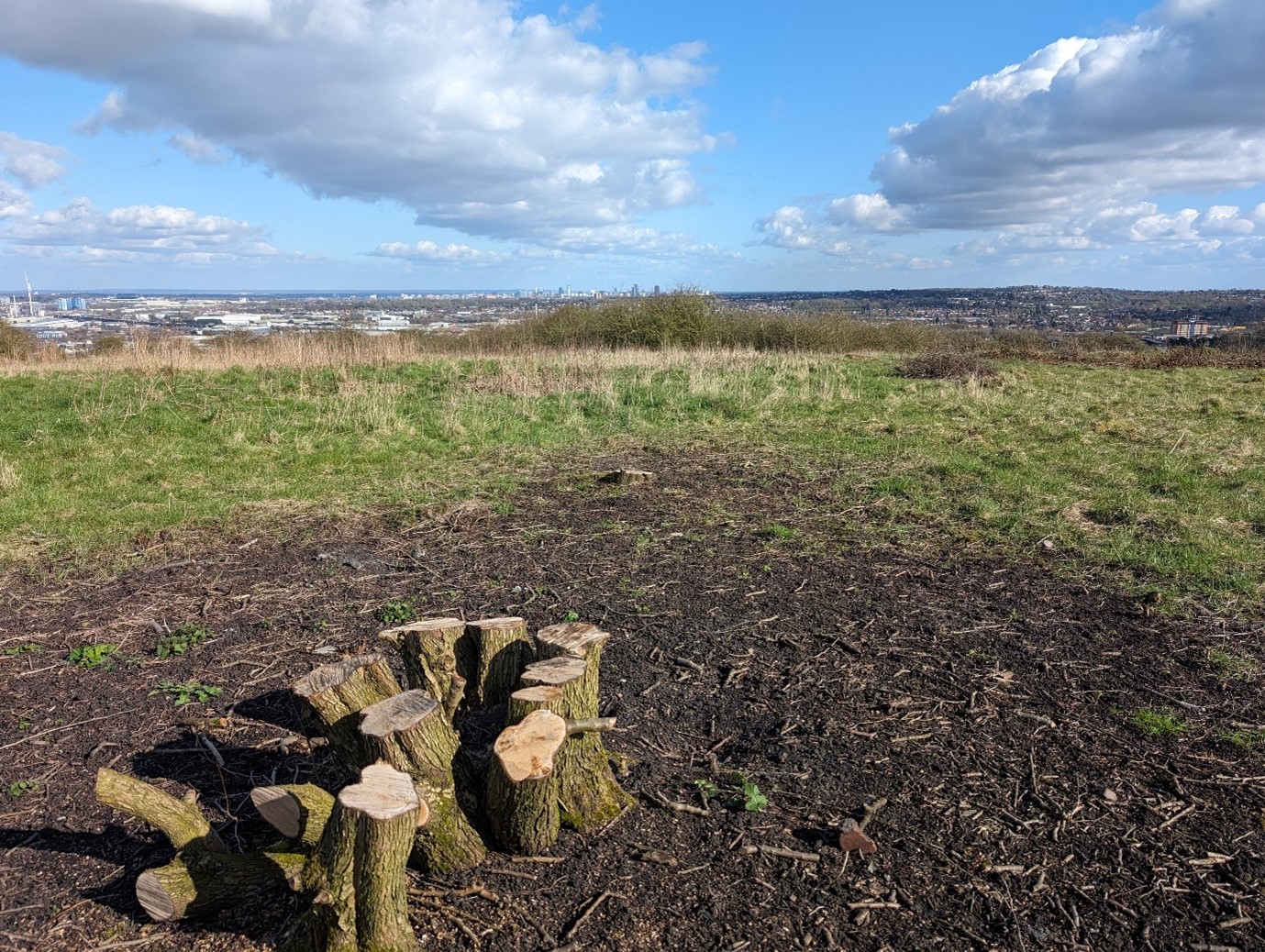
      During the first three months of 2024 an extensive thicket of hawthorn near the top end of Portway Hill was cut down to ground-level to provide an uninterrupted view towards the Birmingham City centre skyline, and at the same time create more open space for colonisation by grasses and wildflowers. Since quarrying ceased here in the 1960s hawthorn and bramble have steadily increased to a point where the open grassland areas were reducing each year and without intervention the site would all turn to scrub.

      Controlling the spread of hawthorn and bramble opening up the view towards Birmingham city centre

      Excessive rain during spring left paths across the site waterlogged and in places virtually impassable. As the tracks dried out the Friends main task was making the public right of way and other well used paths across the site negotiable once again by clearing excessive vegetation growth which had grown over many of the paths.  

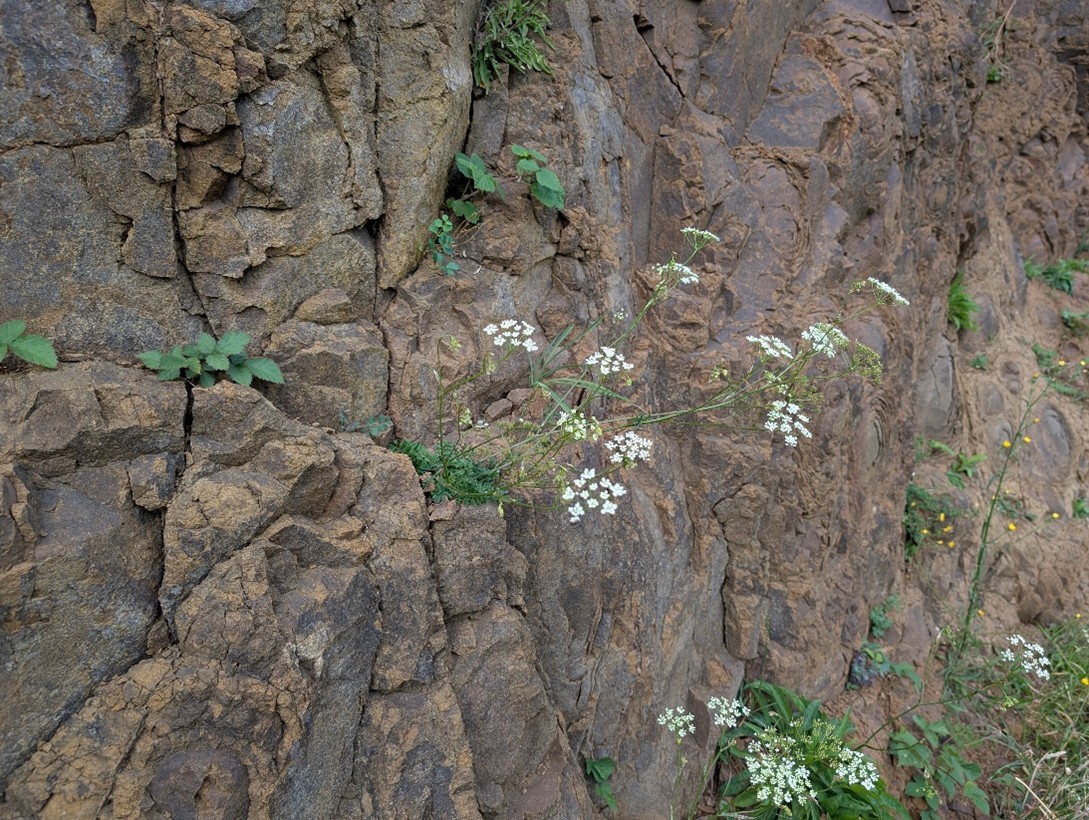
      Volunteering days with the Wildlife Trust for Birmingham and the Black continued on the second Saturday and fourth Friday of each month, and on one of the Saturday meetings was held jointly with the Black Country Geological Society. On this occasion a way to a second section of rock-face was made and vegetation cut down to expose more of the Spheroidal Weathering and Columnar Jointing.

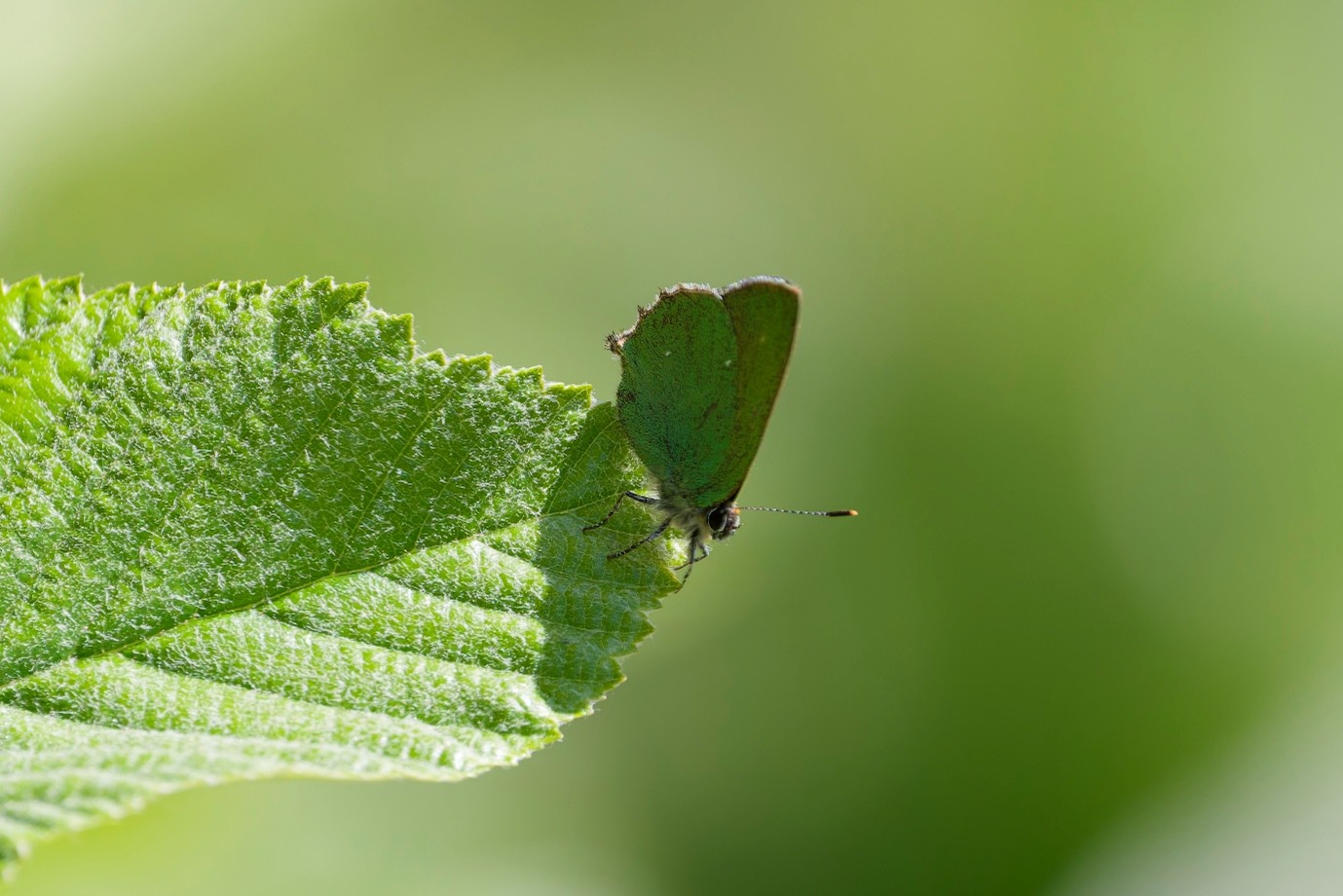
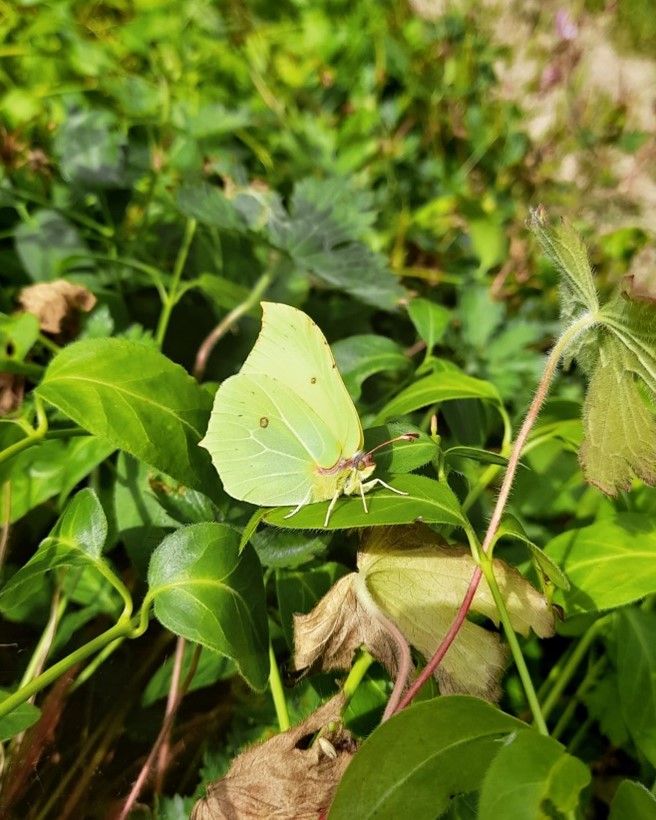
      With so many wet and cold days with temperatures below the seasonal average, the impact this had had on butterfly numbers has been quite significant. However, on one of the few brighter days in April a Brimstone was seen flying across the Portway Hill site, and in early May, two Green Hairstreaks were recorded on the same day.

      Brimstone – photographed by Sarah Nixon
       Green Hairstreak photographed by Dee Lau

      Mowing of the grassland at Bury Hill Park is now managed sympathetically by Sandwell Council, with the sloping grassland down to the Birmingham New Road left mostly uncut through spring and summer, and only mowing the strip along the public right of way and the rectangular area near the top where football posts once stood on a regular basis. This uncut grassland has now become an extension to the Portway Hill site providing a further large expanse of open grassland. This year throughout May 1000s of Pignut s flowered profusely across the hillside turning parts of it white with their blossom. In years past day-flying Chimney Sweeper moths could often be seen on the steeper slopes where the mowers were unable to reach, and now with the grassland left mainly uncut, it is hoped that they will once again be seen, as the caterpillar’s food plant of this day-flying moths is the developing seed heads of Pignut. Badgers regularly forage in the grassland here too suggesting that Pignut tubers a few inches below the surface may be one of their food sources?  

      Pignuts flowering in Bury Hill Park in May

      On Dudley Golf Course and Oakham Riding School side of Rowley Hills local bird-watcher Nick Horton had a surprise on one of his walks. Has he passed the small pond at the side of the track leading onto Dudley Road, he watched a pair of Coots going in and out of the marginal vegetation, when suddenly a Water Rail appeared from the reedbed! This shy and retiring bird inhabits freshwater wetland but is rarely seen. However, it was only believed to be passing through on the way to its breeding area elsewhere.

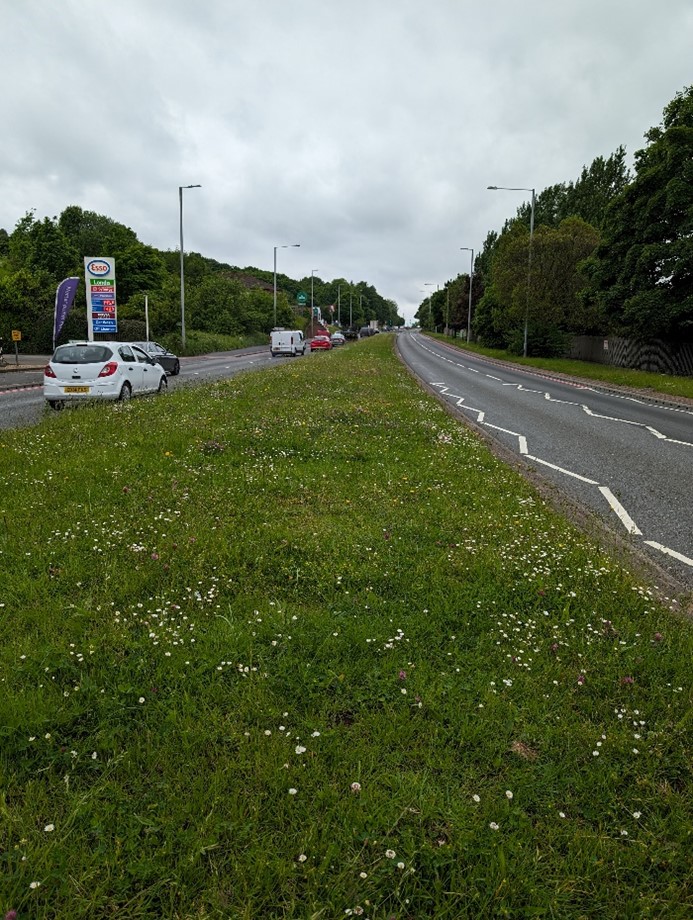
      From late May and throughout June Bee Orchids can regularly be seen on Portway Hill and may be increasing, but finding one growing on the central reservation of Wolverhampton Road was unexpected. Unfortunately, less than a week after this photograph was taken the grassland strip was mown!

      Bee Orchid on central reservation of Wolverhampton Road – 24 May

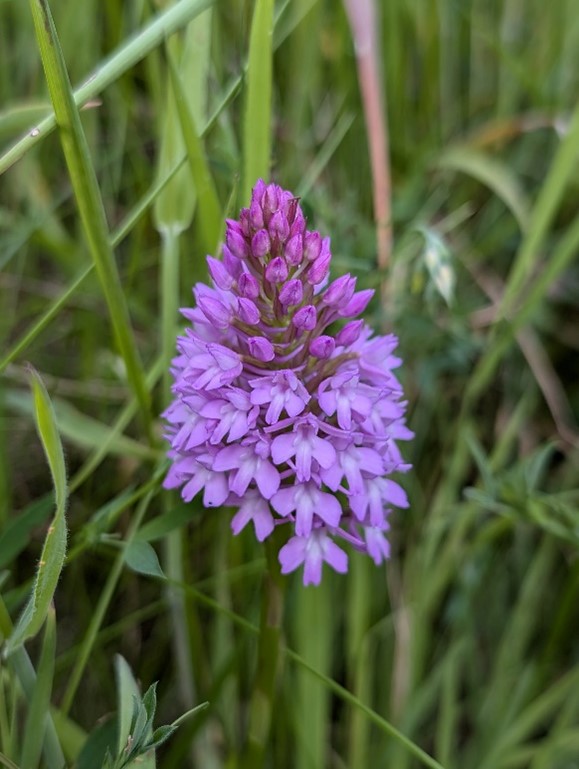
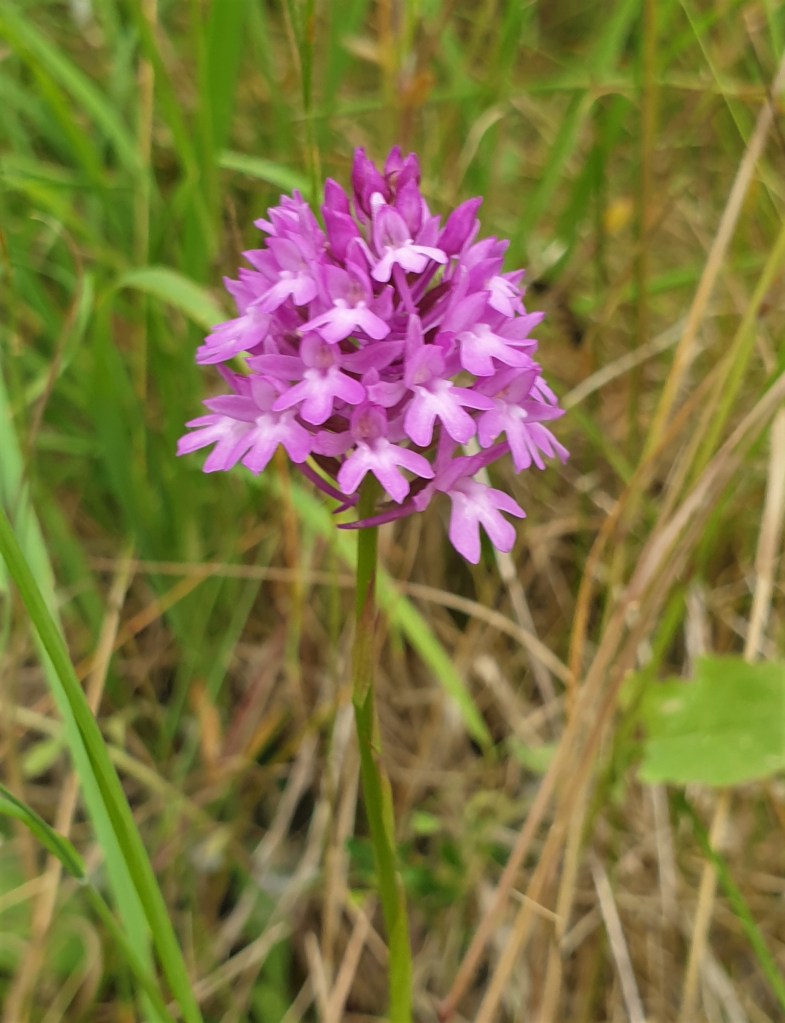
      Another Orchid which appears to be on the increase is Pyramidal Orchid, here seen here seen in grassland near the top end of Portway Hill. A second location for this orchid on the hillside.

      Pyramidal Orchid Anacamptis pyramidalis

      Dudley Golf Club grounds were surveyed during June as part of work by the Wildlife Trust to restore and enhance wildlife habitats and connectivity across the landscape from Wrens Nest to Portway Hill. Several rarely encountered invertebrates and plants were recorded and a full species list will appear in the end of year review.

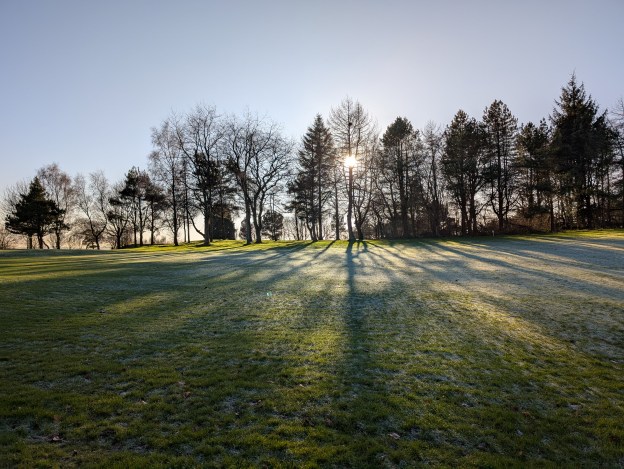
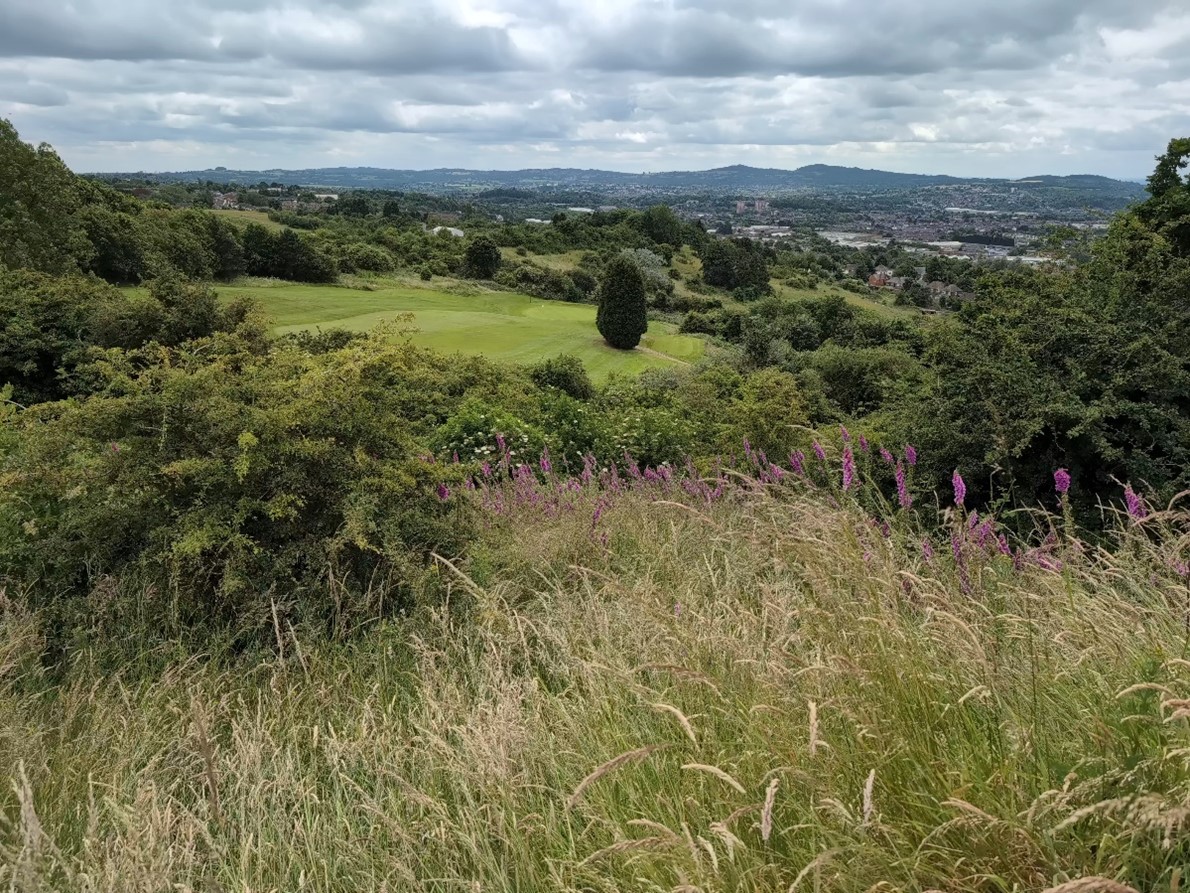
      Dudley Golf Course looking west
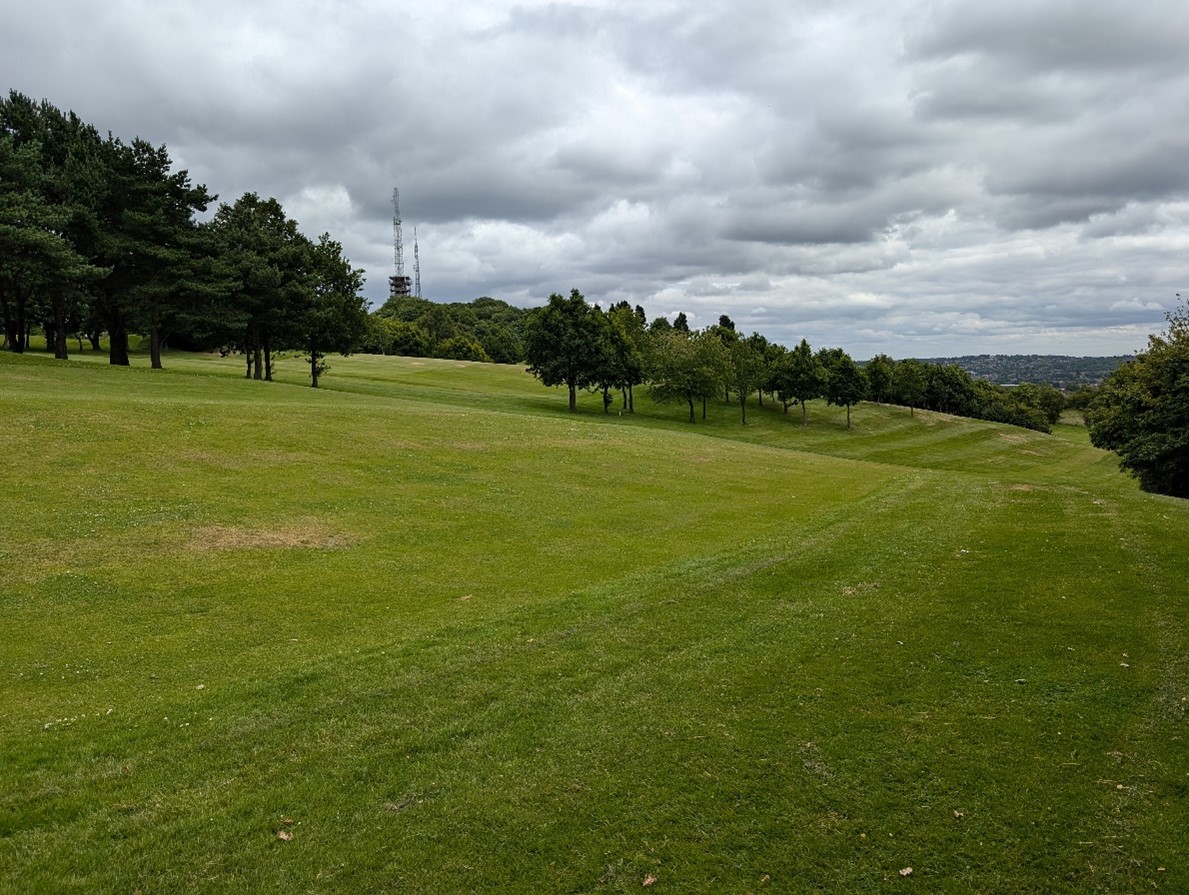
      View from Dudley Golf Course
       

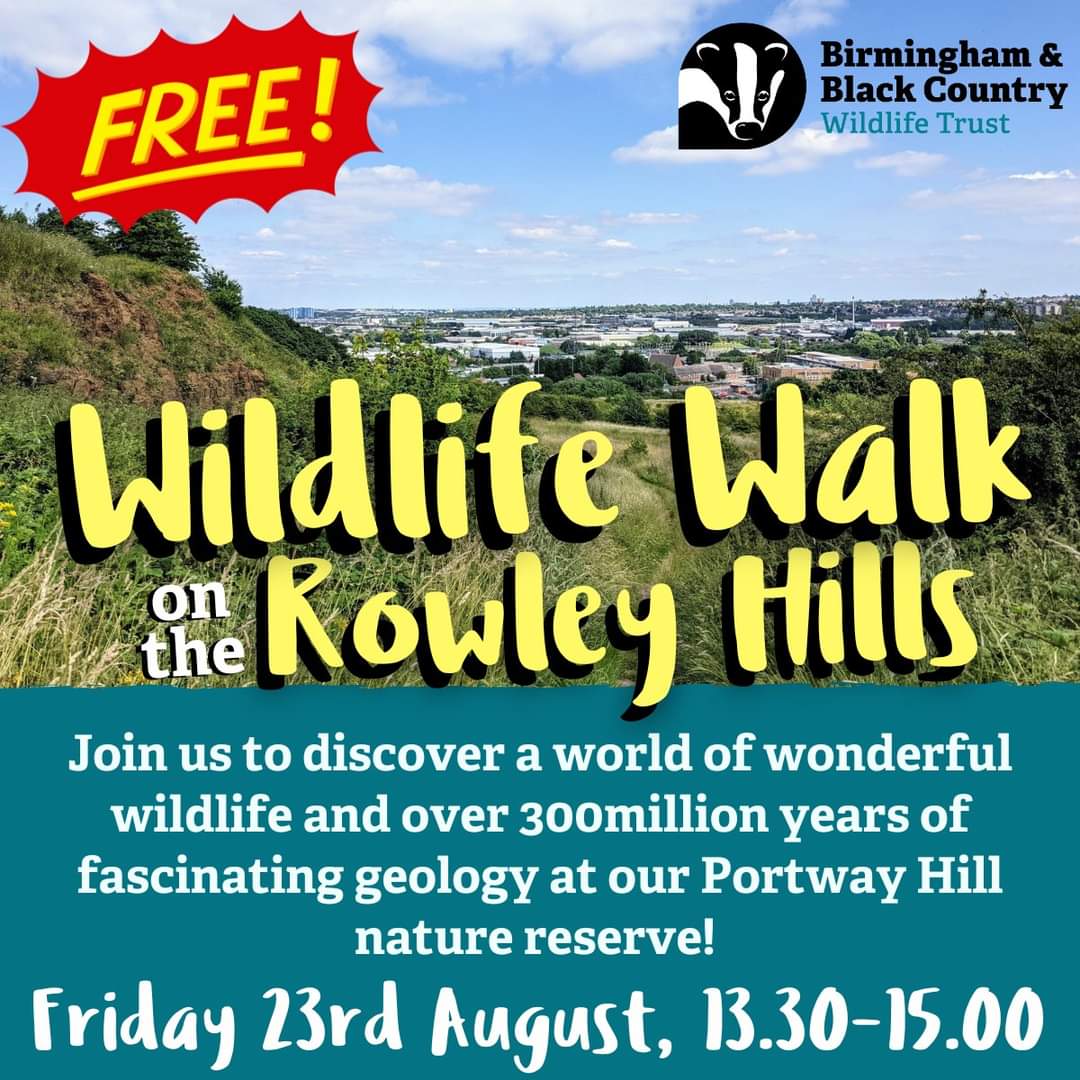
      Join Birmingham and Black Country Wildlife Trust on Friday 23 August to discover wonderful wildlife and over 300million years of geological history on a walk across the Rowley Hills! There will be much to see and learn whilst enjoying some of the best views the Black Country has to offer! Book your free place now: bbcwildlife.org.uk/events/2024-08-23-wildlife-walk-rowley-hills

      Volunteer dates for your diary 2024

      Volunteer days with the Wildlife Trust for Birmingham and Black Country start again this month. If you would like to to take part, meet new people, make new friends, get fit and help us to maintain this fabulous wildlife site on your doorstep, feel free to come along. We meet just inside St Brades Close, off Tower Road at 10:00am. All our days for 2024 are listed below.

      Tools and tea and coffee are provided by the Wildlife Trust, we have spare gloves but you may wish to bring your own. Please bring your own lunch.

      Conservation volunteer day, Portway hill, Friday 26th April 2024, 10:00am – 3:00pm Join the Wildlife Trust for Birmingham and Black Country at Portway Hill for a fun day out meeting new people, helping the environment and learning new skills. Meet on St Brades Close; ensure you are dressed appropriately for the forecast weather conditions, and wear sturdy footwear. No need to book, just turn up!

      Conservation volunteer day, Portway hill, Saturday 11th & Friday 24th May 2024, 10:00am – 3:00pm

      Join the Wildlife Trust for Birmingham and Black Country at Portway Hill for a fun day out meeting new people, helping the environment and learning new skills. Meet on St Brades Close; ensure you are dressed appropriately for the forecast weather conditions, and wear sturdy footwear. No need to book, just turn up!

      Conservation volunteer day, Portway hill, Saturday 8th & Friday 28th June 2024, 10:00am – 3:00pm

      Join the Wildlife Trust for Birmingham and Black Country at Portway Hill for a fun day out meeting new people, helping the environment and learning new skills. Meet on St Brades Close; ensure you are dressed appropriately for the forecast weather conditions, and wear sturdy footwear. No need to book, just turn up!

      Conservation volunteer day, Portway hill, Saturday 13th & Friday 26th July 2024, 10:00am – 3:00pm

      Join the Wildlife Trust for Birmingham and Black Country at Portway Hill for a fun day out meeting new people, helping the environment and learning new skills. Meet on St Brades Close; ensure you are dressed appropriately for the forecast weather conditions, and wear sturdy footwear. No need to book, just turn up!

      Conservation volunteer day, Portway hill, Saturday 10th & Friday 23rd August 2024, 10:00am – 3:00pm

      Join the Wildlife Trust for Birmingham and Black Country at Portway Hill for a fun day out meeting new people, helping the environment and learning new skills. Meet on St Brades Close; ensure you are dressed appropriately for the forecast weather conditions, and wear sturdy footwear. No need to book, just turn up!

      Conservation volunteer day, Portway hill, Saturday 14th & Friday 27th September 2024, 10:00am – 3:00pm

      Join the Wildlife Trust for Birmingham and Black Country at Portway Hill for a fun day out meeting new people, helping the environment and learning new skills. Meet on St Brades Close; ensure you are dressed appropriately for the forecast weather conditions, and wear sturdy footwear. No need to book, just turn up!

      Conservation volunteer day, Portway hill, Saturday 12th & Friday 25th October 2024, 10:00am – 3:00pm

      Join the Wildlife Trust for Birmingham and Black Country at Portway Hill for a fun day out meeting new people, helping the environment and learning new skills. Meet on St Brades Close; ensure you are dressed appropriately for the forecast weather conditions, and wear sturdy footwear. No need to book, just turn up!

      Conservation volunteer day, Portway hill, Saturday 9th & Friday 22nd November 2024, 10:00am – 3:00pm

      Join the Wildlife Trust for Birmingham and Black Country at Portway Hill for a fun day out meeting new people, helping the environment and learning new skills. Meet on St Brades Close; ensure you are dressed appropriately for the forecast weather conditions, and wear sturdy footwear. No need to book, just turn up!

      Conservation volunteer day, Portway hill, Saturday 14th December 2024, 10:00am – 3:00pm

      Join the Wildlife Trust for Birmingham and Black Country at Portway Hill for a fun day out meeting new people, helping the environment and learning new skills. Meet on St Brades Close; ensure you are dressed appropriately for the forecast weather conditions, and wear sturdy footwear. No need to book, just turn up!

      Some sightings from this year

      Here’s a bumper crop of interesting sightings from the Rowley Hills over the summer and autumn this year!

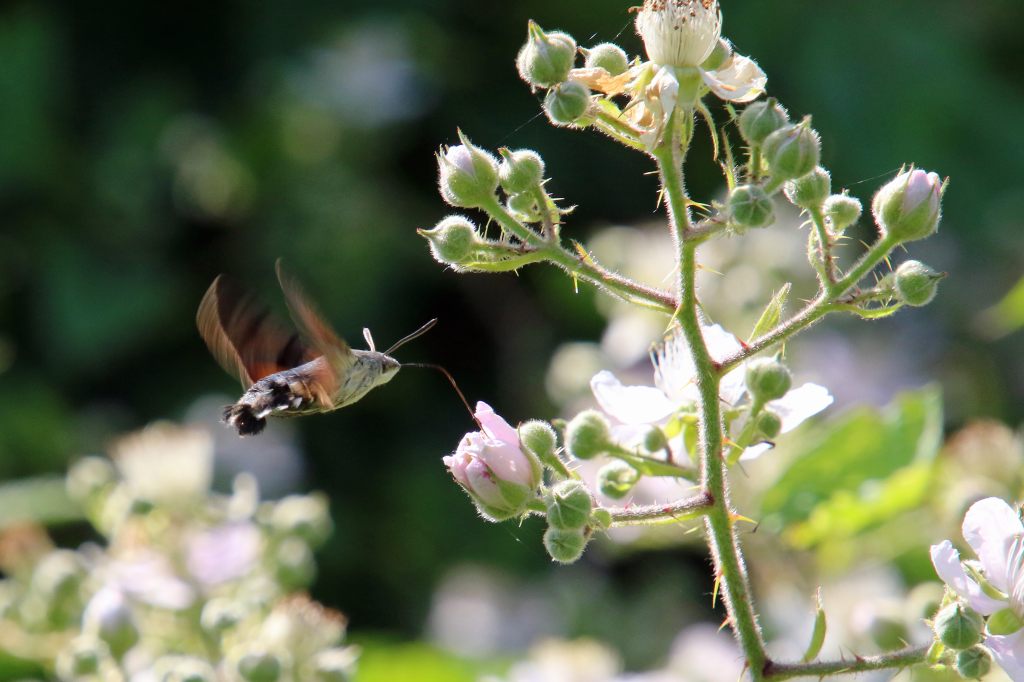
      Andrew Cook photographed this Hummingbird Hawk-moth (Macroglossum stellatarum) on 20 June while he was doing a butterfly survey.

      This Pyramidal Orchid (Anacamptis pyramidalis) was discovered on Portway Hill by Andrew Cook on 24 June. It’s the first record of this orchid at this site, and only the 10th record in the whole of Birmingham and the Black Country. A fantastic record! Photograph by Mike Poulton.

      On the same day, this Bee Orchid (Ophrys apifera) was also photographed by Andrew Cook. One or two Bee Orchids usually appear somewhere on Portway Hill every year, but they are unpredictable!

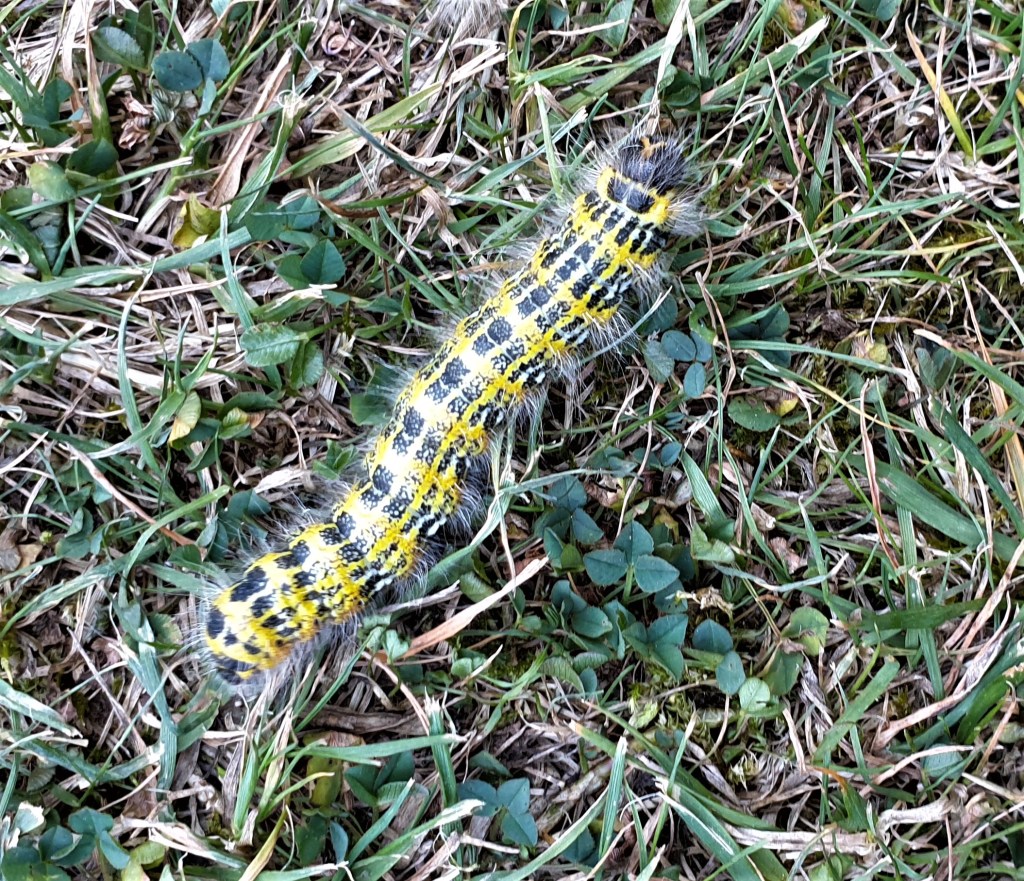
      A Buff-tip moth (Phalera bucephala) caterpillar photographed on 12 August by Mike Poulton.

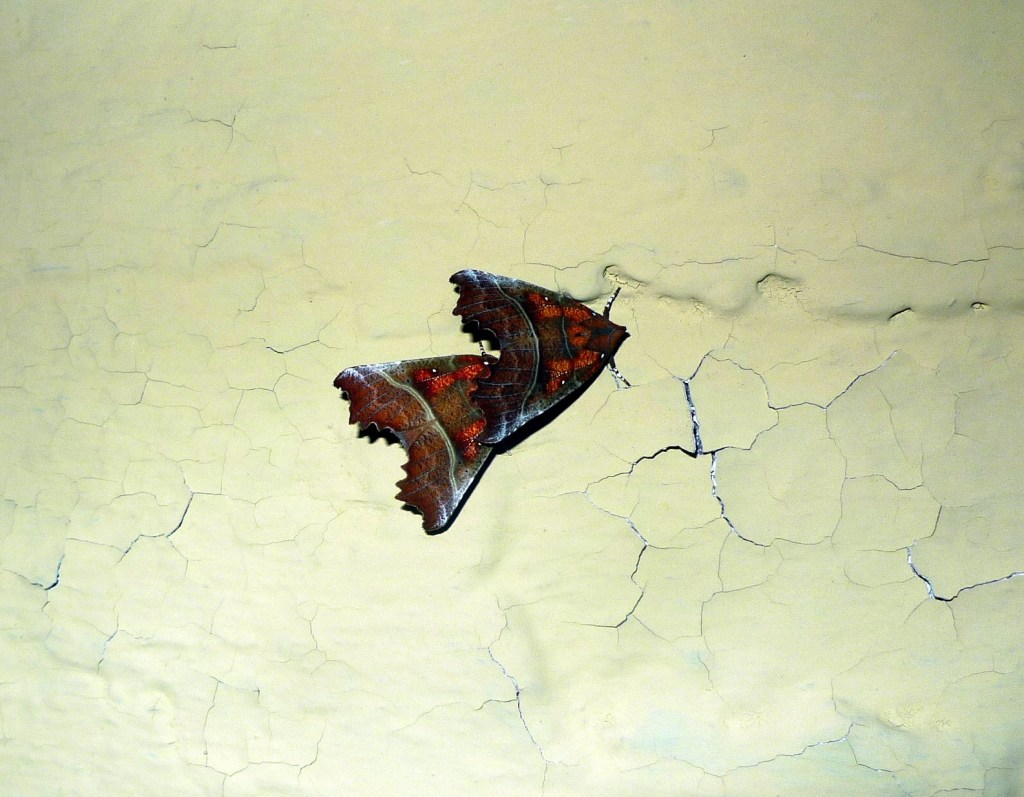
      On 2 September, 8 hibernating Herald Moths (Scoliopteryx libatrix) were found and photographed by Mike Poulton in an outbuilding in the Portway Hill area. This is another new record for the site.

      On 10 September a local dog walker reported to the Wildlife Trust volunteers working on the hillside that he’d just seen a huge Elephant Hawk-moth (Deilephila elpenor) caterpillar walking across the path in front of him. We didn’t manage to find and photograph it, but here is a photo taken by Mike Poulton of the moth that the caterpillar would metamorphose into!

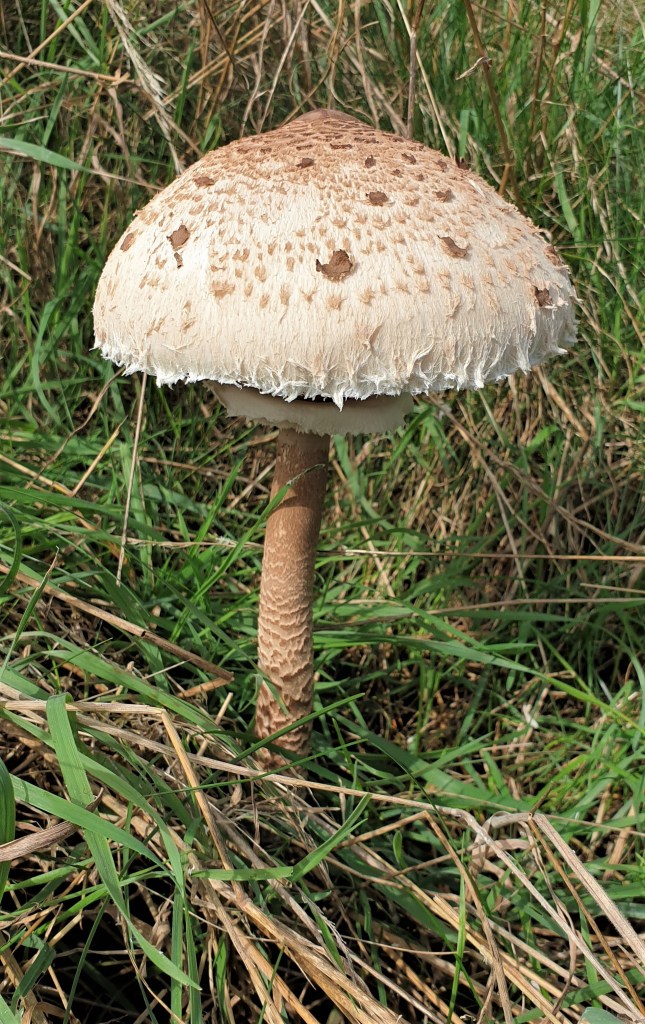
      This Parasol Mushroom (Macrolepiota procera) was photographed on Portway Hill by Mike Poulton on 13 September.

      FORH at Top Church, Dudley Eco Fair this Saturday!

      This Saturday (1st October), Top Church in Dudley are celebrating becoming an EcoChurch by hosting an Eco Fair to mark Great Big Green Week and the Season of Creation. The Friends of Rowley Hills will have a stall at the fair where we’ll be giving out copies of our new trail guide and chatting about the wonderful Rowley Hills to anyone who is interested!

      The Eco Fair will also feature:

      • Eco-friendly, gifts and crafts – made from recycled, repurposed, or sustainable materials – including from Top Church!
      • Yummy vegan, locally made goodies.
      • Guerrilla gardening in the church yard.
      • Activities for children – crafts and face painting.
      • A film screening.
      • Information from local organisations promoting wildlife and sustainable living.

      Hope to see some of you there!

      New Rowley Hills walking trail leaflet published, plus fantastic paintings from local artist!

      A new walking trail leaflet has recently been published, detailing some of the fascinating and intertwined geology and history of the Rowley Hills area. Copies of the leaflet are available from local libraries, Bumble Hole Visitors Centre, Lion Farm Action Centre, Dudley Museum and Archives and more. You can also download and print a copy at home – be aware the whole leaflet is A3 sized. The leaflet is a joint venture between the Black Country Geological Society, Friends of Rowley Hills, Sandwell Council and the Black Country Global Geopark, and has been made possible thanks to funding from Grace Mary to Lion Farm Big Local.

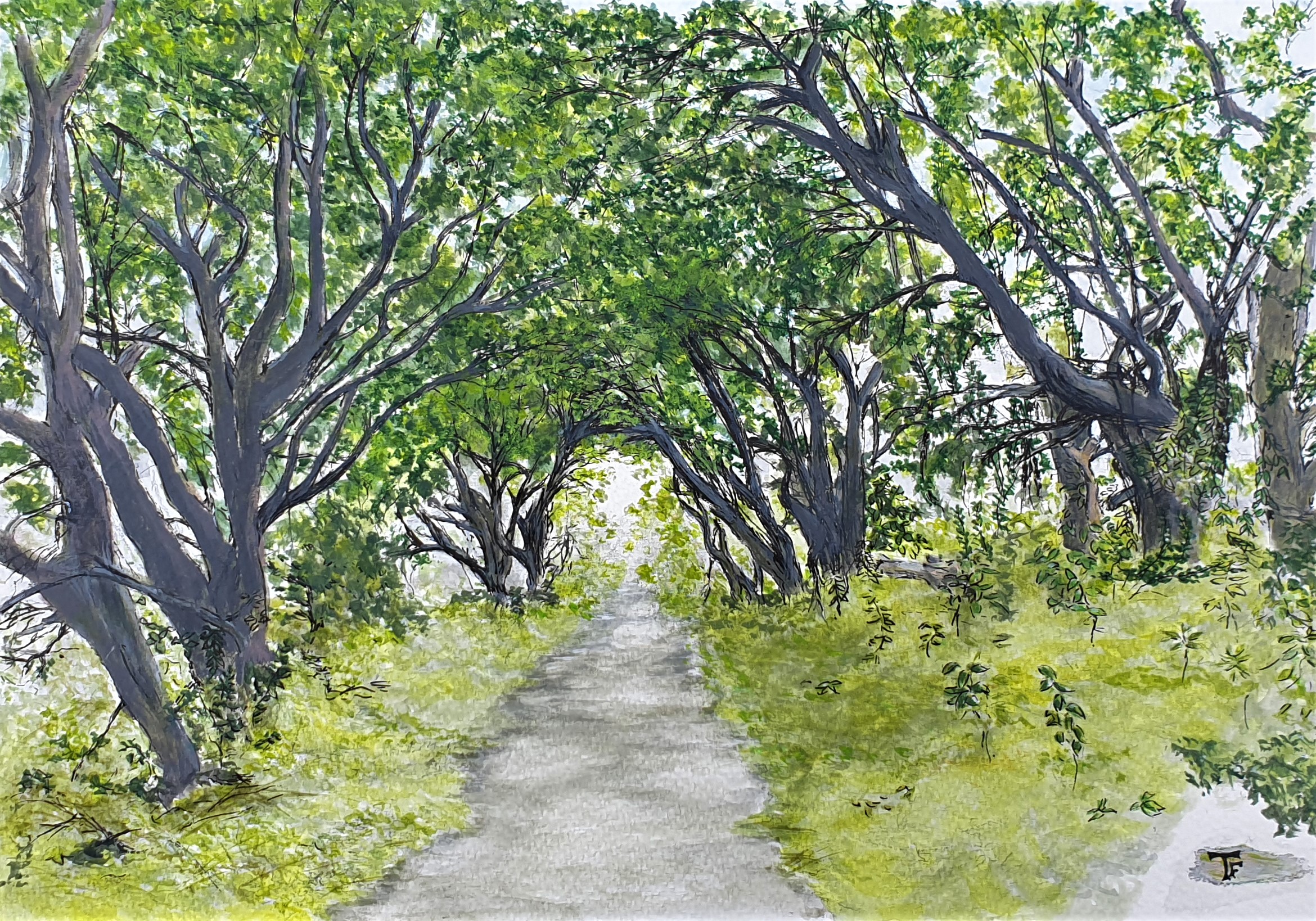
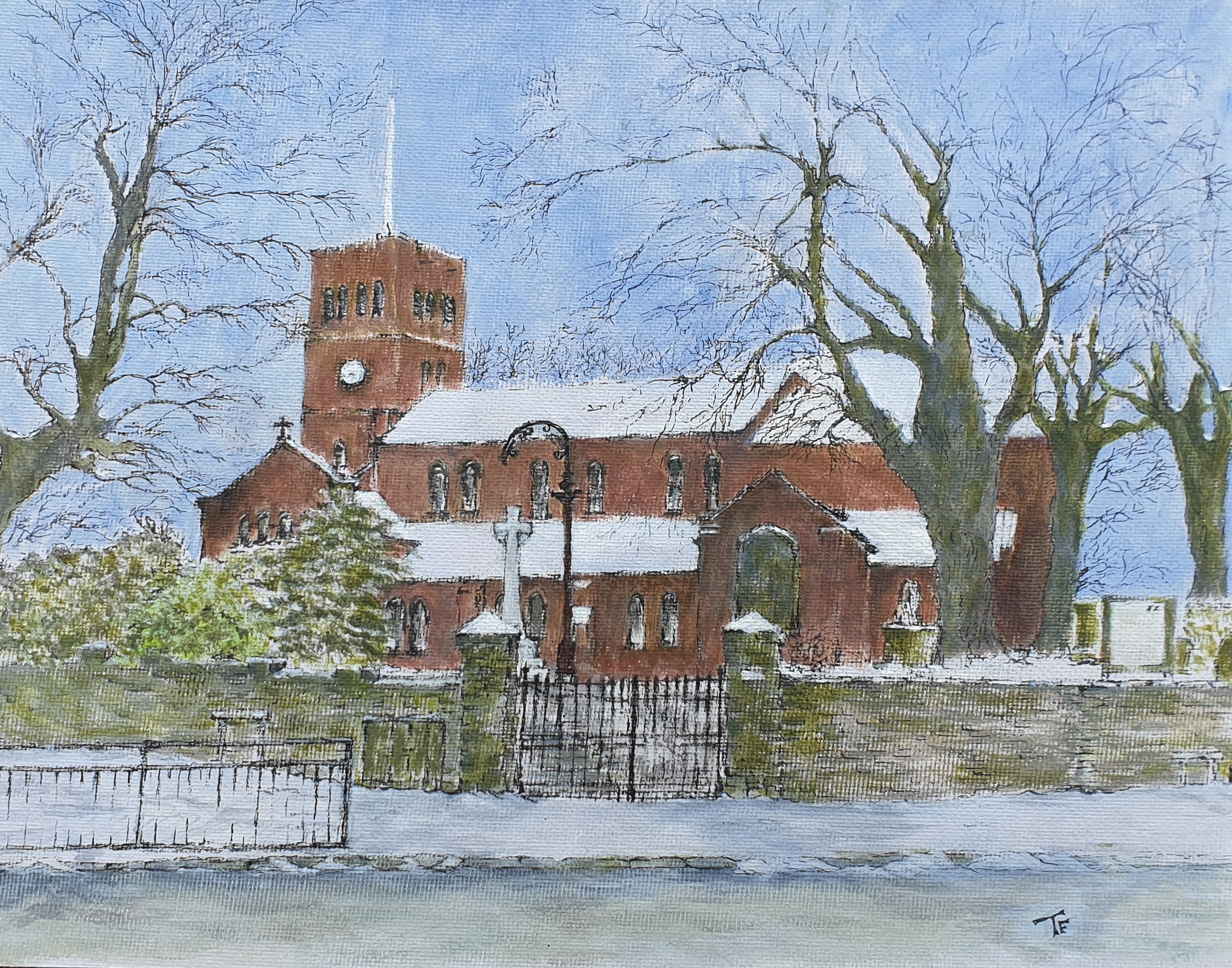
      We’ve also recently been shown these beautiful paintings by a local artist, Tracey F, of the newly opened up section of Church Walk and a Rowley Church winter scene. We hope to see some more of Tracey’s work soon, it’s wonderful to see our local area depicted with such a good eye!

      Narrow miss on Portway Hill

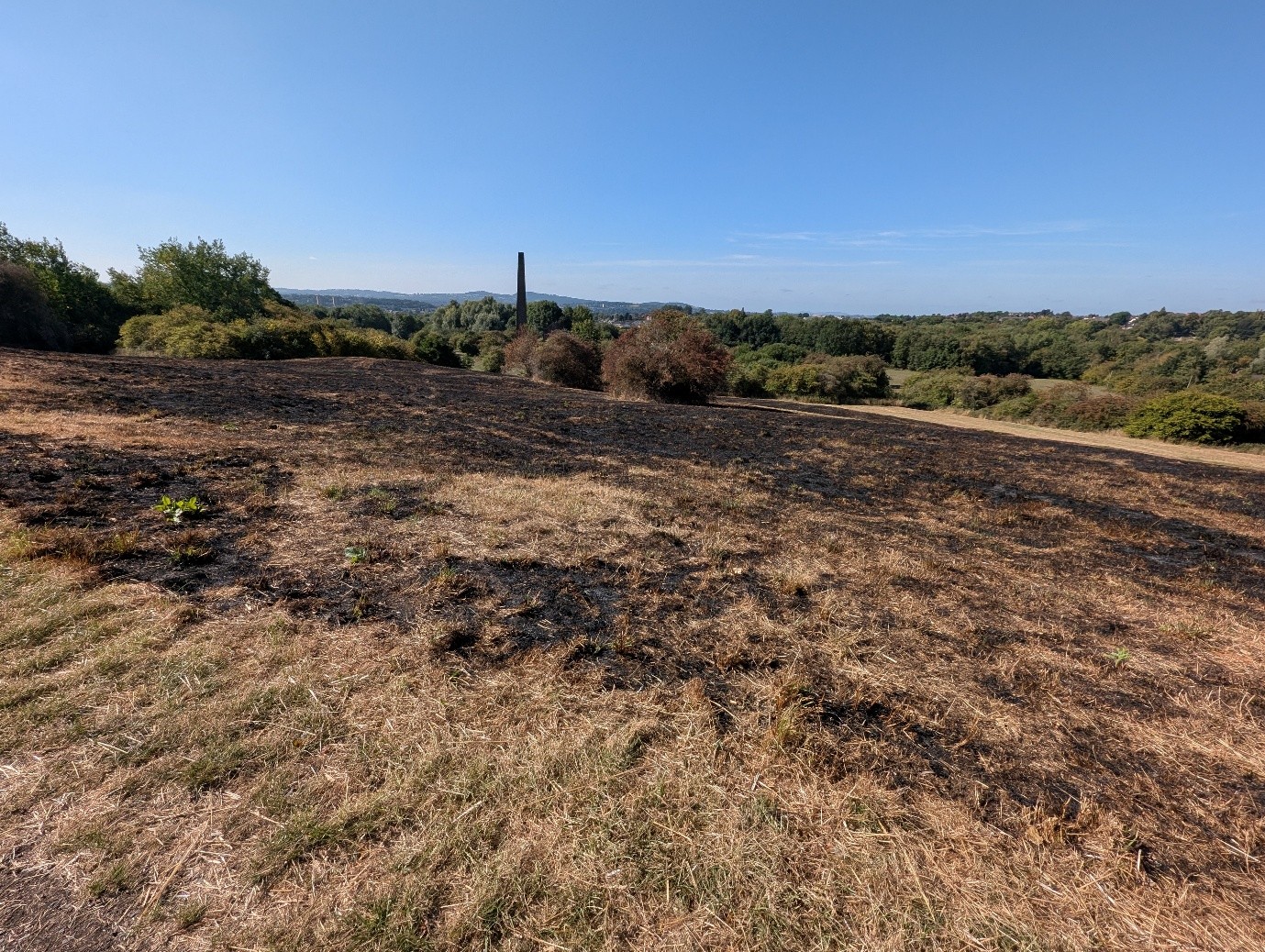
      As has been widely reported during the recent heatwaves, there has been a big increase in wildfires around the country, and unfortunately this has included the Rowley Hills. Last month, a large area of felled trees on Portway Hill at the end of St Brades Close caught fire. These trees had been left by contractors who felled them in 2021, and despite the risk (not to mention the right of way that had become blocked by the trees) had not returned to remove them. The contractors were acting on behalf of the owner of that parcel of land.

      Fortunately the fire was brought quickly under control by the fire service before it could spread to the nearby houses. Had the fire spread to the fences along the back of the houses where the trees had been cut down and just left in situ, and got a hold, the consequences could have been much worse. Following the fire, contractors are chipping the felled trees so the area will be much safer in the future. The Friends of Rowley Hills will be able to use the chippings to spread along the paths later this year.

      Although we’ve since had some wet weather, further warm, dry conditions are forecast over the next week so if you’re out and about in the Rowley Hills and see anything that looks like a fire risk, you can report it. It goes without saying, please don’t use barbecues in the hills or discard lit cigarette butts. Thankyou!